
SC Order on Mass Detentions is a Reminder, What We Needed Was a Reckoning
SC could've initiated contempt proceedings suo motu against the senior-most officials responsible for the crackdown.
advertisement
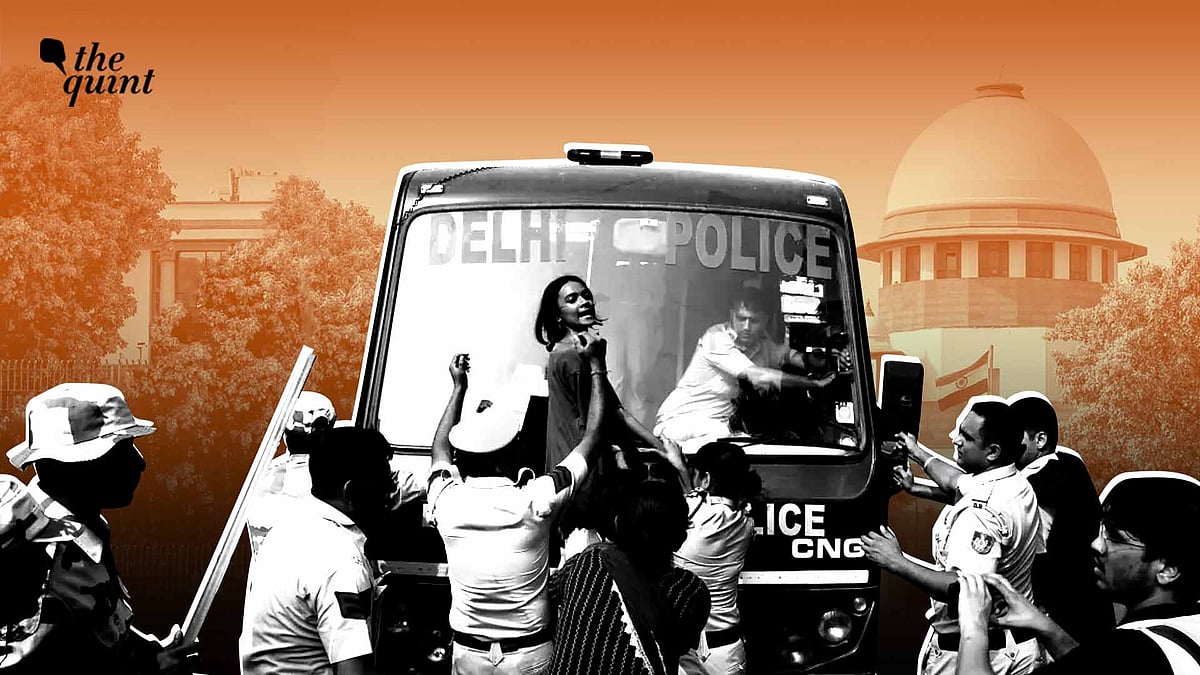
On 10 October, India's national capital was transformed into what senior advocates described as a "police state," with over 7,000 detentions, brutal assaults on lawyers and journalists, and the systematic suppression of peaceful assembly.
The Supreme Court convened an extraordinary Sunday hearing and issued interim directions—but the order merely restated settled constitutional law while failing to address the institutional rot that allowed the crackdown to occur.
What emerged was not a robust judicial intervention but a cautious reminder of rights that were already guaranteed.
On Monday morning, when the situation was communicated to the Chief Justice of India, CJI Surya Kant said that every lawyer has the right to participate in peaceful protests. As quoted by Live Law, he orally remarked:
The events of the weekend, and the continued obstruction that followed even after the Court's order, raise a haunting question: are we witnessing the slow unravelling of constitutional governance, a spectre of the Emergency-era ADM Jabalpur case, reborn?
A Nationwide Movement Meets a Capital Under Siege
Protests against Chief Election Commissioner Gyanesh Kumar erupted across the country in the days following The Indian Express report and the controversies surrounding the Election Commission of India.
By 10 October, the national capital had been sealed into a battlefield. Approximately 41,000 security personnel were deployed. Barricades choked major arteries. Metro stations were shuttered—57 initially, with 45 remaining closed even after judicial intervention.
Internet services were suspended. Railway services into New Delhi and Hazrat Nizamuddin stations were curtailed. The city, in effect, was placed under a de facto Emergency.
The scale of detention was staggering. Reports indicate over 7,000 people were picked up. Former chief ministers were taken from their residences to undisclosed locations. Opposition leaders were barricaded inside their homes. Students were dragged from trains.
Journalists wearing their official accreditation badges were detained. Lawyers were prevented from reaching police stations to represent detainees.
The treatment of legal professionals was particularly egregious. Senior Advocate Shadan Farasat was humiliated, dragged, and thrown into a moving bus near Safdarjung Airport flyover.
Advocate Sumita Hazarika, walking peacefully with 150 other lawyers, saw four colleagues seized and taken away in a prison van; a lady officer pushed and hustled her without allowing her to pause.
The Delhi High Court Bar Association issued a resolution strongly condemning the detention of lawyers and the "excessive and disproportionate use of force" against them.
And it demands recognition for what it was: a black day—not merely for the country, but for the Bar at large, whose members were prevented from discharging their professional obligations and whose physical safety was treated as expendable.
The Sunday Hearing: A Court Convened, a Constitution on Trial
The Supreme Court convened an extraordinary Sunday sitting on 11 October, before a bench of Justice Joymalya Bagchi and Justice V Mohana. The matters before the Court included:
A contempt petition filed by advocate Shailendra Mani Tripathi alleging that authorities continued to restrict Delhi Metro services in violation of the Court's 9 October order in MA Baby vs Union of India, seeking action against Union Home Secretary Govind Mohan, Delhi Police Commissioner Anurag Kumar, and DMRC Chairperson D Thara.
A habeas corpus petition filed by Senior Advocate and Trinamool Congress Rajya Sabha MP Menaka Guruswamy challenging the detention of political leaders including Arvind Kejriwal, Mamata Banerjee, Pinarayi Vijayan, and Manik Sarkar, who were allegedly picked up from their residences and taken to undisclosed locations.
A petition by Rashtriya Janata Dal MP Manoj Jha alleging disproportionate use of force, illegal detention, house arrests, sexual harassment of women protesters, and restrictions on transport and internet, with over 6,000 detentions reported.
A contempt petition by Advocate Aman Prasad against Delhi Police Commissioner Anurag Kumar alleging assault and detention of unarmed protesters, manhandling of women, and police operating without visible identification, including the assault of Shadan Farasat and the detention of Scroll journalist Ayush Tiwari.
During the hearing, Senior Advocate Kapil Sibal informed the Court that police were picking people up from trains and detaining anyone found outside the four kilometres' radius of Jantar Mantar where Section 163 of the BNSS had been imposed. As many as 45 metro stations remained shut despite the Friday order. Internet was suspended.
Farasat addressed the Court directly: "The question is not only about lawyers. We don't have special rights as lawyers. Yesterday, situation in city was remarkably suppressive. Person was not allowed to stand there also. I was thrown in a moving bus after I was picked up. It's about citizens' right to protest"
Senior Advocate Gopal Sankaranarayanan submitted video evidence showing that Section 163 had been imposed outside the Supreme Court itself. "It's shocking. Nature of violence being perpetrated — it's not even a question of proportionate. First, necessity is to be seen. Unarmed children—to beat, kick them… scuffle with them is uncalled for. We are finding several videos—these people wear it as a badge of courage. This is something which has raised many emotions amongst us. It's come so close to the door."
Guruswamy, appearing as petitioner in person, stated: "The last time this court had to consider such challenges was at the time of Emergency. We come back 50 years later — your lordships had passed ADM Jabalpur!"
The Order which was ‘Subject to Law and Order’
The Court issued interim directions as follows:
1. No detention of any person except in accordance with the procedure established by law, particularly with respect to any assembly of peaceful and unarmed persons beyond the area where Section 163 BNSS prohibitory orders are in operation.
2. Removal of the Section 163 board near the Supreme Court, if not already done, to ensure no apprehension regarding access to justice, including ingress and egress to any court of law.
3. Metro and rail facilities shall function normally unless restrictions are required keeping in mind disturbances to public order under Article 19(2).
4. Free movement in the city permitted subject to traffic regulations.
5. Barricades to be reviewed forthwith, keeping in mind law and order and traffic conditions.
6. Internet facilities shall remain undisturbed, with Justice Bagchi orally adding that the Court is not taking away authorities' powers under the IT Act.
7. No advocate should in any way be hindered in discharging their professional duties.
8. Notice issued to alleged contemnors to file affidavits and submit compliance reports; other unlisted petitions tagged with contempt proceedings.
When the Court Speaks in Whispers
The Supreme Court's order was, in substance, a restatement of existing law. The prohibition on detention without legal procedure is the bedrock of Article 21. The requirement that restrictions on assembly be proportionate is inherent in Article 19(2).
The protection of lawyers' access to clients and courts is a necessary corollary of the right to a fair trial. None of these principles required a Sunday sitting to be articulated — they are the ABC of constitutional governance.
What was needed was not a reminder but a reckoning. The Court could have initiated contempt proceedings suo motu against the senior-most officials responsible for the crackdown. It could have appointed a judicial commission to investigate the violence. It could have issued binding directions with timelines and consequences.
Instead, it issued interim directions that the Solicitor General could, and apparently did—claim were already being complied with, while ground reports indicated continued detentions and obstruction.
The answer, long established in Mazdoor Kisan Shakti Sangathan v. Union of India (2018), is that restrictions must be based on a real and imminent threat, must be proportionate to the danger, and must be imposed with "extreme care and circumspection."
When Section 163 orders are imposed across an entire city, when metro stations are shut without justification, when internet is suspended without evidence of imminent violence, the restriction is no longer reasonable — it is arbitrary. And arbitrary restrictions, by definition, cannot be "reasonable" under the Constitution.
Right To Protest: Constitutional Promise, Judicial Affirmation
The right to protest peacefully is not a concession granted by the state. It is a fundamental right. Article 19(1)(a) guarantees freedom of speech and expression. Article 19(1)(b) guarantees the right "to assemble peaceably and without arms." Article 19(1)(c) protects the right to form associations. These rights are the lifeblood of democratic governance.
In Ramlila Maidan Incident, In Re (2012), the Supreme Court declared: "The freedom of speech and expression, the right to assemble, and the right to demonstrate by holding dharnas and peaceful protests are the basic features of a democratic system. The people of a democratic country have a right to dissent against the decisions and actions of the government… The government must respect and, in fact, encourage the exercise of such rights."
In Anita Thakur v. State of J&K (2016), the Court elaborated: "The right to hold peaceful demonstrations to express grievances can be traced to the fundamental freedoms guaranteed under Articles 19(1)(a), 19(1)(b), and 19(1)(c)… 'Peaceful protest is not a legal taboo in a land that witnessed the Salt Satyagraha, the fast unto death, and the 'do or die' struggle.' One of the hallmarks of any democracy is to provide space for legitimate dissent."
In Mazdoor Kisan Shakti Sangathan v. Union of India (2018), the Court held that preventive measures "must be founded on a real and imminent threat and not on the arbitrary exercise of power" and must "be exercised with extreme care and circumspection. It must subserve the purpose of constitutional rights, not subvert them."
The events of 10 October inverted this architecture. The state did not justify its restrictions — it imposed them indiscriminately. It did not tailor its response — it deployed overwhelming force. It did not protect rights —it crushed them.
The Ghost of ADM Jabalpur
In 1976, during the Emergency imposed by Indira Gandhi, the Supreme Court in ADM Jabalpur v. Shivkant Shukla ruled 4-1 that citizens could not challenge detentions during a proclaimed emergency, effectively suspending the right to life and liberty. The decision remains the darkest stain on the Indian judiciary's record—a moment when the Court abdicated its role as guardian of the Constitution.
The parallels to October 2026 are unmistakable. Guruswamy told the Court: "The last time this court had to consider such challenges was at the time of Emergency. We come back 50 years later — your lordships had passed ADM Jabalpur!"
The comparison is not rhetorical. When internet is suspended without formal proclamation, when thousands are detained without charges, when lawyers are assaulted for attempting to reach clients, when the capital is sealed and its citizens treated as enemies of the state — this is an undeclared Emergency.
10 October 2026 must be marked as a black day not only for Indian democracy, but for the legal profession. When Farasat can be dragged and thrown into a bus, when Hazarika can be physically hustled by a police officer without identification, when journalists wearing badges can be detained, the rule of law ceases to exist.
The Bar is not a privileged caste. But lawyers are the instruments through which the right to a fair trial is realised. When lawyers cannot reach their clients, when they are beaten in police stations, when they are threatened with FIRs for doing their jobs, the entire edifice of justice collapses.
Compliance in Name Only
The Supreme Court's order was issued. The Solicitor General assured compliance. Yet reports continued to emerge of detentions, of lawyers prevented from meeting detainees, of professionals obstructed in Delhi and other cities. The gap between judicial pronouncement and executive action is the space where constitutional rights die.
There were reports that even after the order there were detentions from Cannaught Place, New Delhi and AISA President, Neha Bora along with other activists were also detained.
If a Supreme Court order cannot ensure that a lawyer can walk into a police station to represent a client, what does that order mean? If a direction to restore internet and metro services can be met with claims of "technical difficulties" and "public order concerns," what is the value of judicial oversight?
The Court has the power to enforce its orders through contempt. It chose to issue notice instead. It has the power to appoint investigators. It chose to await affidavits.
The Lawlessness That Persists
The protests against Gyanesh Kumar were not merely about one official. They were about whether India's electoral system can be trusted, whether dissent can be expressed without fear of batons and buses, whether the Constitution's promises mean anything when the state decides they do not. The Supreme Court's Sunday sitting was a recognition that something grave was at stake. But recognition without enforcement is hollow.
We can only hope that this lawlessness shall end. We can only hope that the Court will find its voice, not merely to restate what the law already says, but to enforce it.
We can only hope that the Bar will remember that its duty is not merely to argue but to defend the conditions that make argument possible. We can only hope that the citizens of this Republic will refuse to accept that the right to protest must be fought for with blood and broken bodies.
But hope is not a constitutional remedy. The Constitution provides remedies. The question is whether those entrusted with its protection have the courage to use them.
(Areeb Uddin Ahmed is an advocate practising at the Allahabad High Court. He writes on various legal developments. This is an opinion piece and the views expressed above are the author’s own. The Quint neither endorses nor is responsible for them.)
- Access to all paywalled content on site
- Ad-free experience across The Quint
- Early previews of our Special Projects
Published: undefined