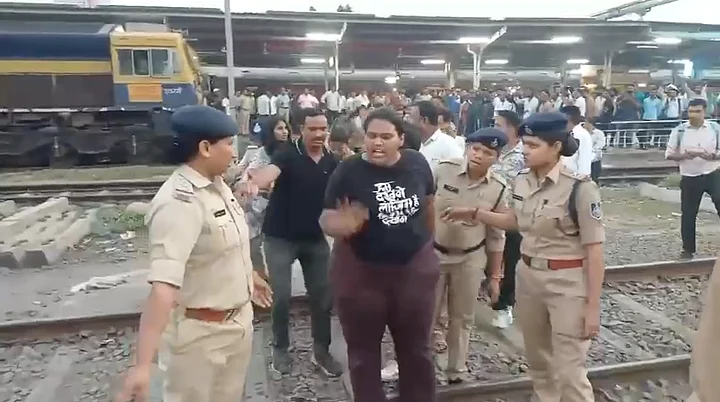
In the days leading up to the 10 October protest in Delhi, thousands of individuals, including students, activists, and political leaders, were detained or placed under restrictions across several Indian states. Authorities implemented extensive travel curbs, including the cancellation of trains and closure of metro stations, while police actions reportedly targeted those attempting to reach the capital for the demonstration against the Special Intensive Revision (SIR) of electoral rolls and Chief Election Commissioner Gyanesh Kumar.
According to Scroll, at least 10,000 people were detained nationwide, with reports of students, farmers, and members of Dalit organisations being stopped from travelling to Delhi. The Cockroach Janta Party (CJP) and allied groups alleged that police detained individuals at railway stations and placed activists under house arrest in states such as Maharashtra, Rajasthan, Gujarat, and Delhi.
As reported by The Indian Express, police in Madhya Pradesh intercepted at least 30 protesters on trains at Bhopal, Itarsi, and Gwalior, detaining them and advising a return to their home states. Student activists from Pune recounted being followed by police before boarding the Goa Express, with several ultimately removed from the train at Itarsi. Similar interventions were reported in other states, with authorities citing concerns over public order.
As highlighted by Maktoob Media, activists alleged that police attempted to forcibly remove students from trains, assaulted and detained CJP spokesperson Deepak Baliyan in Rajasthan, and detained volunteers from Telangana in Madhya Pradesh. In Mumbai, civil society activists were reportedly detained and released on the condition that they remain in the city. The Students’ Federation of India (SFI) also reported police visits to their Delhi office seeking details of activists planning to join the protest.
“Rajasthan Police has brutally assaulted CJP spokesperson Dipak Balyan and his brother. Deepak has been detained and his brother’s head has been cracked open,” CJP founder Abhijeet Dipke stated, according to the organisation’s account.
As noted in an article by The News Minute, Indian Railways cancelled all mail and express trains scheduled to arrive at New Delhi and Hazrat Nizamuddin stations between 4 am and 2 pm on 10 October, citing anticipated road congestion. Delhi Metro Rail Corporation was asked to close 57 metro stations from 9 pm on 9 October, with the possibility of reduced train frequency depending on the situation. Over 23,000 security personnel were expected to be deployed in the capital.
Further details indicated that retail liquor shops across Delhi were ordered shut on 9 and 10 October, while restaurants, bars, and clubs remained open. Entry to Jantar Mantar, the designated protest site, was restricted, with barricades and police presence preventing access even for media personnel.
Legal challenges to the travel and assembly restrictions were filed, as court filings showed, with a petition in the Supreme Court contesting the cancellation of trains, metro shutdowns, and internet curbs. Senior advocates argued that the measures were unprecedented and disproportionate, while the Delhi Police maintained that permission for the protest had been denied due to procedural lapses and public safety concerns.
“Permission was being sought for protests at the designated place. There is such heavy barricading, no person can go there,” Advocate Vrinda Grover informed the court.
Analysis showed that the transport restrictions were accompanied by detentions of students and activists en route to Delhi. Police cited the likelihood of large crowds and potential disturbances as reasons for the closures and heightened security, with Section 163 of the Bharatiya Nagarik Suraksha Sanhita invoked to prohibit gatherings and processions in central Delhi.
Coverage revealed that CJP leaders described the detentions as “mass and illegal,” reporting distress calls from across West Bengal, Uttar Pradesh, Delhi, and Haryana. They urged supporters to continue peaceful protest despite the risk of arrest or house arrest, reiterating demands for accountability in the electoral process.
Note: This article is produced using AI-assisted tools and is based on publicly available information. It has been reviewed by The Quint's editorial team before publishing.