
Not Just Another Indo-Pak War Film, 'Ikkis' a Nod to Bravehearts on Both Sides
'Ikkis' shows the ugliness of war instead of serving up stereotyped Pakistani villains and invincible Indian heroes.
advertisement
"Early in the film, when Dharmendra—playing my father Brigadier ML Khetarpal in Ikkis—says, 'Mera doosra beta Arun, humesha ikkis ka rahega… (my other son will always remain 21)', I was in tears," recalls Mukesh Khetarpal, younger brother of 2nd Lt Arun Khetarpal, India’s youngest Param Vir Chakra awardee.
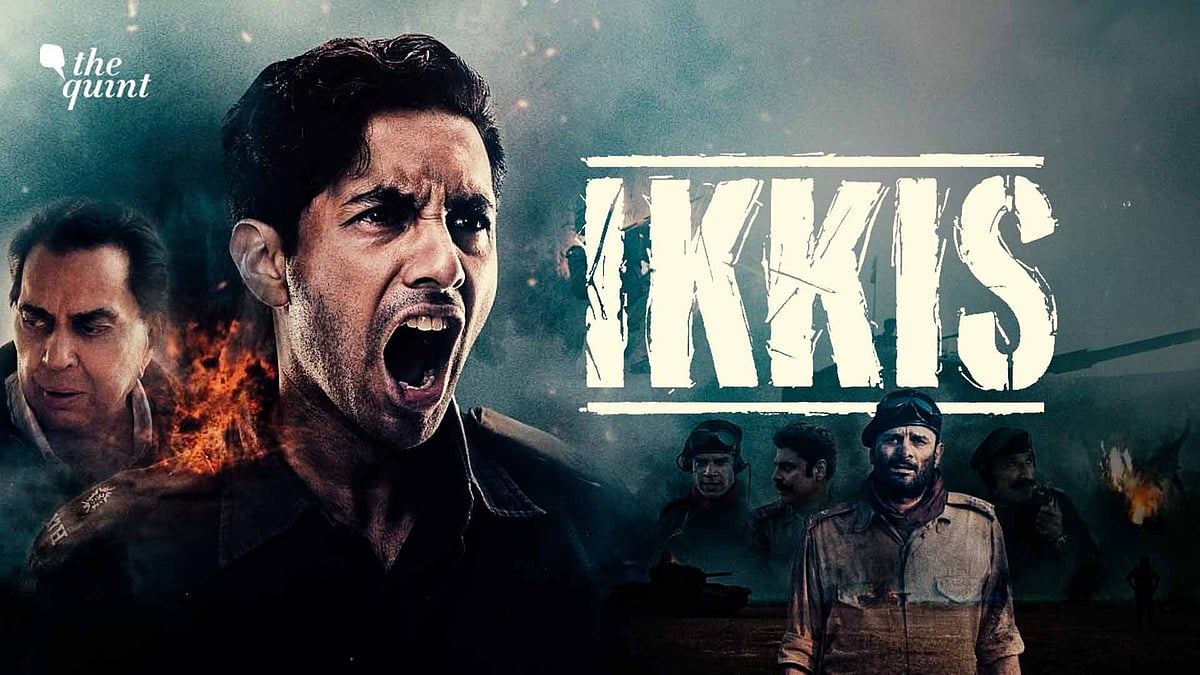
A young tank squadron commander of the 17th Poona Horse regiment, 2nd Lt Khetarpal was killed in the Battle of Basantar on 16 December 1971, the very last day of the Indo-Pak war. In the newly released film Ikkis, directed by Sriram Raghavan, Agastya Nanda essays the role of 2nd Lt Khetarpal.
So, how faithful is Ikkis to the war hero's story? How well does Raghavan handle the complexities of India and Pakistan’s shared history of conflict? And what does the Khetarpal family think about Ikkis?
An Honest Testament
Ikkis captures the ugliness of war. You meet soldiers caught in the vortex of battle with a ‘realness’ that engages and immerses you. Don’t invite death, “maut tumhe khud dhoond legi”, says Subedar Sagat Singh (played by Sikandar Kher) while mentoring young Arun.
From Sepoy Nand Singh, Arun’s newly married radio operator, getting killed mid-sentence by a bullet, to the Pakistani village devastated in the crossfire of battle, and the eerie silences that punctuate the blazing guns of a battle tank, the master yarn-spinner Raghavan (Johnny Gaddaar, Andhadhun) has allowed facts more powerful than fiction, to guide his hand.
The film traces the story of the real story of a raw, 21-year-old officer bursting with ‘josh’, who boldly toasts to his own death while promising to be his regiment’s 2nd Param Vir Chakra awardee. Arun impresses his Commanding Officer, Lt Col Hanut Singh (played by an aptly restrained Rahul Dev), with his precocious talent for tank warfare, and takes out 10 Pakistani tanks in his first day of battle before dying that same day.
If that were not all—fair warning, spoiler coming up—the aging father of the young Indian war hero, travels to Pakistan 30 years later, only to find out that his gracious host is also the Pakistani soldier who took his precious son’s life. All this really happened. Add to this some excellent screenplay and crackling dialogue to give it more punch and you have Ikkis.
Reliving Arun Khetrapal
Through the film, the young actor embraces the various shades of Arun’s personality—the eager gentleman-officer, the young leader, determined, yet at times unsure of what is ‘right’, the prankster cadet, the self-conscious romantic, and finally the intense, focused soldier in battle.
An interesting moment created by Raghavan, and handled well by Agastya on screen, is his first time inside a tank—we feel the young 2nd Lt’s awe, his sense of ‘belonging’ there, and we feel the start of Arun’s ‘romance’ with ‘Famagusta’, the Centurion tank assigned to him.
Even his budding romance with Kiran, the daughter of an Army officer at the National Defence Academy, is handled in a ‘hatke’ manner. Played by Simar Bhatia, who also happens to be Akshay Kumar’s niece in real life, Kiran is feisty and more than a handful for Arun, marking a confident debut for Simar.
The final credits reveal that, though they ‘broke up’ before the war started, Kiran, who went on to become a doctor in the Indian Army, still sends the Khetarpal family a cake every year on Arun’s birthday.
But what sticks with us most about the young star kid Agastya are his brooding, searching eyes, reminiscent of his grandfather Amitabh Bachchan's from his angry young man era in films like Zanjeer and Majboor. Watch out for Agastya Nanda folks... he’s just getting started.
Dharmendra's Last Take
Then there’s Dharmendra.
As Arun’s dad Madan Lal Khetarpal, in his career’s final hurrah, Dharamendra’s performance is effortless. He lives the role of the retired Brigadier, who has borne the grief of losing his son with a quiet dignity for decades, and who, when faced with the man who ‘killed’ his son, chooses forgiveness over anger and hate.
Dharmendra (right) along with Mukesh Khetarpal (below).
(Photo courtesy: Mukesh Khetarpal)
Jaideep Ahlawat has called it a ‘blessing’, and an ‘honour’ to work with Dharmendra. Ahlawat is excellent as the retired Pakistani Brigadier Naseer, who hosts Arun’s father when he visits Lahore in 2001 to attend a Lahore Government College reunion. Naseer also drives Khetarpal Senior to his hometown, Sargodha, and finally to Basantar where he reveals how 30 years ago, then a Major in a Pakistan tank regiment, he fought and killed young Arun.
Raghavan takes the poetic licence of shifting the location of the ‘revelation’ scene from Naseer’s home in Lahore to Basantar. But Mukesh gives the film a big thumbs-up, saying that the film is “more than 90 percent accurate in its details about Arun’s life”.
Even smaller details have been accurately captured in the film. As a Pune boy myself, I smiled when Kiran and Arun mentioned the iconic Manney’s book store in the city’s cantonment area.
During the cross-country race, they showed Arun running in a maroon singlet with a yellow band—the colours of Foxtrot. So, another box ticked by Raghavan’s team.
Cutting Through the Mould
Ikkis intercuts seamlessly between the story of young Arun, and Khetarpal Senior's visit to Pakistan, and is quite different in tone from most India-Pakistan conflict films these days.
It’s not shrill, it does not celebrate violence, and it does not cry for revenge. It talks about honour between warring soldiers, instead of serving up stereotyped Pakistani villains and invincible Indian heroes.
“Barood se bhuni yeh mitti kitni ziddi hai" (This land, smoked and hardened with gunpowder, is very adamant), says Dharmendra, as he gathers soil from around the tree where Arun breathed his last, saying how the land soon forgets who had fought over it. In another scene, he asks poignantly, “Jung sach hai, ya bhaichara?” (Is war the ultimate truth or brotherhood?)
“Till date I salute him, and now I salute his father,” says Ahlawat, describing Arun’s bravery in battle to his father.
In another powerful scene, Khetarpal Senior is confronted in Sargodha by a former Pakistani soldier (a brilliant cameo by Deepak Dobriyal) maimed in battle. The aging Indian soldier embraces the Pakistani soldier, telling him, ‘You lost a leg, I lost my son.’
There are also several gentle but pointed references to India and Pakistan’s shared cultural heritage—Brigadier Khetarpal driving past protestors wanting a chowk in Lahore to be named after Shaheed Bhagat Singh, old Hindi film songs playing in the background right through his Pakistan visit, and even a picture of Dev Anand displayed at the Lahore Government College reunion, to drive home the point that he too was an alumnus of that historic college and had not been forgotten.
Watching Dharmendra doing ‘panja’ (arm wrestling) with an old student at the reunion, Ahlawat fittingly says, ‘He is home!’
Lets’s leave the last word to Dharam paji’s character, Brigadier Madan Lal Khetarpal, who gently narrates a Punjabi poem as he drives to his pre-1947 hometown of Sargodha, which ends with these lines—“Ajj bhi ji karda hai, pind vich apne jawaan” (Even today the heart wishes, to return to the village of its birth).
- Access to all paywalled content on site
- Ad-free experience across The Quint
- Early previews of our Special Projects
Published: undefined