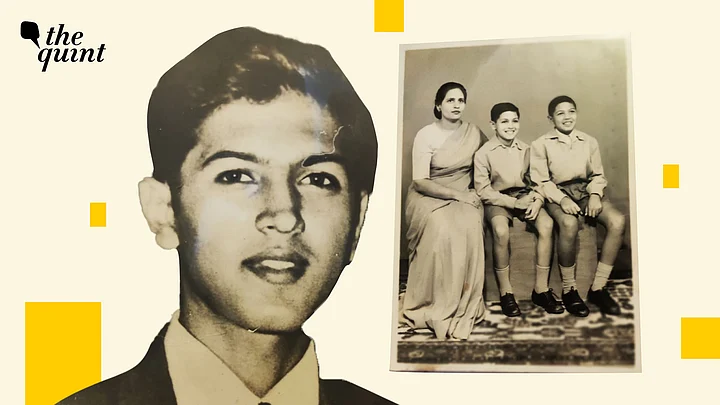
“I was supposed to be the fauji, Arun was to become the engineer...”
It is not easy for Mukesh Khetarpal to rewind to the summer of 1967 to reveal how his elder brother Arun stubbornly "picked his fate" to become one of modern India’s greatest war heroes. The story of Second Lieutenant Arun Khetarpal, who was just 21 when he died in the Battle of Basantar on 16 December 1971, is the stuff of legends.
The film Ikkis, starring Agastya Nanda—and Dharmendra playing the pivotal role of Arun’s father Brigadier Madan Lal Khetarpal—tells the story of Arun's incredible valour. The film, which released on 1 January, is directed by Sriram Raghavan.
The Khetarpals: 4 Generations of ‘Faujis’
The Khetarpals have a proud military tradition—Brig Khetarpal was a World War 2 veteran, and had fought in the 1948 and 1965 Indo-Pak wars. Arun and Mukesh’s grandfather, Chaman Lal Khetarpal, took part in World War 1, and their great grandfather Ram Narain was part of Maharaja Ranjit Singh’s Khalsa Army that fought the British in the 19th century.
Back in the 1960s, it was common for the family patriarch to ‘instruct’ the next generation about what to do with their lives. Madal Lal had served in the Indian Army’s Corps of Engineers, and wanted one of his sons to join the Army, and the other to become an engineer.
Back then, Mukesh believed that Arun was the favourite son. "One reason for that was that I had to make do with the hand-me-downs. Arun ke kapde, Arun ke joote, Arun ki cycle, they were all passed on to me. But he was also a quietly protective ‘bada bhai’, and we got along really well," he recalls.
IIT’s Loss Became NDA’s Gain
Arun, who was just a year older than Mukesh, was regarded as the brighter of the two. Their father was determined that Arun should "go to IIT", and Mukesh be the army man. The brothers studied at The Lawrence School, Sanawar. Initially, not contesting his father's orders, Arun took the IIT entrance exam. But as "insurance", since the IIT entrance exam has always been tough to crack, he also took the entrance exam for National Defence Academy (NDA).
Not unexpectedly, he cleared both. And that’s when trouble erupted. Despite what his father wanted for him, Arun’s heart was set on being a soldier. He pleaded with his mother Maheshwari repeatedly to speak to Madan Lal and convince him. But he refused to budge. What followed was two weeks of a silent, stubborn stand-off between father and son, at the dining table, and every other part of the family home.
But in the end, the patriarch relented. And so, IIT’s loss was NDA’s gain.
In 1967, Arun Khetarpal, assigned service number 7498, joined the 38th course of the NDA in Pune. It is no surprise that Arun excelled there. Under his leadership as Squadron Cadet Captain, his Foxtrot Squadron became the NDA’s champion squadron.
For the record, Mukesh was no academic pushover either. When it was his turn, he too cleared the IIT entrance exam and joined IIT Delhi, without further ruffling Brigadier saab’s feathers.
'Arun was a Natural Soldier'
In a wonderfully well-preserved room full of Arun Khetarpal’s memorabilia—photographs, citations, letters, maps, books, and personal belongings—Mukesh travelled back several decades to tell The Quint about his dear elder brother.
"When we were home from boarding school, it was Arun who would tag along with our father to work, to see the troops, for a ‘feel’ of the army. It was Arun who would enjoy trying on Dad’s army uniform, and pinning on the ribbons, and rank, and beret and baton," recounts Mukesh, to reveal how Arun was "naturally" drawn towards being a soldier.
Fast forward to the fateful year of 1971.
As war clouds gathered, Arun graduated from the Indian Military Academy (IMA) as a Second Lieutenant. Having chosen to join the Armoured Corps, he was assigned to the 17th Poona Horse tank regiment which had an illustrious 175-year-old history. Six years earlier, during the 1965 Indo-Pak war, their inspirational commander Lt Col Ardeshir Tarapore had been martyred at the Battle of Chawinda.
'I’ll be the 2nd Param Vir Chakra of Poona Horse!'
Mukesh recounts that Arun was excited to be a part of Poona Horse, and soaked up all of the regiment’s military history.
"When new officers are being informally inducted, they have a tradition of toasting previous gallantry award winners, each with a shot of whiskey. When it was Arun’s turn, he toasted to Lt Col Tarapore."
But then, Mukesh says, a now very tipsy Arun, surprised everyone by saying he had a second toast to offer. "To myself, 2nd Lt Arun Khetarpal, who will be the second Param Vir Chakra of the regiment!"
Arun’s toast was drowned out in the laughter of his fellow officers at the time, but it was an eerie premonition of his own martyrdom just a few months later.
Mukesh remembers the last time Arun was home in November 1971. The Young Officers Course for the Armored Corps that he had been attending in Ahmednagar had been suspended, as officers were recalled to their units in anticipation of war. Travelling from Ahmednagar to Samba, a town just south of Jammu, where his regiment was stationed, Arun stopped for a few hours in Delhi, and came home to drop his motorbike.
"At home he surprised Mom, Dad and me by packing his golf set, and also his ceremonial ‘Blue Patrol’ Armored Corps uniform. Dad asked ‘Yeh kyon le ja rahe ho?’ and Arun said, ‘Papa, we will be in Lahore soon! I plan to play a round of golf there, and I will need my ceremonial uniform to celebrate our victory!’ That’s how keen he was to see action and take on the enemy,’ explains Mukesh.
‘Sher Ki Tarah Ladna’
As he was leaving, Mukesh remembers their mother Maheshwari’s words to Arun, "Beta, sher ki tarah lad kar aana…" And that’s what he did.
At the Battle of Basantar, on 16 December 1971, 2nd Lt Arun Khetarpal, leading a squadron of three tanks, destroyed 10 Pakistani tanks before he was hit and killed by enemy fire himself. Arun’s bravery foiled the Pakistan Army’s objective of cutting off and occupying the main highway from Punjab to J&K.
Back then, communication was slow. There was also the fog of war. Tragically, Arun lost his life on the very last day of the 1971 Indo-Pak war. On the same day, 16 December, the Pakistan Army surrendered in Dhaka. A ceasefire was declared, that came into force on India’s Western border as well from 17 December onwards.
"My father’s army grapevine had kept us aware that 17 Poona Horse was engaged in action in the Samba sector. With the ceasefire declared, we were happy that Arun may now be out of danger, and we would see him soon."Mukesh Khetarpal
The Dreaded Telegram
But that was not to be. On the morning of 19 December, as the Khetarpal family went about its chores, the dreaded telegram bearing the news of Arun’s death arrived.
"My father and I were at home, but it was my mother who went to the door, and the telegram was handed to her. She was the first to read it. It said, ‘DEEPLY REGRET TO INFORM YOUR SON SECOND LT ARUN KHETARPAL REPORTED KILLED IN ACTION SIXTEENTH DECEMBER. ACCEPT SINCERE CONDOLENCES.’Mukesh Khetarpal
The Khetarpal family has preserved the telegram, and allowed The Quint to photograph it as well.
Mukesh recalls that the initial emotion he felt towards Arun, after hearing about his death, was anger. "I was very angry with Arun back then, for several months. After his tank was hit, he was told to fall back. But he didn’t listen; he kept on fighting."
Mukesh did gradually understand that Arun’s unusual bravery had halted the Pakistani advance, and so the anger did give way to pride. "Till today, I remain proud of Arun. But with the pride, there is also a lot of pain. For my mother and father, the loss and the pain was too much. They did not really recover from it. They gracefully accepted the awards and medals, but they carried the pain to their graves."
‘Arun Never Wanted Glory, But Had an Iron Will’
So was it precocious bravado that drove Arun at Basantar or an immature quest for glory by a young officer? "I have thought about this for over 50 years, and the answer is no. Arun was not a typical brash young fauji. He was actually gentle and soft-spoken, but he had an iron will. And he was intelligent. On that day, I think he understood he could not fall back, as it would have allowed the Pakistani tanks to advance and threaten the road to Jammu," says Mukesh.
Clearly, even in the heat of the battle, even after his tank had been hit and had caught fire, the young 21-year-old officer, thinking with an unusually mature military mind, seeing that his tank gun was still functional, chose to stand his ground and thwart the Pakistani tanks. It was not a rush of blood to go out in a blaze of glory.
Mukesh shared another anecdote during our rambling chat down memory lane.
"I was at a dhaba outside IIT Delhi, where I was studying. Fellow students often asked me about Arun. As I spoke about him, I saw a young helper at the dhaba listening intently. He finally asked, ‘Kya aap Shillong ke St Edmund’s School mein padhte the?’ When I said yes, adding that was 12-13 years ago, he said, ‘Main aapke bhai Arun ko jaanta tha. Mere Papa school mein peon the. Arun bhaiya ne mujhe apna sweater diya tha, winter ke dino mein.'"Mukesh Khetarpal
Mukesh says he was stunned, because he distinctly remembered Arun being scolded for 2-3 days by their mother for ‘losing’ his brand new sweater. "Arun could easily have taken the high road and told our mother that he had given the sweater to someone needy, but instead he took the scolding, and let his good deed remain unknown."
Clearly 2nd Lt Arun Khetarpal was a true selfless hero, who fully earned the Param Vir Chakra, paying the ultimate price in service of the nation.
"I lost my brother when I was just 20 years old. I am way past 70 today. But I do believe that Arun is still ‘always there’ for me," Mukesh says, comforting himself.
(Rohit Khanna is an award-winning journalist and former Managing Editor at The Quint. Previously, he served as Executive Producer, Investigations & Special Projects at CNN-IBN. This is an opinion piece, and the views expressed are the author’s own. The Quint neither endorses nor is responsible for them.)