
‘Hawker Jihad’ to ‘Doodh Jihad’: The Strategy Behind BJP’s BMC Win
As power shifts after 30 years, Mumbai confronts the atmosphere of fear it believed it had outgrown.
advertisement
A man in his thirties, dressed in a body-hugging black T-shirt, his biceps straining against the sleeves, sits bent over a wooden chessboard. Mumbai, he explains in an Instagram reel, is the king under siege. Islamists, he claims, have quietly infiltrated the city, captured its informal economy, and are now waging a “hawker jihad” against Hindus.
Neither video offers evidence for its claims. Both end with a warning: Hindus must unite in the Brihanmumbai Municipal Corporation (BMC) elections.
Together, they have been viewed nearly two million times on Instagram and liked by close to 200,000 users.
The reels were amplified by a network of Hindutva influencers, including accounts linked to the Sakal Hindu Samaj—an amorphous, leaderless outfit whose rallies have frequently featured senior Bharatiya Janata Party (BJP) leaders delivering anti-Muslim hate speeches.
From “hawker jihad” and “doodh jihad” to “coastal jihad” and “parking jihad”, a barrage of Islamophobic messaging flooded social media in the months leading up to the polls. With slick production values and coordinated aesthetics, this digital campaign ran in tandem with an overt Hindutva push by the BJP on the ground—together proving decisive in delivering the party its long-coveted prize: control over India’s richest municipal corporation.
The campaign first took off in 2022, when the BJP dislodged the Uddhav Thackeray-led government and came to power with Eknath Shinde as the chief minister. Since then, Mumbai has seen an alarming rise in religious hate and hate speech: from Muslim hawkers being attacked, to desecration of Christian graveyards to free-flowing hate speeches, Mumbai has been seeing a steady mobilisation against Muslims.
Last week’s BMC elections saw the campaign reach a crescendo: Muslims were cast as an internal threat, and Mumbai’s electorate was polarised along religious lines. In the process of dislodging the Shiv Sena’s nearly three-decade old control over the BJP, Hindutva groups dragged Mumbai to the time three decades ago, when Mumbai last experienced such bitter communal division and violence: the 1992-’93 communal riots.
In the process, Muslims were cast as an internal threat, and Mumbai’s electorate was polarised along religious lines.
Bondi To Mamdani
The BJP’s own campaigning set the tone for much of this rhetoric. Everything—from New York Mayor Zohran Mamdani’s historic election, to the Bondi beach shootout in Australia to the killing of Bangladeshi Hindus—was employed by the BJP in an effort to shore up its Hindutva base.
Satam didn’t stop there. As elections grew closer, he stepped up his inflammatory rhetoric.
In December, he alleged that “demographic change” by Muslims was posing a major threat to society, and threw wild allegations of “vote jihad” as well as “land jihad”
He held a press conference, alleged an international Islamist conspiracy to install Muslim mayors in major global cities, that illegal Muslim infiltrators were “pushed in”, said Mumbai could see a repeat of the Bondi beach shooting in Mumbai’s Girgaum Chowpatty beach, if such a conspiracy is not halted. 15 people were killed when two Islamic State-inspired terrorists attacked a Jewish gathering in Australia’s Bondi beach in December last year.
There was no let up in the rhetoric, even after the polls had finished.
Even as votes were being counted on Friday evening, former BJP MP Kirit Somaiya said his party would never let Mumbai become “Muslim Mumbai”, whatever that meant. In his statement, he used Muslims interchangeably with Bangladeshis.
The Bangladeshi Connect
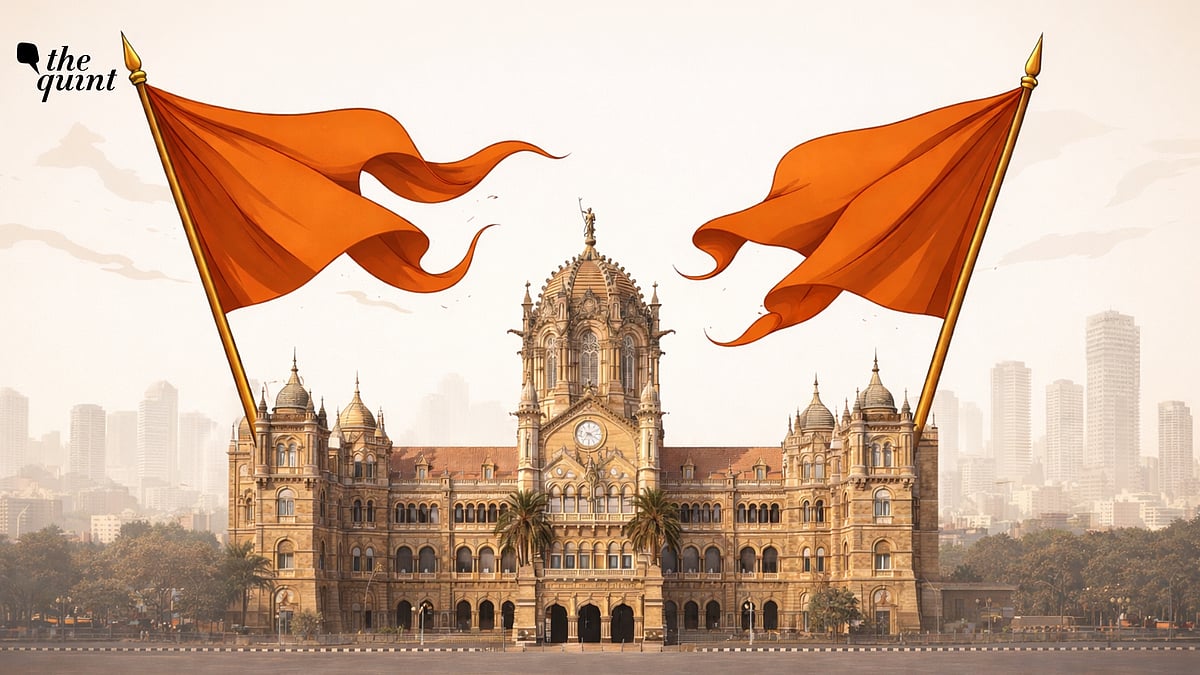
This was in line with the BJP Mumbai and its local affiliate outfits’ use of the killings of Bangladeshi Hindus since August 2024, when the Sheikh Hasina government was overthrown by protesters. In December, Mumbai Bajrang Dal units were allowed to shut down prime areas of Mumbai, including roads outside the Chhatrapati Shivaji Maharaj Terminus, to protest the Bangladesh violence. The violence saw large-scale hate speeches and slogans targeted at Muslims.
The irony that the country’s home ministry—in-charge of the Border Security Force as well as of citizenship matters—was been controlled by their own party for 12 years now, is probably lost on these enthusiastic BJP leaders.
Hindutva To Beat Marathi Asmita
This unprecedented Hindutva mobilisation for a municipal election is a sign of just how much this win matters for the BJP. Controlling the BMC allows access to obscene financial resources—the kind that kept the Sena alive and kicking for decades.
But controlling the BMC also allows the BJP to establish an unchallenged control over Mumbai’s land, a particularly important contention given the massive corporate interests that have been encircling Mumbai’s resources for a while.
Controlling the BMC means easier permissions and nods to projects like the Adani group-led Dharavi redevelopment project—even though the project is not by the BMC, it needs acres of land from the civic body, without which the project would not go through.
Insiders in the party said that its attempt to stoke Hindutva sentiments was primarily just that: to break away some Marathi voters and consolidate its core group.
However, the fact that the BJP—despite putting in all its might to win this—could only manage to win seven more seats from its 2017 tally of 82 seats, shows that the win isn’t as comprehensive as the party touted it to be. Despite its alliance with Eknath Shinde’s Shiv Sena, the alliance tally is only four more than the majority mark of 114 seats.
But, in politics, what counts is the end result. And the bottomline is that the BJP-led Mahayuti alliance has managed to dislodge the Thackeray Sena from its citadel after nearly three decades.
The cost of the victory, though, is harder to measure.
Mumbai, 30 years later, was told to fear itself yet again.
(Kunal Purohit is an award-winning independent journalist, writing on politics, gender, development, inequalities, and the intersections between them. He is an alumnus of the School of Oriental and African Studies, University of London. The views expressed above are the author’s own. The Quint neither endorses nor is responsible for them.)
- Access to all paywalled content on site
- Ad-free experience across The Quint
- Early previews of our Special Projects
Published: undefined