
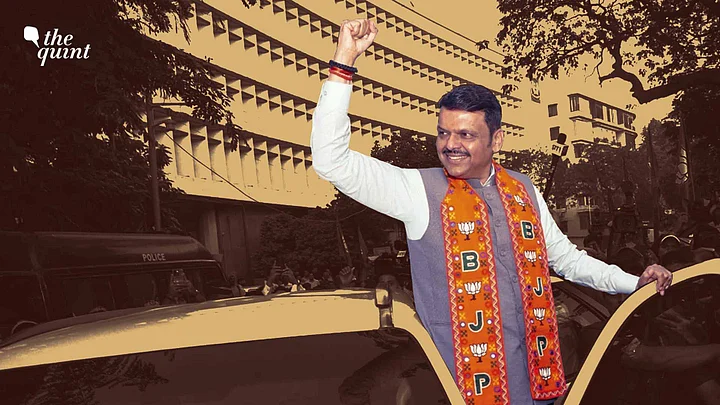
Nearly three decades ago, when the Shiv Sena was sworn back into power at the Brihanmumbai Municipal Corporation (BMC) in what would be a long, historical reign, another political chapter was unfolding nearly 850 kilometres away in Nagpur. A young Devendra Gangadharrao Fadnavis was taking oath as the city’s second-youngest mayor.
Today, life has come full circle for Fadnavis and the Bharatiya Janata Party (BJP), as they take control of the BMC from the Shiv Sena after the 1997 win. While the party has emerged dominant across 25 out of 29 municipal corporations in Maharashtra, the BMC remains the shiniest jewel in its crown.
"The BJP is a party that understands the complexities of the BMC, where it is rare for parties to win without alliance support. It recognises its weaknesses and works on it," political analyst Amitabh Tiwari told The Quint. "It knew that Mumbai's demography is such that it cannot gain majority without the Marathi manoos, who are largely with Thackeray. Its alliance with Shinde brought at least 30 percent of that vote, which may not seem like much but has ultimately enabled the BJP to come into power."
The campaign for the election, which was spearheaded by Fadnavis, extends far beyond a municipal victory. Even though the party has performed only marginally better than in 2017 — leading in around 89 wards compared to 84 earlier — the victory carries heavy symbolic and political weight. It is about who now calls the shots in Maharashtra’s ruling Mahayuti alliance.
Why Mumbai Matters
Mumbai is not just another municipal corporation. It is India’s financial capital, the gateway to the Mumbai Metropolitan Region (MMR), and home to the country’s richest civic body. It controls decisions that shape infrastructure, urban development, transport, and housing across the region, and the budget for the body in the last financial year was Rs 74,427 crore
“One of the reasons Mumbai is very important for the BJP is because it is the commercial capital,” political analyst Hemant Desai told The Quint.
“The MMR drives Maharashtra’s economy, and many regional decisions require the corporation’s approval. The BJP can now say Delhi is with us, and Mumbai is with us too. Thackeray has performed well, but key bodies like the Standing Committee and Improvement Committee will now be controlled by the BJP.”Hemant Desai
Desai said that the BJP could now also say that the Marathi asmita monopoly is no longer with just the Shiv Sena, as “Mumbai is no longer just the Thackerays, it's the BJP's.”
Mumbai's politics have been shaped by identity and regional pride for decades. When Maharashtra was formed in 1960, several business groups and some political leaders wanted Mumbai to be a Union Territory, not part of Maharashtra, but the Samyukta Maharashtra Movement fought to make the city part of a Marathi-speaking state. The Shiv Sena, which was founded by Bal Thackeray six years later, built its politics around this very idea, positioning itself as the protector of the Marathi manoos.
Control of the BMC is seen as control over the city's narrative. The BJP’s emergence as the single-largest party in the BMC signals a shift in this legacy.
A Message to the Alliance
The BJP’s BMC performance is not just an electoral victory. It is also a crucial signal to its own allies about who now calls the shots.
“BJP is where it was in 2017, with just a few more seats. It is not a complete sweep, but the BJP has sent a message more to its alliance than actual rivals with the results," said Girish Kuber, political analyst and editor of Loksatta.
"In one stroke, it has clipped the wings of both Shinde and Ajit Pawar. Even alliance partners won’t be able to dictate terms to the BJP anymore."Girish Kuber
Kuber pointed out that in direct contests between the Uddhav Thackeray-led Sena and Eknath Shinde’s Sena, UBT still holds the upper hand in Mumbai, which has weakened Shinde’s bargaining power within the Mahayuti alliance.
Shinde’s Shiv Sena, however, performed strongly in Thane and some other pockets of Maharashtra. It secured 294 seats overall in Maharashtra, out of which 29 were in Mumbai.
Ajit Pawar’s NCP faction, meanwhile, struggled to make a significant impact, despite contesting in alliance with uncle Sharad Pawar’s NCP in key constituencies. It ultimately lost to the BJP in NCP strongholds Pimpri-Chinchwad and Pune, in what is seen as a major setback for both camps in the Pawar family.
Fadnavis’s Stratergy
Fadnavis said after the victory that, “This win is the result of the hard work of our workers and the people’s trust in our development model." His strategy included fielding over 90 Marathi candidates and announcing that the BJP mayor would be a Marathi Hindu, an attempt to counter the Marathi manoos sentiment from the Thackeray. In a gamble that eventually paid off, the state leadership also decided to not rely on PM Modi, Amit Shah, or even UP CM Yogi Adityanath for campaigning.
BJP Maharashtra president Ravindra Chavan, who took charge in January last year, is also said to have played an important role in mobilising the cadre.
The BMC campaign this time resembled an Assembly or Lok Sabha election more than a civic contest. Across the city, there were massive hoardings, aggressive outreach, and promises of welfare schemes most visible from the BJP.
“BJP takes every election seriously, whether it’s a gram panchayat or a state poll,” BJP leader Poonam Mahajan told The Quint. “All over Maharashtra, including BMC, what has worked for us the most is that our work has been seen by the people over the years. CM Fadnavis's infrastructure push especially has been appreciated."
She added, “Mumbai is not just Mumbai. Its connection to MMR means that people come from these regions for work in Mumbai and the city's workforce is dependent on it. The economy is not dependent on just Mumbai, but the MMR. We have taken a big leap on infrastructure and worked on reducing traffic congestion and building roads over the years."
Party sources, however, acknowledged that the BJP lost several wards by narrow margins, preventing a more decisive victory.
A Shift in Campaign Politics
Kuber pointed out a noticeable shift in the tone of campaigning for the BMC elections this year, saying it “brought Mumbai closer to the cow belt.”
Following Zohran Mamdani's mayoral win in New York City, Mumbai BJP president Ameet Satam repeatedly made statements warning against a “Khan” becoming mayor in Mumbai. Several other communal videos were also used to campaign against "vote jihad" in the run-up to elections by Hindutva influencers campaigning for the BJP.
“For the first time, issues like terrorism, Islam and the Hindu-Muslim binary were heavily used in a municipal election. The use of communal statements in the campaign should have been condemned but they weren't. In a way, one can say the BJP was successful in these efforts as it consolidated its own vote bank with the communal issues and tried to divide the Opposition on it.”Girish Kuber
For the BJP, the BMC victory is part of a longer political arc. While the BJP won only seven more seats than it did in 2017, its strike rate has improved significantly. In 2017, it won 82 of the 227 seats it contested, while this time it won 89 out of the 137 seats it contested.
Despite the setbacks that Fadnavis saw in 2019, when he had to unceremoniously step down from the chief ministerial position, his political arc has now come full circle, with a clear stamp over Maharashtra's political map. He is the face of the saffron party in Maharashtra, not PM Modi or Amit Shah.
The BJP, under Fadnavis, has made its status in Mumbai clear, but the real test now lies in how it governs the city in a "triple-engine sarkaar" and manages its own allies.
