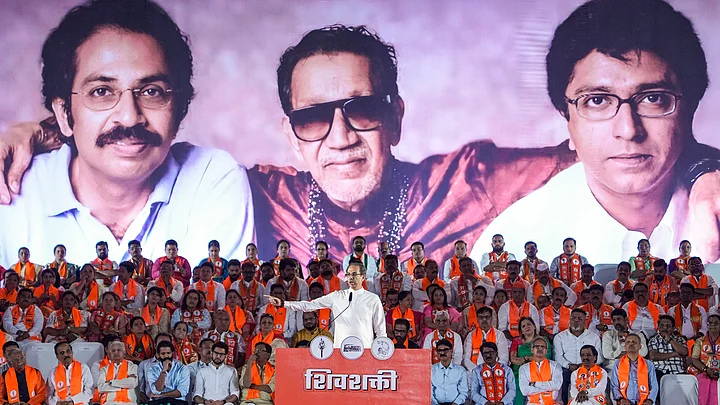
If you are a Mumbaikar who grew up surrounded by Shiv Sena supporters, you may have heard this several times: "Wait till Raj and Uddhav reunite!"
The wait is over, and the verdict is out. The Thackeray cousins reunited and still could not manage to win the Brihanmumbai Municipal Corporation (BMC) elections, despite the long-awaited wish of Mumbai's Marathi manoos coming true.
The Shiv Sena (UBT) won 65 seats of the 160 it contested, a tally not far worse than the 84 seats its party won in 2017 before Eknath Shinde split the Sena in 2022.
It would be naive to claim that their reunion didn't help boost the Thackeray brand electorally in this election, given the Bharatiya Janata Party's ever-rising dominance in the state and a multi-fold ground cadre compared to Sena UBT.
Analysts agree that if not for the sentiments heightened by the Thackeray reunion, Uddhav's tally may not have been as high either. What is still incomprehensible to many is the MNS' tally of 6 seats, which could have been better given the sentiments.
But here are some hard facts:
For the first time in over three decades, Mumbai will not have a mayor from the Shiv Sena.
For the first time ever, the maximum city will have a BJP mayor.
This was about the election results, but for the Thackerays, this fight may not have been as much about winning the BMC as it was about saving the Thackeray brand and their political legacies.
How Should One Actually Look at the 2026 Outcome?
In the last BMC election, contested about nine years ago in 2017, the BJP and the then united Shiv Sena, which were in an alliance at both the state and the Centre, contested the BMC elections separately. The BJP managed to secure 82 seats, while the Sena got 84. The MNS bagged 7 seats.
But come 2026, there are two Shiv Senas, two NCPs, the BJP is far stronger than it was, and the Opposition's MVA alliance is not contesting together.
Compared to the 7 seats it won in 2017, the MNS managed to win 6 this time. Clearly, the Thackeray reunion has not benefited Raj as much as anticipated.
As for the Shiv Sena, the comparison with the 2017 tally cannot be as direct and simple because the party split in 2022.
Shinde's Sena won 29 seats in Mumbai. While it cannot be decisively said how many of the votes Shinde's Sena received in Mumbai were for the Mahayuti and not necessarily for his party, it is safe to say that Uddhav has managed to maintain the lead despite Shinde.
But all this is centred around Mumbai. The more worrisome picture for Uddhav becomes clearer when looking at the party's performance in other municipal corporations.
The Shiv Sena's Performance Outside Mumbai
Thane was a bastion of an undivided Shiv Sena until 2022, with Shinde rightfully credited for keeping the party at the forefront in the region. In this election, Shinde's Shiv Sena won 55 seats, while UBT bagged just one. Shinde's dominance in the area was clearly established after 2022 when the party dominated the outcome in both the Lok Sabha and Assembly elections in 2024.
In Kalyan-Dombivli, Ulhasnagar, Kolhapur, Jalna, Ahilyanagar, Jalgaon, Nanded Waghala, and Malegaon, Shinde outperformed Uddhav by a significant margin.
A similar pattern emerged in Nashik, which was once a Sena stronghold, and where the MNS had dominated the municipal corporation in its first election in 2009.
Aside from Mumbai, SSUBT also performed exceedingly well in Parbhani, where it outperformed the BJP by a massive margin and emerged as the single largest party.
Lessons for Uddhav
The BJP's vote share in this election is over 45%,, while ZShiv Sena (UBT) got over 27% of the total votes polled. That's significant considering UBT's average vote share in the Assembly eelctions in the state was just over 9%.
The municipal elections may have saved SSUBT's base in Mumbai, but they raise significant questions about the party's ability to retain an electoral base in other major regions of Maharashtra.
The 'Marathi manoos' sentiment, as a historical trend, has always been more popular in Mumbai and urban pockets of other cities like Pune and Nashik, where the influx of immigrants is high. Although this narrative may have come to Uddhav's rescue in Mumbai this time, it cannot become the party's blanket strategy across the state.
Experts have repeatedly opined that the trajectory Uddhav has been trying to take the party on, and the strategic make-and-break alliance with the Congress and Sharad Pawar, resonates with only a small percentage of the traditional Shiv Sena voters in urban pockets.
The party may need to seriously rethink its strategies at multiple levels of administrative structures in order to revive itself at the grassroots in panchayats and local bodies.
A clear message that emerges from the Mumbai elections is that the Maha Vikas Aghadi (MVA) alliance has only been partly beneficial for Uddhav after the 2024 Lok Sabha elections. Though clear data is yet to emerge, not contesting the BMC elections in a formal MVA alliance, and not being seen with the Congress, has yielded results.
The Road Ahead for the 'Thackeray' Brand
In several interviews and interactions, Raj hinted that the alliance with Shiv Sena is for the municipal elections. Throughout the course of campaigning, leaders from both parties have been calculated in their responses to questions about the continuance of the alliance after the BMC elections.
Over the past few years, Raj has formed strategic understandings and alliances with several parties — Sharad Pawar's NCP in 2019, the BJP for the general elections in 2024, and with Shiv Sena (UBT) for the 2026 municipal elections.
However, as analysts have repeatedly pointed out, Raj's aura may pull crowds at election rallies but doesn't necessarily translate into votes that can sustain alliances or even support his own candidates.
The MNS has hardly increased its tally, despite reuniting with Uddhav and contesting 94 seats.
Uddhav, meanwhile, has lived to fight another day — at least in Mumbai, Parbhani, and a few isolated seats in other corporations. With nine MPs in the Lok Sabha from Maharashtra and 20 MLAs, Uddhav cannot be written off just yet.
So, what happens to the Thackeray brand and legacy? If the Lok Sabha elections, Assembly elections, and municipal elections are any indicators, it is still very much a brand, though a weakened one. As for the Thackeray legacy, most Hindutva parties, for the sake of pulling votes in Maharashtra, claim to be its true inheritors, including Devendra Fadnavis himself.
While the road ahead for Uddhav is steeper, Raj's path remains, once again, unpredictable.