
How 'Dhurandhar 2' Gaslights its Own Protagonist
'Dhurandhar: The Revenge' doesn’t just tell the story of a man being exploited. It indulges in that exploitation.
advertisement
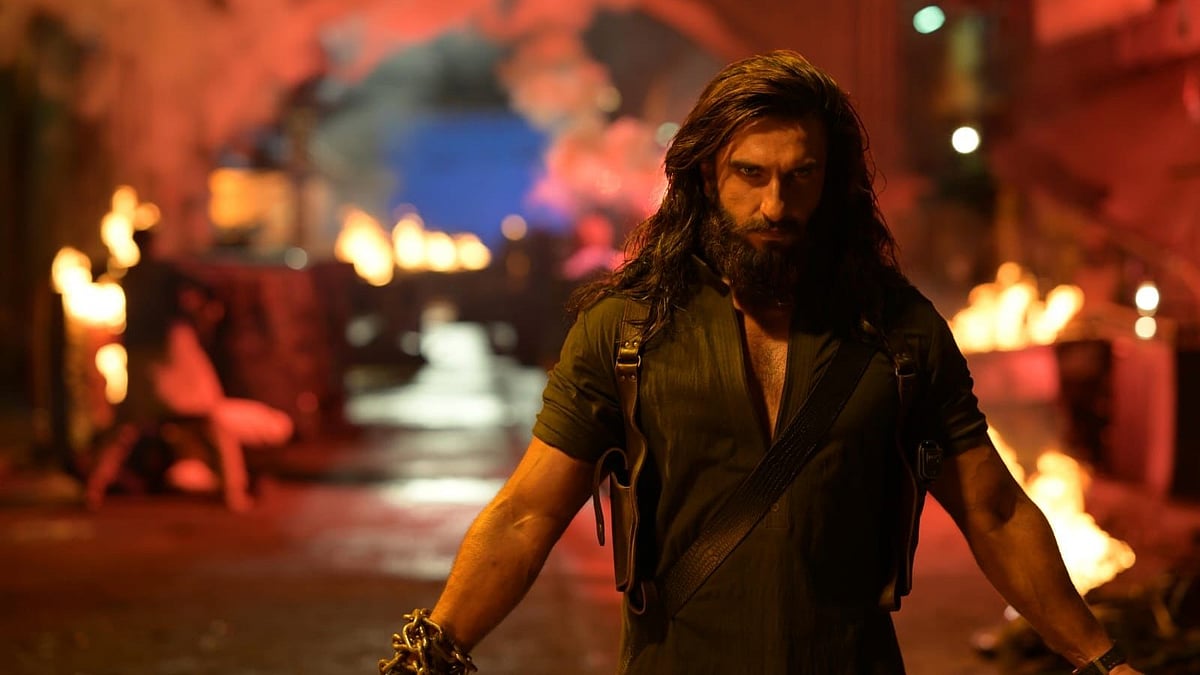
Despite being fully aware of just how vitriolic and propaganda-laden the first installment of Dhurandhar was, I wanted to give the sequel a fair chance. All of this to say that I was surprisingly moved by Jaskirat Singh Rangi (Ranveer Singh)'s backstory.
Atif Ahmed taunts him, addressing him as “smackiye da beta” (son of a drug dealer). Not only is Jaskirat severely underestimated by those around him, he is also failed by the very system meant to protect him. His father is hanged by a power-hungry MLA.
His sister is gang-raped and eventually murdered by men who were intoxicated with power. But the minute he decides to retaliate against this injustice, he is sentenced to jail. There is a sadness to Jaskirat’s story that I, as a critic, found myself unexpectedly engulfed by. For a moment, I was truly invested in this character arc. Somewhere, deep down, I was rooting for him.
But then, Ajay Sanyal (played by R Madhavan) enters the picture.
What does Ajay Sanyal do instead? He weaponises Jaskirat’s trauma to his, and by extension, the country’s advantage.
The whole “ghayal ho isiliye ghatak ho (you are lethal because you are wounded)” spiel is gaslighting at best, exploitation at worst.
A Killing Machine for Rs 30,000 a Month
Ajay convinces Jaskirat to consent to being a spy in Pakistan. This entails not only risking his life and safety, but also becoming a killing machine—a weapon in the State’s hands—in exchange for a paltry sum of Rs 30,000 to be deposited monthly into his mother’s PPF account.
Forget justice or the hope of living a normal life, Jaskirat is manipulated into becoming a killing machine for the State in exchange for an amount that is barely enough for subsistence, let alone adequate compensation for everything he has endured.
Many incels online and bhakts would believe that there is nothing more masculine and honourable than laying one’s life on the line for the nation.
This critic feels there is nothing inherently ‘masculine’ about dying in wars that you did not start or that have, at least directly, no consequence for you. This is foolishness at best, self-sabotage at worst.
Generations have been taught to equate masculinity with sacrifice, making it difficult to recognise when that sacrifice is being orchestrated rather than chosen.
Ajay Sanyal smartly weaponises Jaskirat’s masculinity against him. The playbook isn’t entirely different from what we usually see: men’s masculinity is used to benefit the State.
Hamza—the hypermasculine spy navigating the streets of Lyari amid gang wars and shifting loyalties—is clearly not the ‘alpha’ that he is believed to be, for he remains subservient to the State. If anything, I see him first as a victim of the system that couldn’t get him justice and then as a victim of the same system, which manipulates him into performing masculinity on command.
Aditya Dhar: The King of Peak Detailing
Dhar’s Dhurandhar: The Revenge is written in an attempt to legitimise the very system that breaks Jaskirat down.
What could have been a critique of weaponised masculinity instead becomes a spectacle that aestheticises it. Speaking of Dhar, he is, of course, the king of meticulous detailing.
Every frame he creates oozes cinematic brilliance, the kind that is often “discovered” by blue-tick X accounts long after the film’s release. These accounts hail Dhar as the second coming of Alfred Hitchcock. Random, oblique lines are drawn on these frames in an attempt to manufacture brilliance where there is none.
Recruiting the Broken: The State’s Endless Cycle
If witnessing Jaskirat/Hamza’s exploitation wasn’t enough, the end credits add another layer of insidious propaganda.
The Sanskrit phrase 'Balidaan Paramo Dharma' (sacrifice is the ultimate duty) appears on the screen as we are introduced to a cult of Dhurandhars—young men who were also, presumably, failed by the system—and are being trained as spies in an academy.
They indulge in extreme tasks, such as holding their breath underwater to build endurance. And that is perhaps Dhurandhar: The Revenge’s most insidious sleight of hand. It tricks you into empathising with Jaskirat, only to redirect that empathy towards the very machinery that destroyed him.
There is a version of this film that could have been devastating—a critique of a nation that fails its citizens and then feeds on their grief. But Dhar isn’t interested in that film. He is interested in myth-making: in building a world where obedience is virtue, where masculinity is measured by one’s willingness to die on command, and where the State is absolved of all its failures so long as it can produce a spectacle convincing enough.
(Deepansh Duggal is a film critic based out of New Delhi. His work has appeared in Hindustan Times, OPEN, Outlook, Frontline Magazine and The Economic Times. He has a particular interest in anti-capitalist narratives and films that lie at the intersection of power and ideology. This is an opinion article and the views expressed above are the author’s own. The Quint neither endorses nor is responsible for them.)
- Access to all paywalled content on site
- Ad-free experience across The Quint
- Early previews of our Special Projects
Published: undefined