
Legend-making: 'Shatak' Turns a Century of the RSS into a Sanitised Script
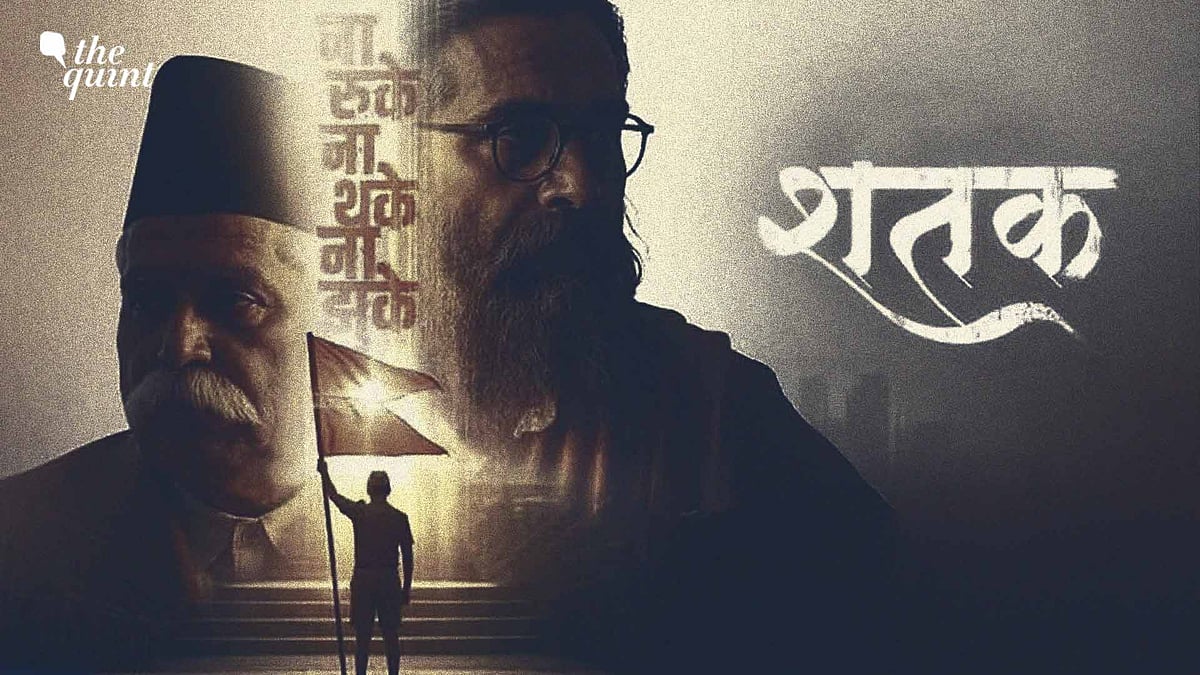
A commemorative film that avoids its own most contentious chapter struggles to command attention.
advertisement
In a twist that borders on irony, screenings of Shatak are reportedly playing to empty halls. 100 years of nation building, cadre building, and holding nationalistic pride on a pedestal were not enough to summon enough people, it seems. Some screenings are withdrawn for lack of an audience.
When I was booking my ticket to painstakingly endure this “masterpiece”, two shows were cancelled in a span of 12 hours. My friends in other cities inform me of similar (non) responses. The show I watched had two couples in dim rows seeking anonymity rather than ideological illumination. For an organisation that has long valorised discipline and self-fashioning celibacy among its pracharaks, this sort of optics are unintentionally comic.
Building a Legend on Screen
The film itself begins in 1897 Nagpur, tracing the childhood of Keshav Beliram Hedgewar, founder of the Rashtriya Swayamsevak Sangh (RSS). We are shown the English school admission pushed by an ambitious mother to see her son as a bureaucrat, the laddoo crushed in the classroom defiance, the early strings of nationalist sentiment.
Failing to linger, the movie hurries through the jail term in 1921-1922, where the Malabar Rebellion is glimpsed through a distance and Akola jail after the 1930 Jungle Satyagraha, without interrogating the politics surrounding them.
Meetings with MS Golwalkar in Ratnagiri and Nagpur, the Wardha camp during Mahatma Gandhi’s 1934 visit, Laxmibai Kelkar’s founding of the women’s wing in 1936, the illness in Sindi in 1939, the encounters with Shyama Prasad Mukherjee: each episode is ticked off like an attendance register. Even Hedgewar’s death in 1940 is staged as a seamless relay, baton passing to “Guru Ji”, Madhav Sadashivrao Golwalkar.
Recitation Instead of Drama
The problem is not the selection of events without delving into the current political scenarios for better context, it’s the tone and texture that fails to grab attention.
Shatak clearly prefers recitation over poised rhythm. The conspicuous absence of reflective intervals means the viewer is never invited to wrestle with ambiguity, even on account of an honest debate.
“The Sangh never participates in popular politics”, we are told, even as the formation of the Jana Sangh in 1951 is presented as a parallel development rather than an organic growth. Most striking, in all its arbitrary and crafted omissions, is what the film refuses to confront. There is no serious engagement with the assassination of Mahatma Gandhi in 1948 by Nathuram Godse, a former RSS member who had also been associated with the Hindu Mahasabha.
The historical record shows that after Gandhi’s killing, the Government of India imposed a ban on the RSS in February 1948, pre-empting a climate of hate that enabled the crime. The ban was lifted in July 1949 after the organisation agreed to adopt a written constitution and restrict itself to cultural work.
Shatak compresses this fraught chapter into a defensive aside, effectively granting itself a clean chit. The narrative emphasises the imprisonment of tens of thousands of swayamsevaks and their eventual release but skirts the moral and political reckoning that defined that period.
Press Release History
The film forfeits credibility by failing to examine the RSS’s own transformation in the wake of the ban and by striking out the ideological currents that shaped Godse’s worldview.
Similarly, references to the RSS’s role in the liberation of Goa from Portuguese rule, activities in Silvassa, participation in the 1963 Republic Day parade after the Sino-Indian war, and the popularisation of the slogan “attack is the best defence” under Golwalkar are presented as self-evident contributions to the nation, making history appear as a series of press releases. One senses a determination to cover ground rather than cultivate depth.
Modern nation-states are civic entities built on citizenship, law and equal rights, not on a single faith. A passport does not certify belief; it affirms belonging. To conflate the two is to reduce the plural republic to religious possession.
Mythmaking vs Memory
In its formative years, the RSS prided itself on being an austere, self-sufficient brotherhood sustained by voluntary guru dakshina.
This is foregrounded pompously in Shatak, but public reporting over the years paints a more layered picture. Now it raises funds through donations, institutional revenues, and through its political wing the Bharatiya Janata Party (BJP), as declared by the Election Commission.
A commemorative film that avoids its own most contentious chapter struggles to command attention. Bypassing complexities to smooth the edges of its failures has positioned Shatak as a carefully crafted tribute. A tribute that’s invested in myth-making rather than in confronting the weight of its past.
(Meenakshi Jha is an educator and freelance aspirational writer. This is an opinion piece and the views expressed are the author's own. The Quint neither endorses nor is responsible for the same.)
- Access to all paywalled content on site
- Ad-free experience across The Quint
- Early previews of our Special Projects
Published: undefined