
ADVERTISEMENTREMOVE AD

'Raanjhanaa' on Steroids: 'Tere Ishq Mein' & the Return of Toxic Masculinity

Anand L Rai's 'Tere Ishq Mein' appears determined to prove that what was once troubling can always become worse.

Published
story-hero-img
i
Aa
Aa
Small
Aa
Medium
Aa
Large

A decade after his last silver screen success, Anand L Rai is back with Tere Ishq Mein, a film that appears determined to prove that what was once troubling can always become worse.

When Rai's Raanjhanaa released in 2013, many viewers were dazzled by its music and emotional climax, even as it normalised relentless stalking in the name of love. How far have we come? Not very.

If Raanjhanaa flirted with the idea of violent, obsessive love, Tere Ishq Mein presses the accelerator pedal all the way down, crashing into the audience with a full-throated celebration of masculine rage.

ADVERTISEMENTREMOVE AD

Same Director, Same Actor, Same Trope

At the centre is Shankar (Dhanush, yet again), the quintessential ‘angry young man’ for whom breaking bones and going to jail are routine chores. His counterpart is Mukti (Kriti Sanon), a psychology student researching whether men with violent tendencies can be changed if treated with compassion and kindness.

What begins as an academic project gradually turns into a devotional pursuit: she wants to ‘fix’ Shankar and the film wants us to admire how sincere that goal is.

But in the process, Tere Ishq Mein sanctifies Shankar’s obsession. He warns that if he falls in love, he will “set Delhi on fire”—and the movie does not frame this as a threat but as a prophecy of grand, poetic suffering. The destruction he unleashes becomes a cinematic spectacle, as if violence performed for love deserves applause. In the world of cinema, women are not simply love interests; they are the triggers, catalysts and excuses for male rage.

Shankar’s actions are repeatedly attributed to how women ‘make men feel’, a trope Bollywood has long indulged. Mukti herself is written as flighty and sometimes unpredictable, her agency diminished to justify the intensity of his affection. Her flaws exist only to explain his fury.

If Raanjhanaa normalised stalking, Tere Ishq Mein multiplies it threefold.

There is no sense of what will happen next, no moral trajectory, and no self-reflection. Love turns into a scorched-earth strategy and madness is made to look like destiny. The film seems to think that male obsession, no matter how destructive, is a sacred act.

A Long Lineage of Bollywood’s ‘Crazy Lovers’

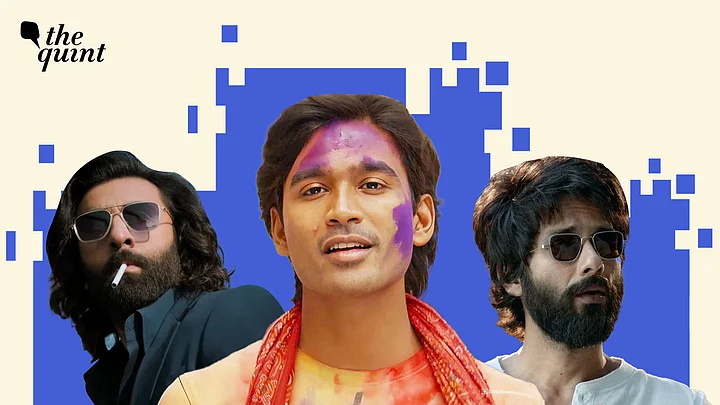
This is hardly a new trend. Bollywood has always played with the idea that real men love fiercely and without reason. From Darr to Tere Naam, Anjaam to Rehna Hai Tere Dil Mein, and more recently Kabir Singh and Animal, the angry male lover has been repackaged across generations. He might change clothes, cities, or social backgrounds, but the archetype stays the same: volatile, wounded, self-righteous, and convinced that women owe him some kind of emotional salvation.

Shankar is just the latest in this cinematic genealogy—the ‘new Indian man’ who is not so new at all. His anger is stylised, his violence is made to look attractive, and his sense of right or wrong is irrelevant. But he is presented as a man worth yearning for, a man whose extremes show how deeply he loves.

In fact, the film subtly borrows from the aura of the Hindu god Shiva, also known as ‘Shankar Bhagwan’—the deity who embodies both destruction and regeneration. Shiva’s cosmic rage is balanced by austerity and the responsibility of dissolving the universe only to create a new one.

The film takes away the moral depth of this symbolism to recast male rage as something holy.

Bollywood has made this emotional illiteracy acceptable for a very long time: the gloomy hero isolates, lashes out, and is nonetheless attractive simply because his problems are seen as a proof of his sincerity. Whether he is breaking rules, bones or boundaries, the narrative insists that his sentiments come first and everyone else must make room for his moodier avatar.

ADVERTISEMENTREMOVE AD

The 'New Indian Man': Modern Packaging, Colonial Shadows

Gender studies scholars have long argued that the concept of the ‘new Indian man” emerges from a deeply paradoxical cultural history. As discussions of the ‘new Indian woman’ grew in the 1990s, representing modernity, ambition and autonomy—the male counterpart evolved in a different direction. Contemporary Indian masculinity is a fusion of British Victorian ideals (discipline, aggression, “gentlemanly” superiority) and local patriarchal traditions. Bollywood has played a key role in shaping this figure, particularly from the 1950s onwards.

The Bollywood hero of the 1950s and 60s was smart and rational—a man stepping boldly into a Nehruvian future. But by the 1990s, as India liberalised, the hero shed his social responsibilities and focused more on himself.

He was tied to his wants, anger and personal demons. By the 2000s, neoliberal India had converted the hero into a picky consumer: well-groomed, fashionable, self-made, and aspirational, but still quite patriarchal.

Kabir Singh, Animal, and now, Tere Ishq Mein are all examples of this neoliberal masculinity. They are hyper-individualistic, self-centred, emotionally unstable, and their actions are always justified by an arc of romantic narrative. This kind of masculinity is both ‘modern’ (slick styling, city life, aspirational) and deeply regressive (with entitlement, aggression and control).

ADVERTISEMENTREMOVE AD

Of Manly Men and Men Written by Women

The tragedy is not just that hypermasculinity exists in Bollywood, but that the alternative has always existed—quietly and without a spectacle. Films like Jab We Met, Dil Chahta Hai, Jaane Tu Ya Jaane Na, Vicky Donor, Khoobsurat, and Piku portray men who communicate, who love without consuming, who deal with their vulnerabilities instead of using them as weapons.

Manu from Tanu Weds Manu is an example of how men can express themselves and accept rejections with humility, without being toxic. Jai from Jaane Tu… does not have to wage a war to prove his affection or Aditya from Jab We Met does not need to set a city on fire; he simply needs to show up. These soft men operate with emotional maturity, respect and introspection—and yet they rarely get the same amount of praise as their aggressive counterparts. In an industry obsessed with spectacle, tenderness does not make as much noise as blood and petrol do.

But these soft men are not random accidents of casting; they point to an entirely different cinematic imagination—one that becomes most obvious when we look at how women filmmakers write and develop male characters.

For a long time, women directors have offered an alternative masculine script—one where men are allowed to be tender without being ridiculed, uncertain without being laughed at and emotional without erupting in rage. Konkona Sen Sharma’s A Death in the Gunj gives us Shuntu, a young man whose only emotional vocabulary is his gentleness. Zoya Akhtar writes men like Arjun in Zindagi Na Milegi Dobara and Sheikh in Gully Boy, who learns to sit with fear, failure, and his feelings instead of pushing through it. Juhi Chaturvedi’s writing in Piku lets Rana be patient, receptive and quietly caring. Even OTT films like Qala and Bulbbul sketch men without bravado. They are honest, vulnerable, and free of the performative toughness that Bollywood usually rewards.

Soft masculinity is also political. These men do not use aggression as a language because they are willing to listen, apologise and allow women to exist independently of their desires.

Their emotional depth is written from inside out and does not offer the fantasy of power that angry heroes rely on. And that is precisely why the soft man matters. He models a form of masculinity rooted in reciprocity rather than domination – a reminder that love does not need to be proven through extremes, and that gentleness has its own cinematic potency.

It is high time films stopped portraying women as therapists for broken men and instead crafted relationships where boundaries and honest communication are signs of adulthood, not ‘simping’. After all, soft masculinity does not drain romance of passion; it redefines passion as something grounded in respect rather than ruin.

The Desirable Destroyer

Films matter not because audiences blindly imitate what they consume, but because cinema also shapes what feels normal, acceptable and even desirable. When violent love is framed as epic, when women are blamed for men’s emotional instability, and when obsession is romanticised as fate, it endorses a cultural script that already permeates everyday life.

The ‘new Indian man’ is marketed as progressive, self-made, urban but at his core he remains trapped in the same patriarchal narrative that Bollywood keeps rewriting with mightier swords. Perhaps most insidiously, this stereotype is not only tolerated but sometimes admired; women in real life often consider these men as role models, even though they bear the brunt of their aggression and entitlement.

And Tere Ishq Mein is the latest, loudest echo.

(Shirin Bismillah is a PhD scholar in Media and Cultural Studies at the University of Roehampton, London. Her poems and translations have appeared in several magazines. This is an opinion piece and views expressed are the author's own. The Quint neither endorses not is responsible for it.)

Speaking truth to power requires allies like you.
Become a Member
Monthly
6-Monthly
Annual
Check Member Benefits
×
×