'As a Jamia Student, I Don’t Get Why Anti-Union Arguments Are Stuck in 2006'
Jamia students demand their elected union back, questioning why 2006 arguments still shape representation today.
advertisement
A university is supposed to be a place where questions are encouraged. Students debate, disagree, and learn to speak up. But at Jamia Millia Islamia, where I have studied for the past two years, one question has remained unanswered for nearly two decades: who speaks for the students?
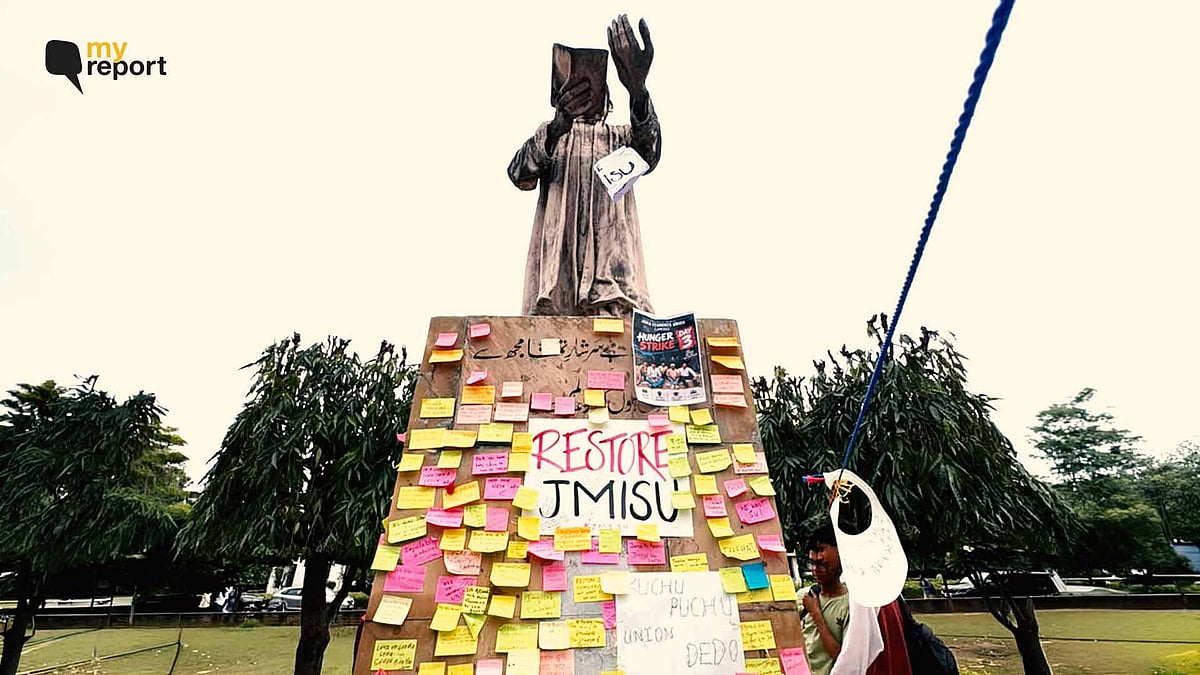
This October, that question has returned to the centre of campus life, with students launching an indefinite hunger strike demanding the restoration of the Jamia Millia Islamia Students’ Union (JMISU).
On 12 October, three students—Jasim Khan, an MA student in International Studies; Najmul Huda, a BTech student; and Ebin Basil, a BA LLB student—began the strike at Gate No. 18, the university’s designated protest site. The protest later moved to Gate No. 7 near the statue of poet Mirza Ghalib.
By 16 October, five students were on hunger strike, with others joining the demand for an elected union.
Jasim Khan, one of the first students to begin an indefinite hunger strike, now faces a campus ban imposed by the university authorities.
(Accessed by The Quint)
'Delhi Police Moved Us Without Warning'
The next day, the situation took a sharp turn when Delhi Police personnel arrived at Gate No. 7.
Syed Sugru (name changed), one of the protesting students, described what happened.
Heavy police deployment outside Jamia Millia Islamia on Monday as students continue their protest demanding student union elections.
(Accessed by The Quint)
Rehan, another student participating in the hunger strike, said the protesters were removed without any warning.
He added, “Nobody questioned what was happening, not even the security guards. The women protesting alongside us were also forced out, and the guards helped clear the spot. One of the guards even told us, ‘Upar se order hai, aap yahan nahi baith sakte’ (There are orders from above; you cannot sit here).”
Several students were detained by the Delhi Police but were later released.
Jamia students argue that an elected union could provide a collective platform to raise grievances over admissions, hostel conditions and campus policies.
(Photo: Ayat Adil)
'Disciplinary Action Against Students'
The university had already taken disciplinary action against some of the protesters. On 16 October, it rusticated Ebin Basil, a fifth-semester BA LLB student, for one year and barred him from the campus. It also imposed six-month campus bans on Jasim and Mohammad Ilmaan, a former student of the University Polytechnic’s Diploma in Civil Engineering programme.
On 19 October, Monday, the university announced a seven-member high-level committee comprising senior deans and professors. The committee is tasked with speaking to the protesting students, examining their demands and working towards restoring normalcy on campus.
In its statement, the university said it remained committed to resolving the matter through dialogue and expected students to cooperate.
Students gather along the road outside Jamia Millia Islamia as police personnel maintain a presence near the campus entrance amid ongoing protests.
(Accessed by The Quint)
The present administration, which took office in October 2024, said it wanted an amicable resolution to the nearly two-decade-old impasse.
'The Need for a Student Union'
For those of us studying at Jamia today, the absence of an elected students’ union is something we inherited. The renewed demand is rooted in everyday campus life: alleged irregularities in admissions, complaints about hostel facilities and food, disciplinary action against protesting students, and concerns about how students can collectively question the administration’s decisions.
An elected union would not automatically resolve these problems. It would, however, give students a recognised platform to raise grievances, seek explanations and hold their representatives accountable.
The current agitation did not emerge in isolation. In August, students began protesting over alleged irregularities in the spot admission process for the 2026-27 academic session. They questioned the decision to conduct spot admissions offline, unlike the online process followed in previous years, and to hold them after only two selection rounds.
According to the protesting students, some candidates lower on the merit list secured admission while higher-ranked candidates remained on waiting lists. The university rejected the allegations as "baseless", and maintained that its admission process was "transparent".
For a student who believes an admission decision was unfair, the issue goes beyond whether a list is revised. It concerns how the university explains its decisions, how students can challenge them, and whether their complaints receive a meaningful response.
Admission can determine whether someone secures a place after years of preparation, giving disputes over merit lists consequences that extend far beyond a single administrative decision.
The university has procedures for individual grievances. But when several students question the same process, they also need a way to organise their concerns and pursue answers collectively. An elected union could help bring together complaints from different departments, seek written explanations from officials and follow up on unresolved issues.
That does not mean a union should decide who gets admitted or override academic procedures. Its role would be to provide a recognised channel through which students can question how those procedures are implemented. Representation cannot guarantee the outcome students want, but it gives them a body they can elect, question and hold accountable.
'When the Complaint Is About Everyday Life in the Hostel'
For students living in university hostels, administrative decisions shape the most basic aspects of daily life, including food, hygiene and living conditions.
In September, students at the Jammu and Kashmir Girls’ Hostel protested over alleged repeated instances of insects and other foreign objects in mess food. They reported finding insects in chhole, worms in food, undercooked rice and glass shards in vegetables.
The university subsequently assured residents that the mess contractor would be removed and steps would be taken to improve food quality and hygiene.
Sania, a hostel resident, said poor food quality had long been a concern. “The food we used to get was never good. It was bad, and most of the time, we could not even eat it. Then a friend of mine found insects in the food. It was terrifying because it could make us sick," Sania told me.
She said students often ordered food from outside when they could not eat what was served, adding to their expenses. She also alleged that some residents who complained about hostel conditions were asked to vacate. These allegations could not be independently verified, and the university’s response was not available at the time of writing.
An elected union would not necessarily act effectively in every case. Its representatives could disagree with residents or fail to pursue a complaint. But elections would give students a means of questioning those representatives and replacing them if they failed to deliver.
'What Kind of Campus Do Students Want?'
For me, as for the students involved, the events of 17 October brought the debate into sharper focus. The original demand concerned who gets to speak for the student community. The confrontation raised another question: what happens when students try to make their collective voice heard and the protest itself becomes a point of conflict with the institution?
The demand for a students’ union has thus moved beyond elections. It has become a dispute over representation, dissent and the space students have to raise their concerns within their own university.
One can question the methods of a hunger strike, disagree with a student organisation or doubt that student politics will improve campus life. An elected union, too, would have to answer to those who elect it. But these concerns do not resolve the larger question of representation.
An elected union would not guarantee fair admissions, better hostel food or agreement with the administration. But it would allow students to choose their representatives, question their decisions and demand accountability.
Nearly 20 years have passed since Jamia last held students’ union elections. For those of us studying here today, the absence of a union is not simply a legacy of the past. It shapes the kind of participation we can expect in an institution that plays a significant role in our lives.
A university teaches its students to question the world around them. At Jamia, students are asking for more than a union: they are asking for a recognised way to question decisions, seek answers together and have a say in the institution they call their own.
(The Quint has reached out to Jamia Millia Islamia regarding the issues raised by the author and the students he has quoted in the article. The Quint has also reached out to the Delhi Police regarding the alleged use of force against the protesters. Their responses are awaited. The story will be updated as and when responses are received.)
(All 'My Report' branded stories are submitted by citizen journalists to The Quint. Though The Quint inquires into the claims/allegations from all parties before publishing, the report and the views expressed above are the citizen journalist's own. The Quint neither endorses nor is responsible for the same.)