'DU is Awake Now': What Jantar Mantar Protests Changed for DUSU Elections
For many DU students, the Jantar Mantar protest was the first time that politics went beyond a mobile screen.
advertisement
Amidst the din of the dafli, two young women watched as student leader Neha Bora urged the crowd to vote.
It had been a couple of weeks since Education Minister Dharmendra Pradhan had resigned—and Bora had ended her hunger strike. A crowd surrounded her at the gate of the Arts Faculty, singing around her.
The two women, who are post-graduate students of Punjabi at University of Delhi (DU), stood on the edge of the street, far away from the deafening chants of the students, but smiling as they looked at the crowd. They had never voted in a Delhi University Student Union (DUSU) election before. The Quint asked them if they were going to vote this year. The answer was a resounding 'yes'.
“There’s an excitement this time. Delhi University is awake,” Sehaj said.
Days after the protests at Jantar Mantar, thousands of first years and students returned to Delhi to attend their classes at DU. August and September, typically a month of great hullabaloo as freshers enter the red walls of North Campus, is also election time.
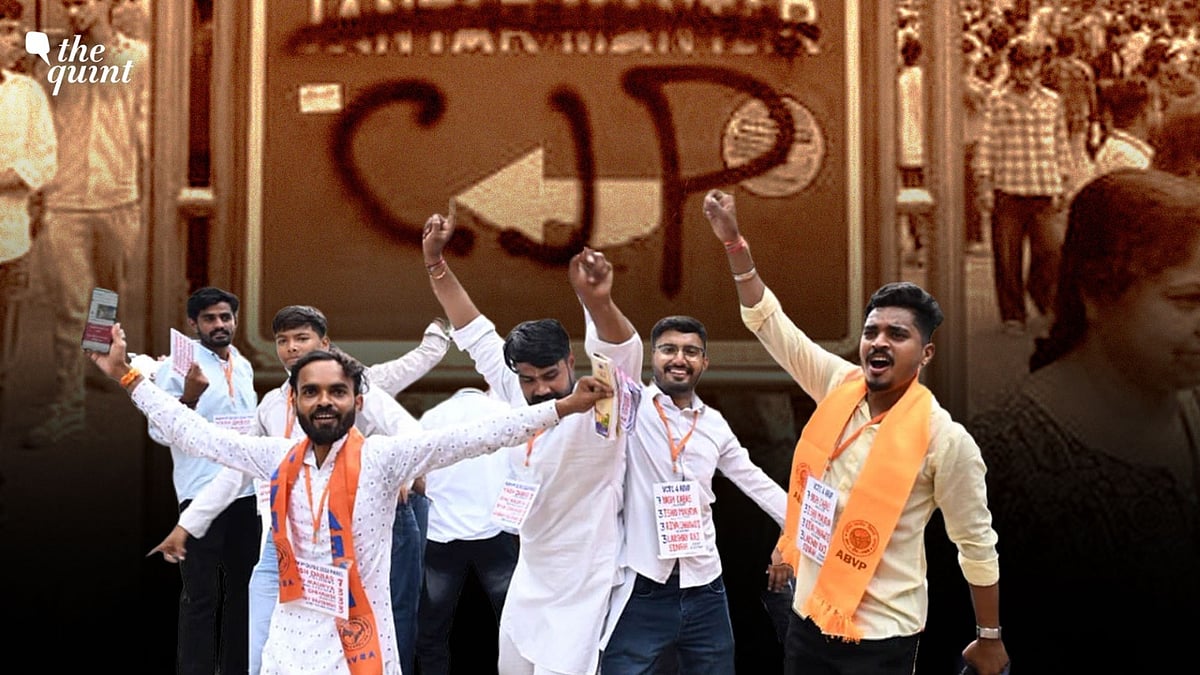
With elections to one of Asia’s largest university student unions due on 18 September, candidates roll through the streets each year in their customary Thar vehicles, waving hand-drawn posters, distributing free ice-creams and the endless onslaught of “hello, do you want to join my party?"
DUSU Elections, Then and Now
Established and inaugurated by Jawaharlal Nehru, the DUSU elections elects students to four major positions—President, Vice President, Secretary, and Joint-Secretary. Many call the elections a ‘jumpstart’ to mainstream politics with Arun Jaitley, Ajay Maken, and Rekha Gupta having previously held positions in DUSU in their college days.
While college-specific elections take place in each constituent college, DUSU was created as a student union in 1949 to represent a host of DU-affiliated colleges and campus departments. Student political organisations like the Akhil Bharatiya Vidyarthi Parishad (ABVP) and the National Students' Union of India (NSUI) have historically dominated elections, with huge member cadres in Delhi and affiliations to the RSS and Congress respectively.
The past few elections have had roughly 2.75 lakh strong eligible voters. And yet, in the past three years, the number of votes cast has remained below 60,000. Another sore point of the DUSU voter cadre has been the exclusion of some colleges, notably women’s colleges. Of the 90 odd colleges under the University of Delhi, only 52 vote in the annual DUSU election.
Yet, every year begins with great enthusiasm from competing student parties and campaigners standing at campus gates.
Last election season was not very different from the ones before. One interesting phenomenon of the 2024 and 2025 election was the high rates of NOTA votes counted. The Secretary and Joint-Secretary races in particular recorded NOTA shares of around 11-13 percent in both years.
'Students Have Become Politicised'
With a long record of student impassion and ‘campus’ issue-based manifestos, what impact are the Jantar Mantar protests likely to have on these elections and on the larger student culture of Delhi University?
The Quint found many students who had never voted before but said they planned to vote this year. Others spoke of a new willingness to question political authority, or of larger expectations that candidates should be willing to take issues beyond the campus and onto the streets.
DU's Walls of Democracy.
There was mobilisation not just from college students, but school children, workers, gig workers, etc. This year has come with hope for us and the people around us. This generation now knows that many fights can be won."
SFI’s Simran, Vice President of the Delhi Unit, echoed the message: “They know now that authority can be questioned.”
One such student, Arnav*, a queer first-year of Hindu College, spoke to The Quint about their experiences. "DUSU candidates should be someone who is really willing to fight for it. Aise hi nahi ki resume mein daal diya. (not just someone who applied for the sake of it). A good candidate is one who can go out on the streets and stay there. Someone who actually goes to colleges," Arnav said.
As per Arnav, most candidates usually only worked for themselves, which meant that expectations from the elections were low. Both on a micro and macro level, the student admits they didn’t really have much hope. Arnav also feels frustrated with the fact that the choice remains among the "lesser of two evils" in any election, even as the real issues remain out of sight.
“Why is the hostel fee Rs 75,000? Delhi-NCR people don’t get a seat in these hostels. How is this inclusive? The right candidate should talk about these issues,” Arnav adds.
These statements align with those of SFI and AISA leaders, who spoke of this election as a time of ‘hope’. Simran has noticed that students were beginning to recognise not only political organisations, but the people who had been physically present during the protests.
Simran feels that energy in the air. When elections come around, she expects this issue to appear prominently.
“With Jantar Mantar, Left politics got visibility across the country. Even the NSUI is now playing the dafli, typically associated with Left groups, at their protests under the hashtag #dafligang. Something that was very unexpected,” added AISA member Tanvi.
Will the 'Awakening' Convert into Votes?
Harshit Sharma, an ABVP member and Ex-Secretary of Shaheed Bhagat Singh College‘s ABVP unit recognised a similar change among students.
Harshit, however, remains confident that it’s more of a narrative game and not a ground reality. He doubts that the protest will transfer into votes these elections. “NSUI is in no way an alternative. I doubt this will transfer into anti-incumbency. NSUI has been at the back-end only of these protests. We care about student issues and regularly have outreach programs for the same. This is quite a temporary issue and we’ve already started working on it, and the Ranchi protest is also a hot topic amongst students.”
He noticed that the leaders that win are the ones that are most popular among the students. Aryan Mann, last year’s DUSU president, had been active on the ground for a while and was quite popular among students, he adds, stating that "popularity and grassroots connect still matters.”
NSUI, which was also present at Jantar Mantar, sees a similar increase in political engagement among students, though it expects existing loyalties to remain a significant factor.
Rehan Abdullah, former Secretary of NSUI Delhi and activist, who was present at the protest for around seven to eight days, said the movement had produced an “awakening” among students. He said this was particularly visible among first and second year students, many of whom had returned to Delhi and gone to Jantar Mantar to see the protests for themselves.
He also said that students appeared more engaged with the actual DUSU campaign than in previous years. In his experience as a returning agent during past elections, many students had treated polling day as a holiday rather than a political event. This year, he said, students were asking organisations what they stood for and "actually reading the manifestos put out by student groups".
“It’s a huge change,” he quipped.
He expects this increased engagement to translate into higher turnout, but does not believe longstanding caste, regional and political loyalties will disappear altogether. For him, however, the real test of whether Jantar Mantar has produced lasting political engagement will come at the ballot box.
“This election will be the litmus for it,” he said. "The change is already visible because people are actually asking us questions. Earlier, they didn’t pay any heed to it. ‘Okay, some organisation is rallying and all of that’, this was the attitude. But now they are genuinely interested: who are you, which organisation do you represent and all of that? So this will be the litmus, let’s see.”
At the same time, he argued that Jantar Mantar should not be viewed as a national political issue entirely separate from DUSU politics. “Jantar Mantar protest was a student issue,” he said. “The lathi charge and police brutality is what made it a national issue.” The core of the protest, he argued, remained the issues affecting students at the university — fees, examinations and the administration of different departments.
Potential voters The Quint spoke with expressed similiar concerns, including those who had not been able to physically participate at the protests due to being away for college vacations.
Varshini, a law student at the Faculty of Law who had voted for ABVP in the past, said, “What I expect from candidates has changed. Earlier, I was in support of ABVP. 2025 I voted for them. But this time I feel their reluctance or their approach towards all these protests was weaker than the other parties. I’m definitely looking for a better candidate.”
While the protest seems to have challenged the expectations students like Varshini used to hold for their candidates, loyalties may just remain unchanged. Varshini points out that if the candidate was from ABVP, she may still go for them.
Another student, Joshita* (name changed) who has both contested college elections and previously been affiliated with the ABVP, echoes the scepticism about Jantar Mantar's impact on political loyalties on campus. The question, she feels, is not whether Jantar Mantar was politically significant, but whether one protest can overcome the structures through which DUSU politics has traditionally operated for almost eighty years.
National vs Campus Politics
Political organisations have been trying to carry the momentum of Jantar Mantar into the election campaign. AISA’s victory march featured posters referencing the outfit’s role at the protests, while NSUI used the slogan ‘Sab yaad rakha jayega’ on posters around the campus. SFI’s Simran believes ABVP’s absence from the protests could hurt the organisation at the polls.
“ABVP was absent from the entire movement. In fact, their leaders were posting reels throwing ‘Hit’ at cockroach posters. Politically, I think it was a very bad move. But deep down, I think they also know that it’s political suicide." Simran said.
ABVP, however, remains confident that the election will ultimately be decided by more familiar concerns. The organisation does acknowledge a shift to some extent but does not expect the protests to translate into anti-incumbency. For many students like ABVP supporter Kunal who spoke with The Quint, electoral success is still primarily about visibility and grassroots connections. The organisation also believes existing political loyalties are difficult to dislodge.
Moreover, for many like Bidisha*, a first-time DUSU voter, a winning DUSU candidate should remain firmly rooted in university politics and not entangled in national issues.
Joshita sees a generational shift in the country's politics, but remains equally aware of the forces that could limit it.
“I think after this, our generation is becoming more [politically aware] compared to the previous generation,” she said. “I hope that this is just the start of the revolution.”
Jantar Mantar may have changed the way some students think about politics. For those who were there, it turned politics from something watched on a phone screen into something experienced physically — through crowds, chants, tear gas and police action. For others, it became an event followed from home, discussed online and absorbed into an already complicated political landscape. But one thing is for certain: the protests have changed the questions some DU students are asking of their representatives, and their expectations from the political leadership are more pronounced than ever.
All eyes are on the DUSU ballot box now.
*Names have been changed to protect identity of students.