
'If DUSU Showed Gen Z Had Spoken, What Explains Hyderabad University's Results?'
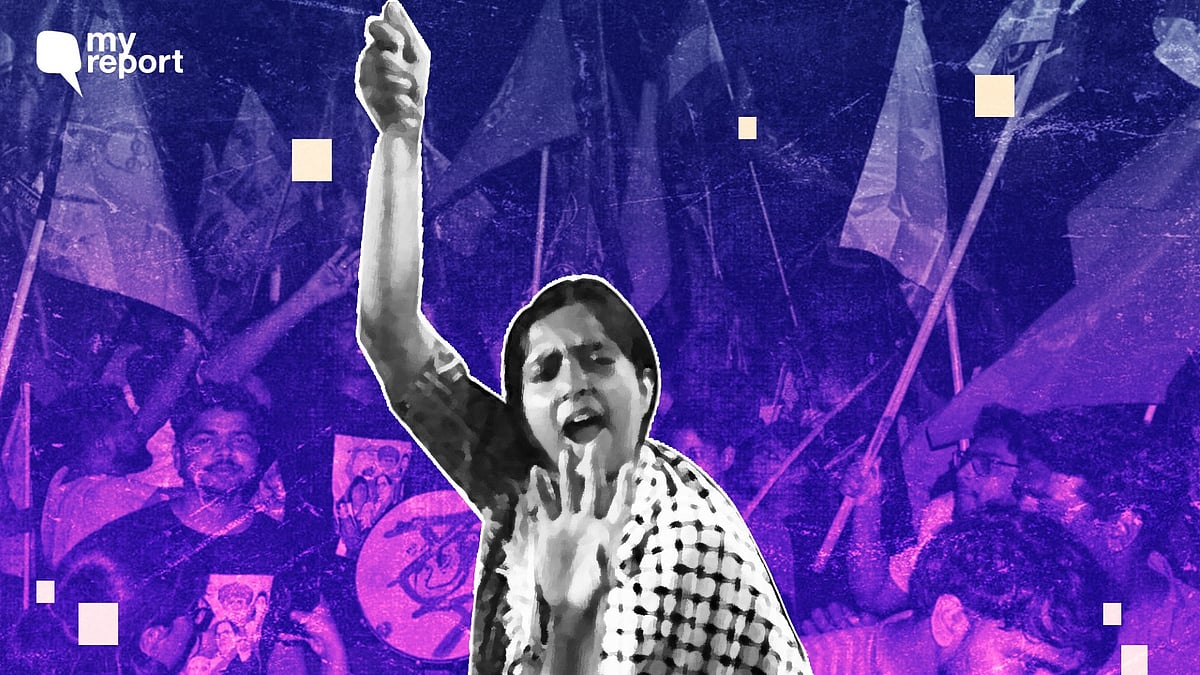
At UoH, Gen Z students make political choices shaped by identities, friendships, and concerns, writes a student.
advertisement
After Akhil Bharatiya Vidyarthi Parishad (ABVP) won three of the four central posts in September's Delhi University Students' Union (DUSU) election, one reading came almost immediately: "Gen Z has spoken".
President-elect Yash Dabas said the result showed Gen Z stood with the ABVP and the nation, and media coverage cast the election results as a window into a changing Gen Z political culture shaped by social media, protests, caste networks, housing, safety, and everyday campus concerns.
But can a student election really tell us what an entire generation believes? The DUSU result itself was more complicated than the three-out-of-four-posts headline suggested. ABVP won the president, secretary, and joint secretary posts, but independent candidate Deepanshu Shokeen, a former National Students' Union of India (NSUI) member, won the vice-presidency.
The presidential race was also relatively close, with Dabas receiving 24,576 votes against the NSUI's Vijay Shankar Meena's 22,523. Several other contests were also closely fought.
'Left-Ambedkarite Alliance Pays Off at UoH'
At the University of Hyderabad (UoH)'s recently concluded student union election, the alliance comprising the All India Students’ Association (AISA), Ambedkar Students’ Association (ASA), Dalit Students’ Union (DSU), Students’ Federation of India (SFI), and Tribal Students’ Forum (TSF) won:
All four executive posts—president, vice-president, general secretary, and joint secretary
PG and PhD Gender Sensitisation Committee Against Sexual Harassment (GSCASH) posts
The ABVP-SLVD (Sevalal Vidyarthi Dal) won:
Sports secretary
Integrated GSCASH post
Around 4,640 of roughly 5,900 eligible students voted, putting the turnout at 78 percent. Dilshada Raihan, who won the presidency, got 2,178 votes against Naresh P of the ABVP-SLVD's 1,727. ASA's Pratik won general secretary by 251 votes, and AISA's Sidhant won joint secretary by 399 votes.
'One Student, Several Political Choices'
The first student I spoke to was Ana, a recent graduate from the North East who had returned to campus for her convocation. She asked me not to use her full name.
There was a reason for her initial support for SFI. She said SFI cadres had helped her during the counselling and admission process. By her second year, she said, she had reassessed the organisations herself and continued to support the SFI for most positions. But she did not vote for the same organisation for every post. She voted for a North-East candidate on the ABVP panel because regional identity mattered to her.
“Candidates from the North East are very few here,” she told me.
She also voted for an independent candidate from her class whom she considered genuine, and for an NSUI candidate who was her friend. She described herself as politically centrist.
She said she considered SFI more pragmatic than AISA and believed that NSUI, despite being closer to her ideological position, was not performing strongly enough at UoH for her to support it.
For her, the ballot was not one decision about one ideology. It was several decisions made for different reasons. I found versions of that complexity in other conversations, too.
'We Meet, Greet, and Talk'
Her political disagreements did not remain entirely abstract.
Ana told me about an argument with a close friend from SFI after she declined an invitation to participate in a political activity. When he described her as a privileged general-category student, she reacted angrily. They stopped speaking for two days before another friend mediated between them. They eventually became friends again.
She also has close friends associated with ABVP. She said she had been invited by ABVP students to participate in cultural events. Because she was considered academically strong, she was also approached to participate in a study circle and lead a discussion around Shankaracharya. She declined to participate in organisational activities. Her friendships, however, did not disappear.
At UoH, some of his friends are associated with Muslim Students Federation (MSF) and the Fraternity Movement, organisations that contested against the SFI-led alliance this year. He told me that some of his MSF friends questioned why the SFI-led alliance had not included MSF despite attempts to build a broader progressive alliance. He personally felt MSF could have been included.
During campaigning, he said, a candidate from the opposing alliance accused SFI of being Islamophobic. He initially did not know how to respond. He later asked SFI leaders about the exclusion of MSF and was told that disagreements over identity politics, LGBTQ issues, and possible counter-consolidation had contributed to the decision.
Those explanations made sense to him, he said. Yet, he did not describe his relationships with those students in political terms alone.
That does not mean political differences were insignificant. It means that, in the experience he described to me, political disagreement and social relationships could exist at the same time.
'A Campus Where Politics Already Has a History'
The individual accounts make more sense in the context of UoH's political history.
UoH is not simply a smaller version of Delhi University. Its student politics has repeatedly been reorganised through alliances, splits, candidate choices, and memories of previous elections.
In 2018, the ABVP-OBCF (Other Backward Classes Federation)-SLVD alliance swept the six major posts after an eight-year gap. In 2019, the ASA-DSU-SFI-TSF alliance returned to power. The 2023 election again produced a broad coalition victory, while the 2024 presidential race was decided by only 18 votes in favour of A Umesh Ambedkar of the Left-Ambedkarite alliance.
Then, in 2025, ABVP-SLVD won all six of the major central posts that were being contested at the time. For students who have spent several years at UoH, these are not just old election results. They form part of how they remember the campus and its organisations.
A student who entered UoH recently, however, may encounter that history differently from someone who has spent several years on the campus. That difference matters because a political history can shape a campus without producing one uniform political experience.
'The Alliance Map Does Not Tell The Whole Story'
The 2026 contest itself illustrates this. The central contest was between three major alliances:
ABVP-SLVD
AISA-ASA-DSU-SFI-TSF
PDSU (Progressive Democratic Students Union)-MSF-NSUI-Fraternity
Minhaj Jamal, president of Fraternity Movement, argued that issues affecting Muslim students should not be treated as secondary to routine campus concerns. MSF president Haafid similarly questioned what representation meant within the alliance. “Fielding an individual Muslim candidate is not the same as representation of a Muslim student organisation,” Haafid told me.
These are competing political interpretations. The election result itself cannot settle them. But they show that even a coalition described as progressive can contain different understandings of representation, identity, and political priority.
And those disagreements do not necessarily map neatly onto individual students' votes.
'Students Remember The Last Election Differently'
Srinivas, a PhD student I spoke to, who has close relationships with leaders across the major organisations and has watched UoH politics for several years, offered a different explanation for the 2025 ABVP victory.
He said ABVP's "One Vote for Change" campaign had appealed to students who wanted to see what a different union could do. But, in his view, the organisation did not meet all those expectations after coming to power. This year, the rejoining of SFI and ASA, along with AISA, DSU, and TSF, changed the organisational landscape. The alliance was able to convert that configuration into a clear electoral majority.
'Some Friends Stopped Talking To Me'
Bhanu Prakash, an ABVP leader I spoke to, also described the election through relationships. He said some ABVP supporters were reluctant to openly share campaign material because they feared attacks or social isolation, particularly in schools where Left and Ambedkarite politics were strong.
“Some friends stopped talking to me after they came to know I was ABVP,” Prakash said.
His experience was different from that of the students who continued their friendships despite political disagreement. But it revealed another way politics could enter students' social lives.
The same student also questioned whether the wider Gen Z protest moment had much direct influence on the UoH election.
Srinivas disagreed to this. He thought the protests could have some effect on ABVP's support, including among some students who were unhappy with the Union government's handling of education-related controversies.
The disagreement itself is revealing. Two students looking at the same election could connect it to a wider political moment differently because they occupied different political and social spaces on campus.
'The Problem With Calling It 'Gen Z Politics''
A generation is useful for describing an age cohort. It becomes much less useful when it is treated as a ready-made political constituency. The students I spoke to at UoH belong broadly to the same generation. Yet, in the accounts they gave me, they inhabited different political and social worlds.
The distinction matters. Instead of asking what Gen Z believes as if it were one political constituency, a better question is what shapes students’ choices: their campus, friendships, organisations, everyday concerns, identities and the candidates on the ballot.
The election results reflect this complexity.
The students I spoke to did not describe themselves as voting simply as a generation. Their choices were shaped by their campuses, relationships, histories and social worlds.
So perhaps the question after DUSU is not what Gen Z has decided, but whether we were too quick to think of Gen Z as one political voter at all.
(Kanchi Dileep is an alumnus of the University of Hyderabad and Pondicherry University, with an academic background in Political Science.)
(All 'My Report' branded stories are submitted by citizen journalists to The Quint. Though The Quint inquires into the claims/allegations from all parties before publishing, the report and the views expressed above are the citizen journalist's own. The Quint neither endorses nor is responsible for the same.)
- Access to all paywalled content on site
- Ad-free experience across The Quint
- Early previews of our Special Projects
Published: undefined