
Rajasthan’s Sacred Groves Vs India’s Solar Ambitions: Why Are Locals Protesting?
Many orans still fall under the wasteland category, making their acquisition easy, reports Deepanwita Gita Niyogi.
advertisement
From coastal villages to forest heartlands, The Quint is telling the full story of how climate change is reshaping lives and ecosystems in India. Help us do more. Become a member.
Pankaj Bishnoi is a resident of Khetolai, a village in Jaisalmer’s Pokhran tehsil, which lies close to the international border and is best known for India’s twin successful nuclear tests conducted in 1974 and in 1998.
Here, the orans, or the sacred groves, are dedicated to Guru Jambheshwar, a spiritual leader revered by the Bishnoi community as its founder.
Pankaj Bishnoi, who grew up in this arid landscape, tells The Quint that in the desert, the existence and survival of communities depend on these deified biodiverse woodlands. “Every village typically has an oran characterised by high biodiversity, especially the unique khejri trees that can even survive in drought. The size of orans varies from 10,000 bighas (2,500 hectares) to 60,000 bighas (15,000 hectares). The oran in Khetolai covers 5,000 bighas (1,266 hectares),” Bishnoi says.
“Wildlife, and even our cattle, depend on them,” he adds.
Orans are biodiversity rich sacred groves.
(Photo: Sumer Singh Bhati)
'Why Can't Solar Projects be Confined to Rooftops?'
In 2024, the government launched the PM Surya Ghar Muft Bijli Yojana, a scheme that aims to provide subsidies to one crore households to install solar panels on their roofs. The subsidy will cover up to 40 percent of the cost of the solar panels.
Shalini Rai, a technical manager at the Rajasthan Renewable Energy Corporation Limited (RRECL) in Jaipur, notes that rooftop solar is incentivised with subsidies to promote solar energy among rural populations, especially farmers. “Rajasthan wants to promote renewables and remove the load from distribution companies in agriculture.”
But that is not entirely meeting India's goals. With a major push for solar energy, a crucial part of India’s climate commitments, vast stretches of land where these orans stand are being allocated to companies for ground-mounted solar installations, according to locals and activists.
A forest department official, speaking on condition of anonymity, explains that the relatively low cost of land in the desert initially attracted companies to the region, as it allowed them to reduce project costs. The other reason was the abundant availability of sunlight in the region.
According to Binit Das, a renewable energy expert at Delhi-based non-profit Centre for Science and Environment (CSE), rooftop solar power systems signal a strong move towards decentralised clean energy. According to a Press Information Bureau (PIB) report dated December 2025, 23.9 lakh households had installed rooftop solar systems toward the target of one crore households by March 2027 under the PM Surya Ghar scheme.
Ironically, Khetolai and several other villages in Jaisalmer district still lack power connectivity or face severe shortages.
Orans Are 'Deemed Forests'
Bishnoi alleges that another important reason oran lands are easy to take over is that they are not documented in government records. And yet, even as they are largely unowned and undocumented, they have been protected by local communities for centuries.
A Rajasthan forest department staff, who did not wish to be named, explains that orans were given the status of 'deemed forests' in a Supreme Court judgment, referring to the 18 December 2024 order that directed the recognition of orans in the state under the Forest (Conservation) Act, 1980.
The landmark order allows local communities with the rights to protect and conserve the forest resources for sustainable use. But, despite the court directive, many orans still fall under the wasteland category.
The forest department employee adds,
As the divisional forest officer of Barmer district, which is also a desert landscape, Savita Dahiya has documented 150 orans on 60,000 hectares.
She tells The Quint,
There are an estimated 25,000 orans in the arid and semi-arid area of Rajasthan, supporting a unique ecosystem. These biodiversity hotspots are critical for the conservation of the Great Indian Bustard. Once found across Uttar Pradesh, Odisha and Haryana, the bird is now found only in Rajasthan.
Besides the Great Indian Bustard, Sumer Singh Bhati from Jaisalmer's Sanwata village informs that there are caracals in the landscape, which he has documented.
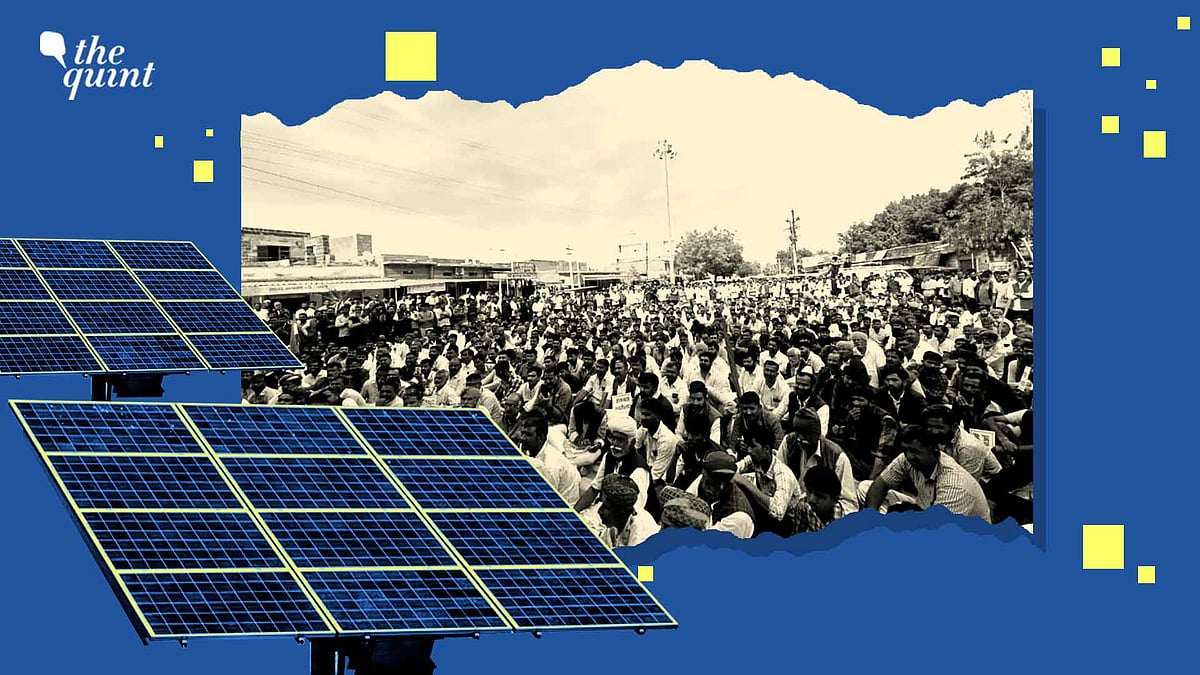
In a show of opposition, local residents launched a padayatra to register their protest against the diversion of their lands toward solar projects.
Local residents from several villages in Rajasthan launched a padayatra to protest land acquisition.
(Photo by: Sumer Singh Bhati)
Communities are registering protest against the acquisition of Oran lands for renewable projects.
(Photo by: Sumer Singh Bhati)
Problems with India's Solar Projects
In October 2025, the Indian government announced the country had surpassed its 2030 target of 500 GW of total installed electricity capacity. Of this, solar is a dominant source due to its cost competitiveness.
However, the CSE's Das points out that because rooftop solar remains underdeveloped, the government is relying heavily on ground-mounted installations, which demand vast tracts of land. There is a need for a balanced approach between centralised and distributed renewable deployment, he says.
In October 2025, the Indian government announced the country had surpassed its 2030 target of 500 GW of total installed electricity capacity.
(Photo: Akshita Jain)
There is another pressing issue.
Silicon, derived from quartz and purified for use in solar cells, is the key semiconductor material in solar energy. When photons from sunlight strike silicon, their energy excites electrons, setting them in motion and producing electricity through the photovoltaic effect.
Das explains that India imports almost 60-80 percent of its solar manufacturing units, including silicon cells and wafers, from China, hiking up costs. "These cells are typically six to eight inches in size in modern modules (or solar panels),” he says, adding, "We currently lack large-scale polysilicon and wafer manufacturing capacity."
From 1 April 2026, China is set to abolish the VAT export rebates for solar photovoltaic products like silicon. This is expected to further raise the cost of solar panels and energy storage systems globally.
India is also a major exporter of solar panels to the US, with over 90 percent of its solar module exports in the financial year 2023-2025 destined for the US. But, as of 25 February 2026, the US Department of Commerce imposed preliminary countervailing duties of 126 percent on solar cells and modules imported from India.
Storage, too, poses a challenge—particularly for off-grid projects that operate independently of the main utility grid.
Off-grid solar systems depend on batteries—most commonly lithium-ion—which are currently in short supply in India, says Sanjeev Jain who has retired from the Chhattisgarh State Renewable Energy Development Agency. But the government has prioritised grid readiness, transmission expansion, and energy storage deployment as integral components of development of renewable energy sources in the country, says a PIB report dated 23 March 2026.
Jain further points out that 40 percent custom duty is imposed on imports to promote Make in India. Though India assembles modules or panels domestically, companies like Waaree Energies, Tata Power, and Adani Solar have started manufacturing solar wafers to reduce dependence on imports.
Tarang Khurana, who runs Raipur-based Icon Solar-en Power Technologies, a solar panel manufacturing unit in Chhattisgarh, is optimistic about change. He says the Indian market is growing—and the ecosystem is gradually strengthening.
In reality, even as land is being acquired for solar projects like that in Jaisalmer, India is still dependent on coal. The country's 427 million tonnes per annum (MTPA) of planned new coal mine capacity places it second globally after China with 596 MTPA.
“India must focus on wind to complement solar,” says Das. The National Wind Solar Hybrid Policy issued in 2018 could make this possible. The wind energy installed capacity reached 53.99 GW in November 2025, which is an increase of over 12.5 percent as compared to the 47.96 GW in November 2024, according to a PIB report.
Also, as of November 2025, India is building about 59.24 GW of hybrid (wind and solar) renewable energy projects that can supply clean electricity round the clock, even when sunlight or wind is not available.
Development vs Environment: The Way Forward
Back in Rajasthan, as of 28 February, the sanctioned number of standalone solar pumps was over 13.3 lakh against 10.2 lakh installed under the Pradhan Mantri Kisan Urja Suraksha Evam Utthaan Mahabhiyan (PM-KUSUM), launched in 2019.
Rai explains that the oran lands were inadvertently allotted to some developers, but the decision is now being reconsidered in the face of public opposition.
Dahiya, on the other hand, says that locals initially raised objections, but a public hearing was held on 26 January, where these concerns were recorded, and authorities maintained that the fears were unfounded.
“The chief reason for the objections is that many people feel that once declared as 'deemed', the ownership of orans may pass on to the forest department. Others feel that their cattle entry would get obstructed. Some also think that they would lose ownership of water harvesting and storage structures and micro percolation tanks inside orans," says Dahiya, adding, "But it is a misconception.”
However, Sujit Narwade, Deputy Director of the Bombay Natural History Society, sounds a note of caution, saying that if renewable projects come up in wildlife habitats, the Thar Desert’s biodiversity could be severely impacted.
He feels that some critical areas, which have species like the Great India Bustard, should be locally conserved—and common lands documented systematically to prevent acquisition.
In Himachal Pradesh’s Spiti Valley, 13 sites for large-scale solar parks were scrapped as these would have impacted the snow leopard habitat.
A gathering of protestors.
(Photo by Sumer Singh Bhati)
As part of an MoU with RRECL, the Government of Rajasthan’s nodal agency to develop solar parks, the Adani Renewable Energy Park Rajasthan Ltd is developing a 500-MW-capacity solar park in Jodhpur's Bhadla, and 1,500-MW-capacity solar park in Jaisalmer's Fatehgarh. The latter will be spread across 9,981 acres (4039.167 hectares).
The Indian government has sanctioned a total of 50 solar parks with an aggregate capacity of 37,490 MW in 12 states across the country under the Solar Parks Scheme since 2014.
(Deepanwita Gita Niyogi is a New Delhi-based freelance journalist.)
- Access to all paywalled content on site
- Ad-free experience across The Quint
- Early previews of our Special Projects
Published: undefined