
What’s at Stake in the Aravallis? Mining Threats, Wildlife, and Tribal Heritage
Mining lobbies and legal battles threaten the Aravallis' ecology and cultural heritage in Rajasthan.
advertisement
Inside a forest nursery—home to Alwar's divisional forest office—a unit of the Rajasthan Armed Constabulary (RAC) is stationed. It was the RAC that assisted former divisional forest officer Apoorva Krishna Srivastava in stopping the mining mafia in its tracks and carrying out rewilding in 2021 in Kahrani, a village near the district’s Bhiwadi industrial hub, and an integral part of the Aravallis.
One of the oldest mountain ranges in the world, the Aravallis are rich in biodiversity and stretch across northwestern India, spanning the National Capital Region (NCR) as well as parts of Haryana, Rajasthan, and Gujarat.
Historically recognised across up to 37 districts, the range has, over the years, been severely degraded by illegal stone crushers who have denuded large stretches and stripped them of native vegetation.
Speaking to The Quint, Satish Naruka, a ranger in the Kishangarh Bas area in Alwar, says, “At present, maintenance work is on as part of the regeneration project under which native tree species were planted."
In Naruka's range, almost 100 hectares have been covered with 20,000 saplings after illegal mining was stopped.
Views of the Aravallis from Udaipur’s Amarpura and Puduna villages.
(Photo: Deepanwita Niyogi)
However, the ongoing legal tussle on the Aravallis has created uncertainty that could undo conservation gains and open the region up to further illegal (and even legal) mining.
Legal Uncertainty, Mining Pressure, and the Battle Over the Aravallis
Though the Aravallis stretch across several districts of Rajasthan, Alwar—about 140 km from Delhi—has long been a hotspot for stone crushers. According to the state Department of Mines and Geology’s website, 318 minor mineral leases have been issued in the district.
Mining in the Aravallis has long been a contentious issue, but it came into sharp focus after a Supreme Court judgment delivered on 20 November 2025 defined the range solely on the basis of elevation.
The ruling triggered widespread public outcry, as it would effectively exclude hills below the 100-metre threshold above local relief from being classified as part of the Aravallis.
Following widespread protests, the apex court stayed its earlier order on 29 December.
Now as a new definition of the Aravallis is awaited, the Supreme Court has also sought clarification, through a suo motu writ petition, on whether the claim that only 1,048 of Rajasthan’s 12,081 hills meet the 100-metre elevation threshold, thereby stripping the remaining ranges of environmental protection, is factually and scientifically accurate.
Rajasthan has followed the 100-metre definition of the Aravallis since 9 January 2006.
The campaign, running until 15 January 2026, is a joint operation involving personnel from the mines and geology, revenue, police, and forest departments to inspect and curb illegal mining in the Aravallis.
Denuded Aravallis in Alwar district of Rajasthan as a result of illegal stone crushers.
(Photo: Deepanwita Niyogi)
Apart from Alwar, Kanaram Sirvi, the district collector at Sawai Madhopur, informed The Quint about the formation of special teams on 5 January.
All the seven blocks in Sawai Madhopur have teams now to inspect stone crushers and riverbed sand extraction as part of the Rajasthan government’s campaign against illegal mining.
In addition to stone mining in the Aravallis, illegal sand mining continues in the Chambal, India’s cleanest river, renowned for its gharials, despite an official ban.
Dholpur, a district in eastern Rajasthan which shares a border with Madhya Pradesh, too, has considerable sand mining on the banks of the Chambal.
More than just Mountains: The Aravallis’ Cultural and Spiritual Significance for Tribal Communities
The Aravallis not only check the expansion of the Thar desert, but also holds a special place as far as tribals belonging to the Meena, Bhil and Gameti communities of Rajasthan are concerned.
Dhuliram Meena, a resident of Banda village in Sawai Madhopur district, famous for the Ranthambore Tiger Reserve, said the Aravallis converge with the Vindhya mountain range in the district.
He added,
A Gameti household in Udaipur district of Rajasthan. Since ancient times, tribals have maintained deep ties with hills and forests which are revered in their world view.
(Photo: Deepanwita Niyogi)
Meena added that his community has long held the Aravallis in deep reverence and voiced concern over the spread of Prosopis juliflora, an invasive thorny species that has destroyed native vegetation cover.
Nathibai Meena, a resident of Karget village in Udaipur district, also spoke about the region’s religious and cultural ties to the hills. Located about 790 km from Delhi, Udaipur lies in southern Rajasthan and is known for its lakes, including Pichola and Fateh Sagar.
A Gameti woman with her livestock.
(Photo: Deepanwita Niyogi)
Apart from the temple, the Aravallis support a vast forest area in Karget, which has been protected and conserved through community efforts over the years.
Traditional management ensures sustainable practices in this forest spread over 2,318.39 hectares.
Local Stewardship, and the Fight to Protect the Hills
Rajkaran Yadav, who runs the non-profit Hanuman Van Vikas Samiti working in Karget and nearby villages, said many people fear that classifying the Aravallis solely by height would ultimately destroy the hills.
To do his part, Yadav has started a campaign to mobilise the public to protect the region’s natural resources, grow native trees, and remove weeds.
According to Yadav, the tribal way of life has long been deeply intertwined with the natural world. While this connection has weakened to some extent in recent years due to migration in search of livelihoods elsewhere, it remains deeply valued, with communities recognising the mountains’ role in water and soil conservation.
Bhurelal Gameti runs a small-scale brick manufacturing unit where Nathibai and other women from Karget work daily. He said the government permits once allowed limited, small-scale activity in nearby hillocks through a local tribal shramik society in Karget, but this was shut down around 10 years ago.
Though illegal mining is now stalled, according to information available on the Department of Mines and Geology website, there are 178 active major minerals leases and 429 active minor minerals leases in Udaipur.
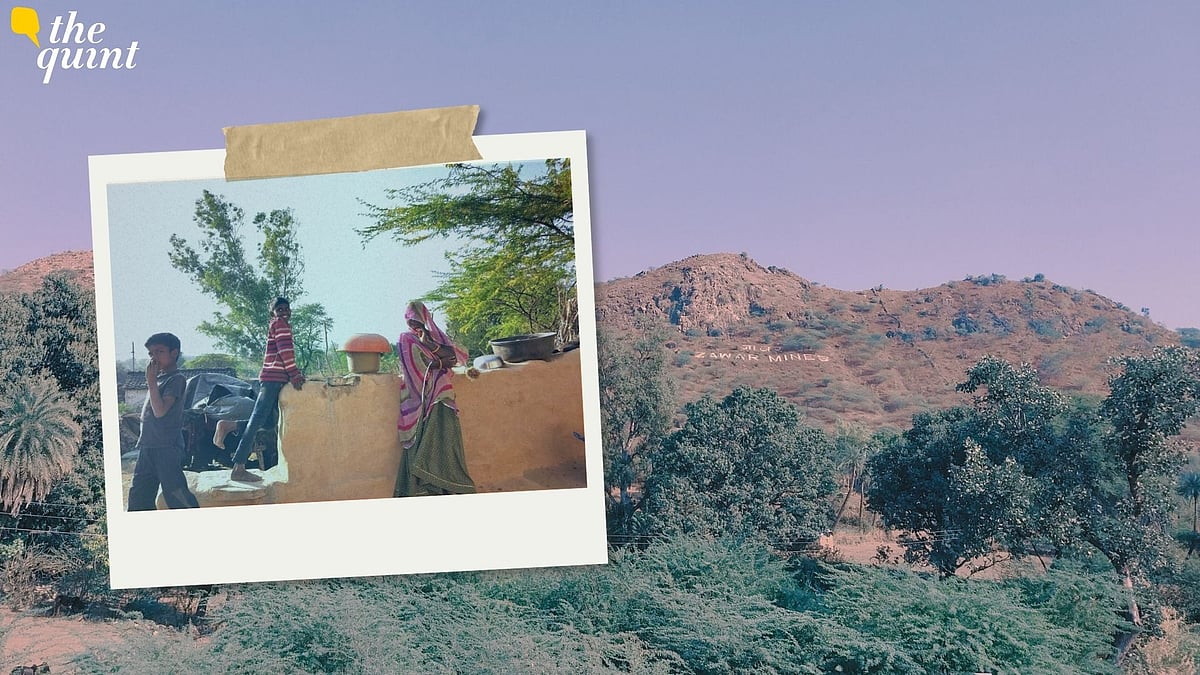
Udaipur district falls under the Southern Aravalli range and is well-known for the Zawar Mines.
(Photo: Deepanwita Niyogi)
Adverse Impact on Wildlife
In a state where human-leopard conflict is high, the destruction of the Aravallis through large-scale mining activity will only serve to escalate the issue.
However, the report states that the leopard population estimates for Rajasthan was restricted to current and proposed tiger reserves only.
Conservation ecologist Shantanu Sharma explained that protected areas, such as national parks and tiger reserves, are off-limits to human activities like mining. In addition, the mandatory eco-sensitive zones around these areas, which extend at least one kilometre, are also protected to help safeguard wildlife and biodiversity.
However, as leopards have increased in number even outside protected areas due to several factors, the state has started a comprehensive leopard census, and the results will be out in July 2026.
Rajasthan’s Udaipur district has nearly 150 leopards. So, conflict with humans is common across several villages.
(Photo Courtesy: Shantanu Sharma)
Although protected areas are officially excluded from mining, its impact can still disturb wildlife.
For instance, Ranthambore has 87 leopards and around 63 tigers according to a National Tiger Conservation Authority report, and at present, there is a ban on mining.
But, Dhuliram Meena noted that illegal mines in villages such as Uliyana, Rawal, and Charoda, which fall within the Kundera range of the Ranthambore Tiger Reserve, are disrupting tigers.
Forest guard Seema Meena said the range is close to the road, and despite increased surveillance, locals often ignore regulations and carry out secret mining activities.
Sariska’s tiger tracker Kaluram Gujar informed that though Sariska does not have disturbances due to mines in the critical habitat or core area, the buffer zone is not completely free from impacts due to the blasting operations.
Illegal mining was ongoing 20-25 km away, but has now been halted for inspection. Forest guard Giriraj Singh, posted at the Sariska Tiger Reserve, said that of the reserve’s five ranges, mining in the Talvriksh range has been closed for the past 12 months.
Rethinking the Aravallis’ Classification Before It’s Too Late
A source, who did not wish to be named, explained that if hills under 100 metres are not classified as such, the Aravallis would be finished.
A view of the Chambal River from Palighat, Sawai Madhopur. The Chambal faces the threat of sand mining.
(Photo: Deepanwita Niyogi)
The source added, "It is also the reason that the buffer area in Sariska was reduced. Wildlife is not always restricted to the core area. Even outside the protected areas, the Aravallis are an important biodiverse area.”
According to retired Indian Forest Service officer Mohan Pargaien of the Telangana cadre, the ecological significance of the Aravallis is well established. Now serving as an advisor to the Singareni Collieries Company, Pargaien believes there is no one-size-fits-all rule, as some landscapes naturally hold greater potential for water conservation and biodiversity preservation.
That is why classification should be area specific, and not height specific. As the Aravallis await a new definition amid public protest, Sharma reiterated that even small hillocks can support animals like hyenas and foxes.
(Deepanwita Gita Niyogi is a New Delhi-based freelance journalist.)
- Access to all paywalled content on site
- Ad-free experience across The Quint
- Early previews of our Special Projects
Published: undefined