
US President Donald Trump surprised the world when he recently posted on Truth Social that the US and Iran have had “very good and productive conversations regarding a complete and total resolution of our hostilities in the Middle East”.
He went on to declare in his 23 March post that “based” on these discussions, he had ordered US defence forces to “postpone” all military strikes on Iran’s “power plants and energy infrastructure for a period of five days". This pause will be over on 28 March.
With Trump’s post, global oil prices went down and stock markets went up. They had gone in opposite directions following his earlier warning that the US would destroy Iran’s power production if it did not immediately open the Strait of Hormuz.
Tehran did not do so. A few hours after Trump’s post, Esmaeil Baghaei, spokesperson of Iran’s Foreign Ministry, posted on X, “Messages from the US, sent via friendly countries to seek talks and end the war were sent and answered in line with Iran’s principles”.
In his media responses, Trump had maintained “I didn't call, they called. They wanted to make a deal”.
It is commonly seen during wars that no belligerent wants to acknowledge that it took the initiative to begin talks unless it has been defeated. What generally happens is that intermediaries tend to convey to belligerents that all parties in the conflict wish to seek a way out. In all likelihood that has occurred in this war too.
Pakistan as a Mediator?
Sections of the international media have reported that Oman, Pakistan, Egypt, and Turkiye are seeking to ‘mediate’ between the US and Iran. Significantly, all the four countries are Islamic, though they are Sunni-majority states. Leaders of all these states are in contact with their Iranian counterparts.
Of these countries, it is Pakistan that is the most eager to host US-Iran talks.
On 24 March, Prime Minister Shehbaz Sharif stated on X, “Subject to concurrence by the US and Iran, Pakistan stands ready and honoured to be the host to facilitate meaningful and conclusive talks for a comprehensive settlement of the ongoing conflict”. Earlier, the official spokesperson of the Pakistani Ministry of Foreign Affairs had conveyed much the same to sections of the media.
The Iranian reaction to the idea of talks between the US and Iran has stretched from being outright dismissive and negative to the use of the word, by one unnamed Iranian official, "speculative".
A prominent international news agency has reported that an Iranian ‘source’ has told it, “There has been outreach between the US and Iran, initiated by Washington, in recent days, but nothing that has reached the level of full-on negotiations. Messages have been received through various intermediaries to scope out whether an agreement to end the war can be reached. The proposals being looked at are aimed not merely at achieving a ceasefire, but a concrete agreement to end the conflict between the US and Iran”.
Iranian responses to the opening of the doors of diplomacy between the US and it, through intermediaries, to end the war have moved towards more definiteness.
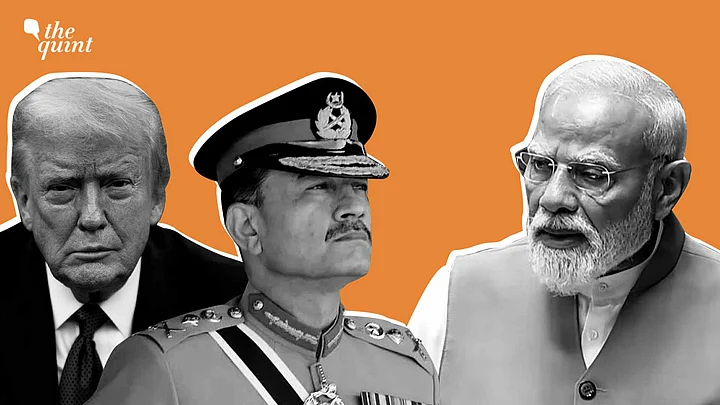
Pakistan is obviously keen to be the venue of US-Iran talks. Apart from the public offer by Sharif, Field Marshal Asim Munir, Army Chief and Chief of Defence Forces of Pakistan, has reportedly talked to Trump to advocate his country’s ability (naturally with his involvement) to become the main intermediary for US-Iran talks.
Munir is not only Trump’s ‘favourite Field Marshal’, but he may have access to the Islamic Revolutionary Guard Corps' leadership. Pakistan’s civilian leadership would not have that. A respected international newspaper has reported that the US has given a 15-point proposal for ending the war which Munir has conveyed to Tehran.
Notable Shifts, Geopolitical Implications
These reports cannot be dismissed even though it is unclear if Iran’s Supreme Leader Mojtaba Khamenei is in a position to take decisions. If he cannot do so, it is unlikely that any other person in Iran can take vital decisions for peace-making, including lifting the choke on the Strait of Hormuz.
The Iranian system is resilient enough to keep fighting and deft enough to play the diplomatic game, but decisions on crucial matters of war and peace can only be made by the top leader.
Pakistan will claim great diplomatic success in the event that Islamabad or any other location in the country becomes the venue for US-Iran contact. This will be especially so if the US delegation is led by Vice President JD Vance and Secretary of State Marco Rubio. In that event, the Iranian delegation, too, will be led at a senior level.
The choke on the Strait of Hormuz has already begun to cause an energy crisis in the world. This will get progressively more severe. Hence, the world’s eyes will be on the talks and Pakistan as the intermediary—because talks will take place, at least initially, in an indirect mode—it will seek to derive the maximum advantage to burnish its current image of a state with multiple and deep problems. It will attempt to project itself as a security provider in the region.
Pakistan-Iran-Saudi Ties & Shia-Sunni Politics
In the 1990s, a sustained proxy sectarian conflict occurred in Pakistan fuelled by Saudi Arabia as the champion of Sunni Wahhabism—and Iran as the bastion of Shia Islam. Conservative estimates put the death toll from this violence at around 1,000.
Pakistan is a Sunni-majority state and its state apparatus is tilted towards the Sunnis. The Pakistani state came under great pressure from both Saudi Arabia and Iran, Pakistan’s neighbour. It tried to navigate between them, but its inclinations and interests lay with Saudi Arabia.
Pakistan and Iran's relations were always testy but neither country ever let them break down despite a lack of trust. By now, Pakistan has contained sectarian violence but the fissures between the two branches of the faith are deep and abiding.
In light of the past, Pakistan’s keenness to provide a venue for US-Iran talks is a sign that it wants to overlook the difficulty it has had in dealing with Iran previously. Should the talks take place in Pakistan, it would indicate that Iran has sought a venue that is convenient to it in current circumstances. This convenience is because of Pakistan’s geography and it can be projected that it is part of the Ummah.
Pakistan has a Defence Pact with Saudi Arabia. It is also dependent on it for its macroeconomic stability. The Saudis would have given a green light to Pakistan to seek to host US-Iran talks. This way they would know exactly what is taking place.
Trump called Prime Minister Narendra Modi on 24 March. Earlier, External Affairs Minister S Jaishankar had spoken to Rubio. Naturally, the priority for both countries is the opening of the Strait of Hormuz.
That is what the Indian readout of the conversation stressed. The question is, if Trump’s call to Modi in the midst of possible US attempts to get Iran to accept peace largely on US terms, is to assuage Modi’s feelings in advance should the talks be held in Islamabad?
(The writer is a former Secretary [West], Ministry of External Affairs. He can be reached @VivekKatju. This is an opinion piece, and the views expressed above are the author’s own. The Quint neither endorses nor is responsible for the same.)
