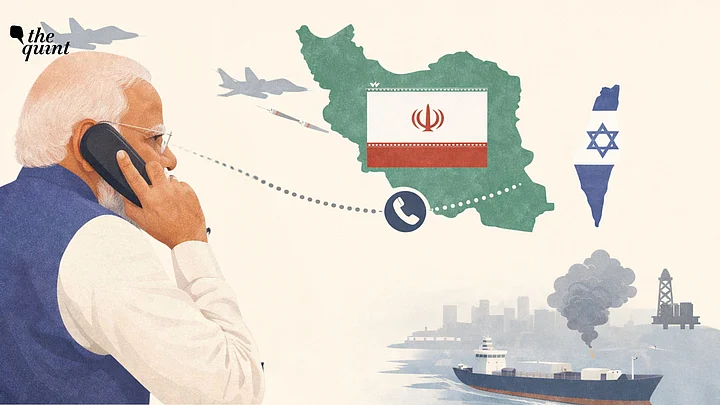
On Thursday, twelve days after the Israeli-American attack on Iran, Prime Minister Narendra Modi picked up the phone to talk to President Massoud Pezeshkian of Iran.
In those twelve days, the geopolitics of West Asia had changed, and it would appear at first sight that India was sleeping. In a social media post, Modi said that he had expressed “deep concern over the escalation of tensions and the loss of civilian lives as well as damage to civilian infrastructure.”
India remained silent when, in the opening hours of the attack, Iran’s supreme leader, Ayatollah Ali Khamenei, was targeted and killed along with members of his family. India was silent when a strike on a school led to the deaths of some 60–170 civilians, mainly schoolchildren.
India remained silent when over 100 Iranian naval personnel were killed when their ship, returning from an Indian Fleet Review at Visakhapatnam, was torpedoed and sunk near Sri Lanka.
It is true that on the outbreak of hostilities, the Ministry of External Affairs had issued a statement expressing “deep concern” and urging all sides to exercise restraint, avoid escalation and prioritise civilian safety. Also, External Affairs Minister S. Jaishankar had spoken on the telephone with his Iranian counterpart Abbas Araghchi. But this was neither to condemn the wanton attack on Iran in breach of the UN Charter nor to condole the passing of its Supreme Leader. It was a routine expression of India’s “deep concern” and call for de-escalation.
On the same day, Jaishankar spoke to Israeli Foreign Minister Gideon Sa’ar with a similar message of concern and the need for de-escalation.
Outreach to Gulf Leaders
On 1 March, Prime Minister Modi spoke with UAE President Sheikh Mohammed bin Zayed Al Nahyan and condemned attacks on the Gulf nation, without mentioning Iran, and reiterated support for regional stability. In the next few days, he spoke to the King of Bahrain, the Emir of Qatar, the Crown Prince of Saudi Arabia, the Sultan of Oman, the Crown Prince of Kuwait, and the King of Jordan.
He also spoke to Benjamin Netanyahu and discussed the situation in West Asia, conveyed his concern at the developments there, and called for an early end to hostilities.
But he did not speak to the leader of the country that had been attacked by the US and Israel and which had, in retaliation, attacked its Gulf neighbours where the US had several military bases.
Jaishankar’s Statement in Parliament
Following the intensification of the conflict and growing criticism of New Delhi’s one-sided stand, on March 9 Jaishankar made a suo motu statement in the Lok Sabha reporting on the situation, its impact on regional infrastructure and efforts to safeguard citizens.
He said that there were three guiding factors guiding the Indian approach:
India was in favour of peace and urged a return to dialogue and diplomacy, while seeking de-escalation and the safety of citizens.
The well-being and security of the Indian diaspora in the region was “our overriding priority.”
India’s national interest, including energy security and trade flows, “will always be paramount.”
But the national interest did not apparently extend to the need to condemn an attack on Iran and the assassination of its leader.
Continued Contact Between Tehran and New Delhi
On Thursday night, the Iranian Foreign Minister dialled Jaishankar for the fourth time, and Jaishankar tweeted that they had discussed bilateral matters and BRICS issues. An Iranian readout said that Araghchi had briefed Jaishankar on the latest situation arising from the US-Israeli attack and its consequences for the stability and security of the region and the world.
The Minister told Jaishankar that it was Tehran’s firm determination to exercise the “legitimate right to self-defence.”
“Araghchi emphasised the need for international and regional forums and organisations to condemn military aggression against Iran,” the readout said.
“Referring to the importance of the role and position of BRICS as a forum for developing multilateral cooperation, he considered it essential for this institution to play a constructive role at the current juncture to support stability and security in the region and the world,” it added.
But New Delhi underscored that it had, in effect, taken sides in the war when, on March 12, it co-sponsored a Gulf Cooperation Council resolution at the UNSC condemning Iranian attacks on Gulf countries. The resolution called on Iran to immediately stop such actions.
One could get the impression that Iran allegedly attacked sites in neighbouring countries entirely of its own accord and out of malicious intent. While the facts of the matter are that the current crisis is rooted in entirely unprovoked aggression by the US and Israel against Iran.
In fact, Russia proposed a counter-resolution that would condemn all attacks on civilians, without assigning blame. But this was not acceptable to the sponsors.
Why Did Modi Call After Twelve Days?
The big question obviously is: Why did Prime Minister Modi pick up the phone after 12 days?
Not to condole Ayatollah Khamenei’s death, which in protocol terms New Delhi says had been done when Foreign Secretary Vikram Misri signed the book of condolence at the Iranian embassy in New Delhi on March 5.
Not to condemn the US-Israeli bombing, because that is not mentioned in the Indian readout.
Not to call for a cessation of hostilities, though he did reiterate India’s “consistent position that all issues must be resolved through dialogue and diplomacy.”
His call was motivated by scenes across India when the country was suddenly hit by a shortage of LPG cylinders. Many of the demonstrations were a panic reaction, while the government’s own gauche handling of the issue created further problems. Essentially, he was seeking to obtain Iranian acquiescence for “unhindered transit of energy and goods” for India.
And sure enough, Iran responded with a measure of generosity and self-interest when its ambassador announced on Friday that, in the interests of Indian-Iranian friendship, it would permit Indian ships to transit the Hormuz Straits.
Almost immediately, an LPG tanker sailing to India came through without any incident, and another tanker was expected to pass through the straits thereafter.
Silence Towards Washington
In all this, the most striking thing is that there have been no calls made to Washington, which began this war whose consequences are now lapping at our shores. All there have been are conversations between Indian officials and US officials who were in India for the Raisina Dialogue.
The last Modi call to Trump was on 2 February, when the US announced a reduction in tariffs on India.
In his suo motu statement in Parliament, Jaishankar did mention that throughout the recent weeks India had maintained contact with relevant countries, noting that the Prime Minister had spoken to the President of the UAE, the Amir of Qatar, the Crown Prince of Saudi Arabia, the King of Bahrain, the Sultan of Oman, the King of Jordan and the Prime Minister of Israel. He noted the contacts with his counterpart in Iran.
But “insofar as the United States is concerned, we have maintained regular contacts through diplomatic channels.”
A Muddled West Asia Policy
If anything, this brings out New Delhi’s shoddy response to the West Asian war. While the government has correctly identified the paramount importance of energy flows for India’s national interest, it seems to have made little effort to deal with the principal perpetrator of the West Asian crisis — the United States.
It is another matter that a week ago, out of the kindness of its heart, Washington “allowed” India to buy Russian oil for another 30 days.
Ostensibly, India is taking what it thinks is a proactive, pragmatic and multi-aligned approach to the developments in West Asia. But the reality is that it is essentially tailing the US and Israel in its current policy, even while claiming that it is being pragmatic.
If the policy appears to be muddled, it is muddled.
(The writer is a Distinguished Fellow, Observer Research Foundation, New Delhi. This is an opinion piece and views expressed are the author's own. The Quint does not endorse or is responsible for them.)