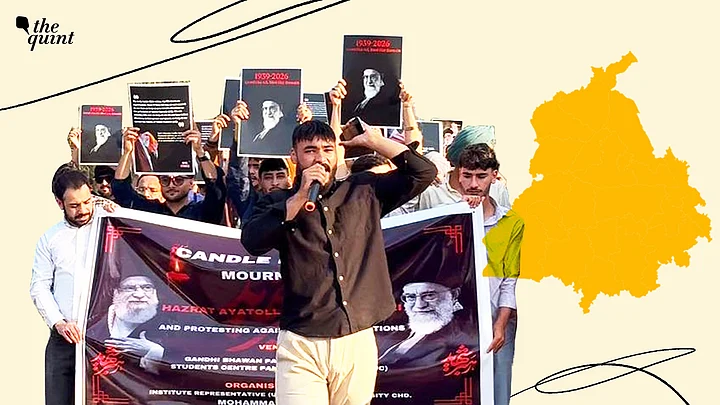
The manner in which Iran’s Supreme Leader Ayatollah Ali Khamenei was assassinated in an Israeli attack and the subsequent killing of 160 innocent schoolgirls in an American air strike have resonated deeply in Punjab.
From political parties to civil society organisations and farm unions, several sections of Punjabi society have expressed solidarity with the people of Iran.
The Punjab Vidhan Sabha, on March 6, paid tribute to Ayatollah Khamenei as well as to the innocent schoolgirls who were killed in the bombing by Israel and the United States. MLA Sukhwinder Sukhu, who introduced the motion of condolence, described it as a great humanitarian tragedy.
Congress MP Dr Dharamvir Gandhi also posted on his social media opposing the US–Israel attack on the sovereign nation of Iran. People in Ludhiana, Punjab, took to the streets to protest against the assassination of Khamenei. Protests were also held in Panjab University.
On March 9, a delegation of Akali Dal Delhi leaders, led by Paramjit Singh Sarna, visited the Iranian Embassy to pay tribute to Khamenei and offer their condolences over his assassination.
Several farm unions and student organisations have also carried out protests in solidarity with Iran.
One of the reasons Khamenei’s assassination has resonated in Punjab is the centrality of martyrdom in both Sikhism and Shia Islam.
Martyrdom in Sikhism and Shia Islam
Beyond its geopolitical consequences, the killing of Iran’s Supreme Leader can also be interpreted through the powerful lens of martyrdom, a concept deeply rooted in Shia Islam. Shahadat in Shia Islam draws its inspiration from the memory of the Battle of Karbala, where Prophet Mohammad’s grandson, Imam Hussain, was martyred along with his companions for refusing to accept the rule of the tyrant Yazid.
A shahadat occurs when someone, out of their moral consciousness, accepts death for a righteous cause. Hussain could have saved his life by accepting Yazid as the ruler, but he refused. He willingly accepted death along with his family members. As Hussain is often remembered to have said, “Death with dignity is better than life in humiliation.”
Sikh history is also filled with similar examples. Guru Arjan Dev Ji and Guru Tegh Bahadur accepted death rather than submitting to tyranny, standing instead for the rights of oppressed people. They stood for a cause—a cause aligned with their moral and spiritual consciousness, a cause that shaped the course of the subcontinent and Sikh history.
Khamenei’s cause, as portrayed by his supporters, was resistance against imperialism and Zionism. He was vocal against Israel’s occupation of Palestine, unlike many Middle Eastern leaders who aligned themselves with Western powers. Many of his supporters echoed similar sentiments.
The region we belong to—Punjab, the birthplace of Sikhism—has historical connections with Shia Muslims through figures such as Pir Budhu Shah, who fought alongside Guru Gobind Singh and whose sons attained shaheedi during the Battle of Bhagani.
Pir Budhu Shah was later arrested and tortured for siding with Guru Gobind Singh and was killed by the Mughal commander Usman Khan. The ties between Punjab and Shiism are reflected in shared cultural, linguistic, and historical memories of standing against injustice.
When Guru Gobind Singh created the Khalsa at Anandpur Sahib, he asked for five heads from the crowd, forming the Five Beloved Ones (Panj Pyare) who would take decisions for the Khalsa Panth. This echoed the spirit expressed by verses written by Guru Nanak Dev ji..
ਜਉ ਤਉ ਪ੍ਰੇਮ ਖੇਲਣ ਕਾ ਚਾਉ॥
If you desire to play this game of love with me,
ਸਿਰੁ ਧਰਿ ਤਲੀ ਗਲੀ ਮੇਰੀ ਆਉ॥
Then step onto my path with your head in your hand.
ਇਤੁ ਮਾਰਗਿ ਪੈਰੁ ਧਰੀਜੈ॥
When you place your feet on this path,
ਸਿਰੁ ਦੀਜੈ ਕਾਣਿ ਨ ਕੀਜੈ॥
Give your head and do not pay attention to public opinion.
One of the most important political documents written by Guru Gobind Singh Ji after the shaheedi of his four sons, the Zafarnama, was written in Farsi. The Zafarnama was not merely a political letter; it was a challenge to the tyranny of Aurangzeb. In it, Guru Gobind Singh reminded Aurangzeb that even after he had made the Guru’s four sons shaheed, the Khalsa still remained and would continue to fight against injustice and oppression. A verse from the Zafarnama reflects this spirit:
“Chun kar az hama heelate dar guzasht
Halal ast burdan ba shamsheer dast.”
Meaning:
When all other means have failed, it is righteous to take up the sword.
Shiism and Sikhism have shared deep spiritual exchanges throughout history. The concept of shahadat in both traditions represents the sacrifice of life for a just cause. It is not only a moral cause but also a form of spiritual sovereignty.
The Centrality of Resistance
When news of Khamenei’s killing emerged, it triggered strong reactions among people here because of the deep cultural, linguistic, and religious ties between Iran and communities in this region. It also happened during the month of Ramadan. From Punjab to Kargil, people protested and held remembrance gatherings for Khamenei.
However, these gatherings received considerable criticism from both right-wing groups and some liberals. Some voices even went so far as to question the nationalism of those participating in the remembrance.
Many people did not realise that Khamenei was not only the political leader of Iran but also one of the highest religious authorities of the Shia community like the Pope for the catholics, respected by followers across the world. The way Khamenei was assassinated evoked memories of Imam Hussain for many people, and they protested against the United States and Israel while remembering their religious leader.
When Iran appears to be confronting powerful global forces, including Western influence and Zionism, this situation is often understood by its supporters through the cultural framework shaped by Karbala. A culture that takes pride in its history of sacrifice often sees martyrdom as an honorable outcome in the struggle against oppression.
From this perspective, Khamenei’s ability to resist external pressure for decades is viewed by his supporters as significant, particularly given the persistent geopolitical struggle surrounding Iran.
There is a famous saying in Shia thought: “Every day is Ashura and every land is Karbala.” It suggests that whenever and wherever injustice takes place, it becomes the moral duty of people to stand against oppression and tyranny.
Martyrdom also functions as a form of moral pedagogy across generations. By remembering their martyrs, communities draw courage and strength, and these memories become a guiding framework through which people interpret injustice and shape their moral choices.
Khamenei is regarded as a shaheed by many of his followers because he did not flee. At the age of 86, he remained in his office and faced death rather than exile or surrender.
Echoes of Shia Thought in Sikh Hagiography
One of the most intriguing references to the Shi’a tradition within Sikh literature appears in the Bhai Mani Singh Janamsakhi. Bhai Mani Singh’s Puratan Janamsakhi recounts an episode in which Guru Nanak encounters a group of pilgrims from Mashhad in Iran who pose a theological question: “The Sunnis believe in Muhammad, we believe in ‘Ali. Who is right?” Guru Nanak’s response is both concise and profound: “Know that Muhammad and ‘Ali are one. Muhammad excelled in knowledge. ‘Ali excelled in chivalry. The light of God is both in Muhammad and ‘Ali. It is also in the four friends and in your heart, but you have forgotten about it.”
This statement carries multiple layers of meaning. The opening assertion that Muhammad and ‘Ali are one closely echoes a well-known hadith describing the Prophet and Imam ‘Ali as sharing a single divine light even before creation. The presence of such an idea in a Sikh hagiographical text is significant. The Islamologist Mohammad Ali Amir-Moezzi of the École pratique des Hautes Études notes in Le Guide Divin dans le Shi’isme originel that this tradition reflects a central theme in early Shi’a thought: the intimate spiritual relationship between the Prophet Muhammad and Imam ‘Ali, and its implications for questions of divine guidance, authority, and succession. Within Shi’a theology, both Ithna‘shari (Twelver) and Ismaili traditions interpret this narrative as expressing a profound metaphysical unity between the Prophet and Imam ‘Ali while simultaneously affirming their distinct spiritual roles.
The passage in the Bhai Mani Singh Janamsakhi also contains another significant reference: the char yar, the “four friends.” In this context, the term refers not to the first four caliphs of Sunni Islam but to four major Sufi saints of Punjab and Sindh: Baba Farid Shakar Ganj of Pakpattan (1174–1266); Jalaluddin Bukhari of Uch-Bahawalpur (1196–1294); Bahauddin Zakaria of Multan (1170–1267); and Lal Shahbaz Qalandar of Sehwan (1177–1274).
All four saints trace their spiritual lineages back to Imam ‘Ali. Taken together, these narratives reveal a remarkable spiritual dialogue across traditions. Within Sikh hagiography, Shi’a concepts of divine light, spiritual authority, and mystical devotion appear not as foreign elements but as part of a broader tapestry of shared metaphysical concerns. In that space of mystical thought, the boundaries between religious communities become more fluid, allowing figures such as Guru Nanak, Imam ‘Ali, and the great Sufi saints to be understood within a common language of spiritual illumination.
So this shared tradition is another reason why the attack on Iran feels much closer home in Punjab.
(Nishtha Sood holds a degree in Politics and International Relations from SOAS, London, and writes on terrorism laws in India, linguistic movements, and issues of identity. Jagpreet Singh is an activist and social worker based in Chandigarh, known for his work on the ground and his active involvement in Punjab’s protest movements. This is an opinion article and the views expressed above are the author’s own. The Quint neither endorses nor is responsible for them.)