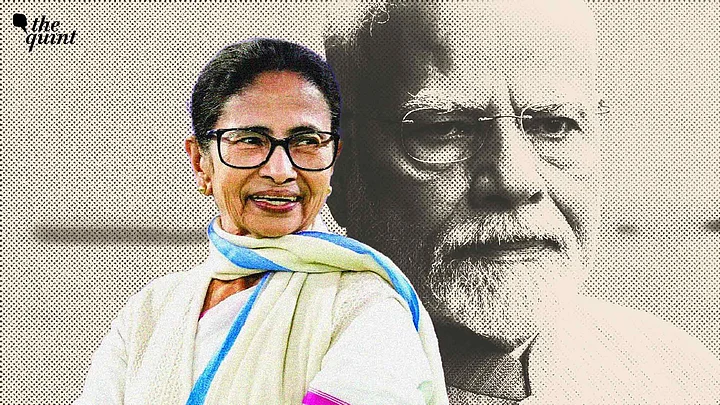
After 15 years in power in West Bengal, the Trinamool Congress (TMC) has been trounced by the Bharatiya Janata Party's (BJP) electoral juggernaut. And TMC chief Mamata Banerjee, the 71-year-old leader who has fought tooth and nail to avert just such an outcome, has been resoundingly thwarted in her attempt to rule the state for the fourth consecutive time.
Predicting that the TMC would get over 200 seats, Mamata has witnessed a devastating rout for her party, which has plunged from 213 out of 294 seats in 2021 to 81 this time. She herself has lost to her one-time lieutenant, Suvendu Ahikari, Suvendu Adhikari.
To be sure, this particular battle was never going to be easy for Mamata Banerjee. The media will soon be awash with the granular analyses of the results.
We will know the exact extent of the consolidation of Hindu votes which swelled the BJP’s numbers so spectacularly, taking it from 77 seats in 2021 to a mammoth 206 this time. We will know which bloc voted which way—did the mahila vote, which has been staunchly behind Mamata thus far, grateful for the welfare schemes she gave them, largely abandon her this time? And if they did, was that because they felt the Rs 1,500-Rs1,700 per month handout (Rs 1,700 for Scheduled Castes/Scheduled Tribes) was paltry compared to the Rs 3,000 promised by the BJP if it came to power?
Perhaps we will also know the extent to which the Election Commission of India’s (ECI) Special Intensive Revision (SIR) of electoral rolls, which ended up deleting about 63 lakh names of voters and disenfranchising 27 lakh more on the grounds of “logical discrepancies”, ate into the votes of the TMC.
For instance, it should not be lost on anyone that over 50,000 names were struck off in the Bhabanipur constituency and Mamata lost that seat by 15,105 votes.
Politics of Appeasement Vs Saffron Surge
All these factors have doubtless played their part in shaping the final outcome of the polls. But one thing is clear: Mamata cannot escape responsibility for the fact that a saffron wave is sweeping across Bengal today, and the streets of Kolkata, once the very citadel of secular liberalism, are echoing to the cries of ‘Jai Shri Ram’.
The widespread discontent over the corruption and lumpenisation of her government, the culture of cut-money—a reign of terror that Mamata would not or could not end—the lack of jobs, development, and so on, had already made a lot of people yearn for change.
The Sarada chit fund scam of 2013 may be a distant memory now. But, the multi-crore West Bengal School Service Commission recruitment scam, which came to light in 2022, is a more recent example of the humongous corruption at the highest levels of the TMC that many voters are still outraged about. It was natural that the BJP, the main Opposition party in the state, would pull out all the stops to capitalise on this sentiment.
Besides, the general perception that the TMC supremo has engaged in brazen appeasement of Muslims, who account for 27 percent of the state’s population, at the cost of its Hindu citizens has also proved to be a stroke of luck for the BJP.
The party, which brought out its entire armada led by Prime Minister Narendra Modi and his Home Minister Amit Shah to campaign in Bengal, fanned this perception and pushed the specious narrative that the TMC was facilitating the influx of ghuspaithiyas or Muslim illegal immigrants from Bangladesh to augment its voter base. A further polarisation of Hindus in favour of the BJP was but a short step from there.
The astute politician that she is, Mamata could not have failed to read the signs. To counter the charge of Muslim appeasement, she began to peddle a sort of soft Hindutva, building a massive Jagannath temple in Digha last year, and announcing the construction of a Mahakal Mandir in Siliguri in north Bengal.
SIR Impact vs Ageing Aura
Again, realising that the youth were angry because the state had failed to provide them with jobs, Mamata launched a welfare programme called Juba Sathi just before the elections, with the promise of giving them a monthly payment of Rs 1,500. She clearly hoped that the scheme would win over the youth who felt let down by her government.
But Mamata’s biggest and most high-profile battle in the run-up to the elections was fought against the SIR process that was being carried out by the ECI. Ever since it was launched in Bengal in October 2025, she resisted it in every which way she could. The reason was not far to seek.
If the ECI was indeed an instrument in the hands of the BJP government at the Centre, as was alleged by every Opposition party, Mamata knew that the deletions would be carried out in a targeted manner—to hollow out her own voter base in order to benefit her only challenger, the BJP.
It should be noted that multiple research have revealed that the fear was not unfounded. In many constituencies in Bengal, the deletions have been disproportionately large in the case of Muslim voters who traditionally lean more towards the TMC.
In February this year, Mamata took the unprecedented step of appearing in the Supreme Court to personally argue her government’s case against the ECI. In terms of optics, it was an unbeatable performance, clearly aimed at burnishing her image as a lone woman taking on the might of the state to protect the democratic rights of her citizens.
Indeed, even as many of her colleagues and party workers stood deeply discredited, Mamata herself has largely retained her image as someone who is not personally corrupt, someone who is ever ready to march for her people, and protect the multi-cultural, multi-religious identity of Bengal. She is the quintessential Didi, the brave big sister next door who has taken upon herself the role of standing up to the outsider, the invaders who are threatening to overrun and overwhelm the syncretic cultural matrix of the state.
That image, that narrative, has failed to gain traction this time. It has floundered amidst the misrule that she enabled or failed to rein in. And it has come up short against the mighty election machinery of the BJP, its polarising messaging, and the agencies of the state that it used with calculated and ruthless efficiency to muscle its way into power in Bengal.
Didi is Yet to be Written Off
But let us not write Mamata’s political epitaph just yet.
This is the woman who shot into prominence when, as a young firebrand leader of the Congress, she defeated the CPI(M) stalwart Somnath Chatterjee in the Jadavpur Lok Sabha seat in 1984. This is the woman who was beaten up by CPI(M)’s goons in a Calcutta street in 1990. This is the indomitable, never-say-die leader whose protest rally was fired upon by the Left Front government's police in July 1993, which left 13 persons dead. And this is the woman who in 2011 toppled the Left from power in Bengal after 34 years.
Mamata Banerjee is at her best when she plays David to someone’s Goliath. She may yet pull off that feat again.
(Shuma Raha is a journalist and author. This is an opinion piece and the views expressed are the author's own. The Quint does not endorse or is responsible for them.)