
ADVERTISEMENTREMOVE AD

Protest Surveillance: What Database is Delhi Police Matching Your Face Against?

The police must account for what happens after the camera records a face, writes Nikhil Pahwa.

Published
story-hero-img
i
Aa
Aa
Small
Aa
Medium
Aa
Large

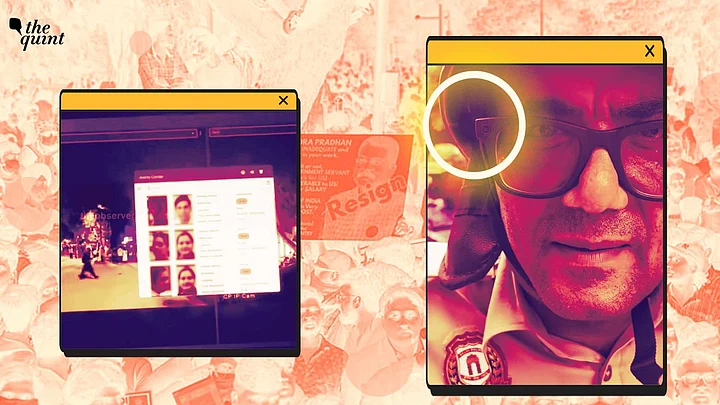
Sandeep Lamba, a senior Delhi Police officer at Jantar Mantar who was caught on camera slapping a woman protester, was spotted by Decode wearing smart glasses with a camera. While it's not clear what capabilities these smart glasses have (there are those that can do facial recognition), there's little doubt that videos were being recorded to run facial recognition on students participating in the Cockroach Janata Party (CJP) protests.

At the same protest, according to the Internet Freedom Foundation (IFF), stood a Mobile Command and Control Vehicle and 'Ikshana' surveillance vans, whose software draws green boxes around faces on a live video feed of protestors, and matches them, in one officer's words, against a large database of criminals. 'Ikshana' is a remnant of the G20 Summit, and carries eight fixed cameras with 360-degree coverage.

Despite this, India's Solicitor General Tushar Mehta told the Delhi High Court that "there is no snooping, there is no surveillance," and called the petition against it "luxury litigation", adding that every protest is always recorded.

The fact that every protest is always recorded is news to me: there is no standard procedure identified related to protests, or ratified by law, nor is it publicly available. Is lathi-charging peaceful protestors and stopping and hitting protestors running away, or people like Lamba thuggishly assaulting women, a part of Delhi Police’s standard operating procedure for protests?
ADVERTISEMENTREMOVE AD

Recording and Recognition

We've seen protests recorded before: during the anti-Citizenship Amendment Act-National Register of Citizens (CAA-NRC) protests, we saw policemen with cameras, and police drones in the air.

A few questions come to mind:

First, protesters are neither accused nor suspects, so where is the probable cause for turning every face into an investigative lead?

IFF's 2022 analysis records the Delhi Police's disclosure that an 80 percent similarity score is treated as a positive match, while the same IFF analysis says that a system allowed by the Delhi High Court for finding missing children was subsequently used for the North East Delhi violence, the Red Fort violence, and Jahangirpuri.

Home Minister Amit Shah told the Rajya Sabha that facial recognition had identified 1,922 alleged perpetrators, about 73 percent of the 2,619 people arrested in the riots, while Decode's account of a 2025 investigation says some people were arrested solely on facial matches without corroborating evidence, including a man identified as Ali who spent more than four and a half years in pretrial custody. Who bears those lost years when an uncertain match becomes the case?

Second, the police must account for what happens after the camera records a face: IFF's Jantar Mantar report says a senior officer acknowledged that no specific retention guidelines were being followed and footage might remain on police systems indefinitely.

Delhi Police has previously refused to disclose whether facial recognition had led to arrests, its accuracy, its databases, or its privacy safeguards. How does a wrongly identified person obtain a remedy?

Disclosure and Authority

Third, a private vendor's role requires disclosure. IFF's Jantar Mantar report says CP PLUS, owned by Aditya Infotech, developed the 'Ikshana' prototype with Delhi Police and integrated its monitoring software with cameras capable of face detection and recognition.

Delhi Police withheld tender documents on national-security grounds even as the vendor described the system publicly, while no contract or data-handling agreement for 'Ikshana' has been disclosed. Can the vendor access or transmit biometric data, and who is liable if that data is copied or misused?

Fourth, the legal authority is missing: IFF's Jantar Mantar report says the Delhi Police stated in writing that no specific rule governed its use of facial recognition. Decode reports that a 2023 Bill proposing magistrate-level authorisation for police facial recognition remains pending in the Rajya Sabha. The Supreme Court's Puttaswamy judgment requires legality, legitimate aim and proportionality for an invasion of privacy, while privacy is a fundamental right, the Indian government exempts itself from the key provisions of the Digital Personal Data Protection Act and holds that publicly available personal data is outside of the ambit of the largely impotent law.

It is in this state of lawlessness that the State surveils us with impunity.

But one key question remains: the cameras, whether on the face of a Delhi Police person or on a van run by them, have to compare the data with some database. How are they getting the data that is used to recognise a person on the street?
ADVERTISEMENTREMOVE AD

Big Brother State

The State's fascination with facial recognition and cameras is not new: Hyderabad has among the highest number of CCTVs in the world. Delhi once attempted to put CCTVs in classrooms. This obsession with facial recognition is second only to its obsession with databases and linking them together: linking IDs and creating central and state level IDs, whether Apaar ID for education, ABHA ID for health, linking PAN and driving license to Aadhaar, and FasTag to driving license, the Indian State has created a web of IDs linking public databases together.

This now links to NATGRID, or the National Intelligence Grid, which is supposed to provide realtime surveillance of individuals, eventually linking over 1,900 public and private databases together.

At a personal level, I've fought hard to protect my three-year-old’s privacy: from refusing to give Aadhaar for his birth certificate, getting him a passport without Aadhaar, to ensuring that we're excluded from his preschool’s mobile app which used facial recognition on toddlers. "Till when will you fight this," a friend had asked me.

The fact is that if our rights were being protected we shouldn't need to fight this. Under the undefined, all-encompassing ruse of National Security, which even former Chief Justice NV Ramana refused to deal with when faced with having to adjudicate the Pegasus case, the Government of India has built a panopticon.

The unrestricted, unregulated facial recognition we see at protests are a testament to the failure of our judiciary to address this.

We've reached a state where the police are doing facial recognition on children, and we don't even know how they got that data.

The students were out on the streets because they felt they had no other mechanism to be heard. When will the rest of us be heard?

(Nikhil Pahwa is the founder of MediaNama. This is an opinion piece and the views expressed are the author's own. The Quint does not endorse or is responsible for them.)

Speaking truth to power requires allies like you.
Become a Member
Monthly
6-Monthly
Annual
Check Member Benefits
×
×