
Over six years have passed since a working-class settlement in northeast Delhi was convulsed by communal violence that took 58 lives and destroyed thousands of others. Without any help from the state or the Central government, those who lost loved ones and property have slowly rebuilt their broken lives. The communities have been estranged—it seems now permanently—on communal lines.
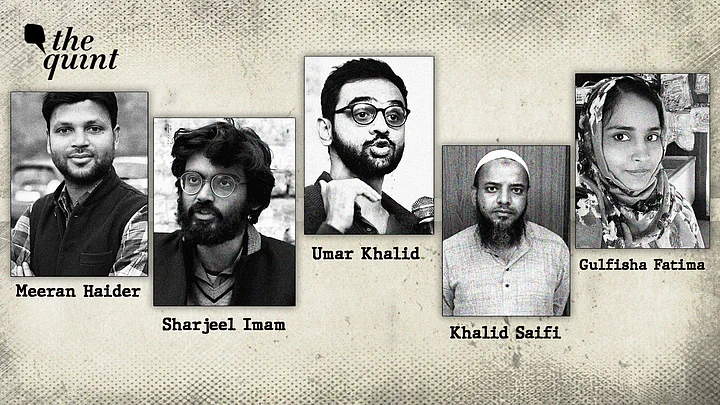
Five and a half years have also passed since 18 persons were charged for what became known as the so-called “Delhi riots conspiracy case” in the FIR 59/2020 registered by the Delhi Police’s Special Cell.
The Delhi Police charged these 18 persons—most of whom were student leaders and activists, with one politician—with this alleged terror conspiracy.
All of these 18 persons accused of this conspiracy were active in the protests against the Citizenship Amendment Act (CAA), 2019. All except two of these were people of Muslim identity, and these two also were active in the protests against the citizenship law amendment.
Lives on Hold: The Accused
The charge sheet in this case was filed just over six months after the violence broke out, on 16 September 2020. Running into over 17,000 pages, it did not cite a single act of violence, recovery of weapons, speeches resulting in incitement, or calls for violence that could be attributed to any of the accused persons.
Instead, it brought together various acts of protest and civil disobedience. It relied on WhatsApp conversations, speeches, and financial transactions to build an extravagant narrative of a terror conspiracy.
The police claimed that the violence was timed to coincide with the visit of the US President Donald Trump to India. Its purpose was to “internationalise the CAA issue by portraying it as a pogrom against the Muslim community in India.” The “intrinsic, deep-rooted, fervent complicity” of the accused was in pursuit of their sinister goal of “engineering riots on communal lines” across the country.
They further claimed, “The conspiracy hatched, nurtured, and executed by the petitioners sought to strike at the very heart of the sovereignty and integrity of India by destroying communal harmony and instigating armed rebellion.”
The protests were “Regime Change Operations”, and they argued that, in cases striking at the integrity of India, “jail and not bail” must remain the norm.
The accused persons were thrown into prison under the dire anti-terror law, the Unlawful Activities (Prevention) Act [UAPA], 1967, which enables prolonged incarceration without bail. The application of this statute was clearly deliberate because it allowed the prosecution to demand bail denials and to extend pre-trial detention sometimes for many years.
The Delhi Police over the years has consistently opposed the bail pleas, persisting in describing the February 2020 violence as a “deep-rooted, premeditated and orchestrated conspiracy.”
On 5 January 2026, more than five years after their incarceration, the Supreme Court finally released on bail five persons (Gulfisha Fatima, Shifa ur Rehman, Meeran Haider, Md Saleem Khan, and Shadab Ahmad) after over five years of imprisonment. It, however, rejected the bail of two persons, Umar Khalid and Sharjeel Imam. Of the 18 persons implicated in the FIR, six people remain in custody at the time of writing. The remaining four are Khalid Saifi, Athar Khan, Tasleem Ahmad, and Saleem Malik.
The UAPA Bogey
The reality is that the UAPA not only sets aside the standard norm in criminal justice procedure of “bail, not jail”, but instead builds formidable barriers to bail through its Section 43D(5). This section lays down that the court will not release an accused person on bail if—based on the evidence of record—there are reasonable grounds to believe that the accusation is prima facie true.
A literal reading of the language of this section suggests that what it does is raise the evidentiary burden at the bail stage by requiring the application of mind of the judges to conclude after engaging with the evidence on record that the charges are believable.
However, the barrier to bail was further reinforced by ruling in the 2019 NIA vs Zahoor Ahmad Shah Watali, in which the Supreme Court laid down that at the bail stage, courts must not engage in a “detailed analysis of evidence.” If the materials prima facie supports the allegations, bail should be refused.
In Vernon Gonsalves & Arun Ferreira vs State of Maharashtra (2023), there is a modest course correction, by the court requiring a “surface-level analysis of the probative value of evidence” when assessing whether the case is prima facie true under Section 43D (5) of the UAPA.
In practice, courts have mostly tended to accept at face value the evidence placed on the record even before trial begins to deny bail. For instance, the court was not convinced when Umar Khalid’s lawyer Kapil Sibal played Khalid’s 17 February 2020 speech in Amravati in the court, which the Delhi Police had cited as evidence of conspiracy. The speech, Sibal pointed out, invoked Gandhian principles and urged non-violence. “If this is inciting”, he said, “then many of us are liable to go to jail.”
He added, “What have these kids done? They were protesting… You cannot say that it is a terrorist act.” Likewise, senior advocate Siddharth Dave, appearing for Sharjeel Imam, challenged the Delhi Police’s description of Imam as a “dangerous intellectual terrorist” without a full-fledged trial or even a single conviction. He was already in police custody at the time of the riots, how then could he have planned the riots?
The court ruling perilously threatens democratic dissent by its interpretation of what constitutes a “terrorist act”. The definition of terrorist act under Section 15 of UAPA included not only “conventional modes of violence” or “immediate physical violence” but also violence “by any other means of whatever nature”.
I quote the People’s Union for Democratic Rights (PUDR):
“The case of the accused seeking bail was that a protest was being construed as a terrorist act. Speech and organising around issues cannot be considered terrorism. In a few paragraphs… the court has essentially evaded the fundamental question raised by the accused from the beginning: should the UAPA even apply? Why are the 18 accused persons being set up in a terror case—as opposed to the individual cases relating to violence and destruction of property that some of them are already facing? The very application of the UAPA is suspect and appears politically motivated and a method to ensure further incarceration”.
Khalid, Imam, and the Fabricated 'Hierarchy of Guilt'
PUDR pointed to further flaws in the 5 January order denying Khalid and Imam bail. The Supreme Court differentiated between the alleged role of the accused as ‘masterminds’ and ‘architects’, and based on this hierarchy of alleged guilt, it further prolonged the pre-trial detention of Khalid and Imam. It then said it relied on the “statutory plausibility, not evidentiary sufficiency” of the prosecutorial materials.
Further, PUDR points to the stringent bail conditions. The court required two local sureties for Rs 2 lakh each, overriding the accepted judicial mandates that surety amounts must not be prohibitive. It bars the accused from associating with any group or organisation “linked” to this case and from participating in social or political activities. Overall, PUDR concluded that the order of the Supreme Court “serves the political interests of a State that favours persecution over prosecution”.
The CJP rightly observed:
“FIR 59/2020 is no ordinary criminal proceeding. It is a study in how the machinery of justice, even when questions of personal liberty are involved, can end up incarcerating without trial, and accusing without resolution. Under the expansive shadow of the UAPA, the line between protest and conspiracy has been blurred, perhaps deliberately. And in the half-decade since its registration, this case has revealed how the legal process, when even the constitutional courts fail to adequately respond, can start to resemble indefinite detention by another name”.
The CJP also observes how the UAPA enables “the conceptual separation between trial delay and the statutory bar on bail”. The prosecution consistently argues that the material is complex, the conspiracy vast, and the trial long. Yet, they simultaneously resist bail even when the accused have been in custody for four to five years. The absence of time-bound charge framing, combined with the absence of mandatory periodic bail reviews, is what transforms the UAPA into a tool of preventive detention without having to declare it as such.
As a result, the “Delhi riots conspiracy case” in the FIR 59/2020 continues to be trapped in a purgatory of pre-trial. Even five and a half years later, the trial has not even begun. Indeed, not a single charge was framed. A succession of benches heard the matter “with judges being reassigned, transferred, or rotated mid-way through critical proceedings”.
In this way, 18 lives of persons who came out to the streets to peacefully protest what they saw to be an unjust law were pulverised. And through this the fundamental democratic rights to protest and fair trial have been asphyxiated.
Complicit and Partisan Police Machinery
I recall a press conference that was called in Delhi on 4 September 2020 to protest against the charge of a conspiracy to create the communal violence that erupted in the Delhi working class settlement with the theme: “The truth is being ripped into shreds and reimagined to create the mythology of a conspiracy of hate, violence and insurrection”.
What I said then continues to be relevant more than five years later. “The Delhi Police believes that there was a conspiracy behind the communal violence in Delhi during the third week of February,” I said. I added, “We agree”.
I explained, “But the actual conspiracy was a very different one from the one which Delhi Police is propagating. The truth is that not just the Delhi 2020 carnage; no major episode of communal violence is spontaneous: it is always planned, organised and facilitated.
“Such violence requires first the systematic creation of hatred. In Delhi we saw the build-up during the Delhi elections of a climate of hatred spawned by hate speech by senior leaders targeting the protestors against CAA, National Register of Citizens (NRC), and the National Population Register (NPR). This was led from the front by the Union home minister, the chief minister of Uttar Pradesh, and several other Cabinet and Bharatiya Janata Party (BJP) leaders. The outcome was the spread of unprecedented levels of toxic communal venom, unmatched in any previous election in Delhi."
“But beyond the manufacture of hatred and the organisation of the violence, the critical factor in any riot conspiracy is the role of the State, and particularly the police. No riot can go on for more than a few hours except if the government wishes for it to do so."
“There is massive evidence of the complicit partisan role of the police in the Delhi violence. I have spent a lot of time with the victim survivors of the Delhi carnage. I have heard hundreds of testimonies from them about the role of the police enabling, encouraging and actually indulging in hate violence."
“The video of policemen tormenting four young men lying on the ground, among whom Faizan subsequently died, is telling. The police while beating the men prone on the ground are taunting them by asking them to sing the national anthem; it was clear that they are punishing them for the protests, in which the national anthem had become an iconic symbol of the protests, of resistance, of unity and of solidarity."
“This was the conspiracy behind the Delhi communal violence. It was a bid by the Indian State, aided by the Delhi Police, to punish and crush the largest non-violent protests that independent India has seen."
“The police story is quite the opposite. According to them, it was the anti-CAA-NRC-NPR protests which were the conspiracy, and that the non-violence of the protests was only a facade."
“In pursuit of this story, every day the Special Branch of the Delhi Police, which normally investigates grave crimes like terror, is busy for the past months summoning mostly young people, and sometimes seniors, grilling them, intimidating them, and sometimes – as Umar Khalid has testified – forcing them create false evidence."
“Large numbers of young people are today languishing in prison for months without bail in the name of this so-called conspiracy. We are gathered here today above all in the defence and solidarity with all of these young people”.
I declared, “Yes, they and we did participate in the non-violent movement against CAA NRC NPR, and we are proud to have done so”.
I unpacked the mischievous misinterpretations by the Delhi Police Special Branch.
I said, “During the protests some WhatsApp groups were made. Now every word exchanged in these groups are being examined with a defective microscope by the police, their meaning and context deliberately and mischievously misinterpreted, the truth ripped into shreds and reimagined to create the mythology of a conspiracy of hate, violence and insurrection.
"There were significantly other WhatsApp groups that the police themselves admit to, wherein indeed people are actively calling for and organising the violence on those dates. None of these are being the subject to any investigation of a conspiracy."
“Our protests, and those of the young people now in our prisons, were to uphold the Constitution, and the idea of an inclusive and humane country of equal citizenship, which is the proudest legacy of our freedom struggle."
“The young people and we protested because we love our country dearly, and we seek to make this country better for all its citizens, of every religion, caste, class and gender, by holding the state accountable to stand by its duties to the constitution."
“It is a travesty to describe this as a crime against the nation. Those who are seeking to create divisions and hate among us are those who are committing crimes against our country."
“The objective of the government is transparent: to destroy the basic guarantees and freedoms of our Constitution.
The effort of the Indian state, facilitated by the Delhi Police, is to crush our voices, our dissent, and our struggles to uphold our Constitution”.
I concluded, “We declare here—and hope those holding highest office in the country hear us loud and clear—that the government will never succeed in silencing us, and will never succeed in taking away from us the dream we inherited from our freedom struggle, the dream of together building a country which is just, and equal, and kind”.
(The author is a social activist, writer, and researcher who started the Karwan-e-Mohabbat campaign in solidarity with the victims of communal or religiously motivated violence. This is an opinion piece and the views expressed are the author’s own. The Quint neither endorses nor is responsible for them.)
