
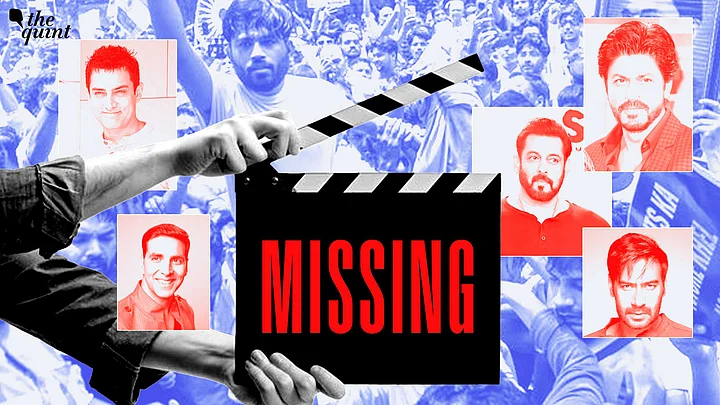
Cowardice has plagued the so-called artists of Bollywood for a while now, and yet, their acts surprise us every time they bother to crawl out of their luxury hiding holes to parrot.
It-couples like Ranbir-Alia and Vicky-Katrina, yesteryear cine icons like Amitabh Bachchan, Hema Malini, and Rajnikanth, and commercial filmmakers like Vidhu Vinod Chopra to Rohit Shetty—they have all shown up for selfies with the Prime Minister with equal aplomb. They have also abandoned the future of this country: the protesting youth.
Bollywood has been suffering from a collective case of cowardice for a while. Most prominent Bollywood biggies have already shown their general pusillanimity and true allegiances (to politics and power) time and again.
There are no vaccines or cures for their collective case of cowardice yet. So, they continue to behave like selfish zombies of the zeitgeist, motivated by self-preservation and ticket sales. However, a few untainted ones—the rebels and true poets at heart, the ones who still believe in revolutions always show up in time and with solidarity to keep things interesting.
The Silence of the Khans vs Rakhi Sawant
The biggest superstars in the country have been largely missing in action from the momentous youth protests that have shaken the system.
Shah Rukh Khan has remained entirely mum. Aamir Khan—the man who built his brand as the voice of consciousness of the nation—has distanced himself from things entirely. He recently denied that Sonam Wangchuk was an inspiration for his 3 Idiots character Phunsuk Wangdu.
Salman Khan has shown up with his meaningless bro-dom. People have already made jokes about Aamir and Akshay Kumar fighting over the biopic rights of this protest 10 years down the line.
Salman shared his take on the issue on Instagram, while flaunting his brand-new hairline, only a few days before the rest of Bollywood. He followed his first post with another, eloquently adding a line that is sure to go down in cinematic history: “Sonam, it’s done, bro. Don’t extend this.”
Ajay Devgn dropped the trailer of his upcoming film Chauhan in the midst of all this. The trailer has a line, which reduces pellet gun violence in Kashmir as something that is merely an issue of “limited” collateral damage. Barring this, Devgn joins a long list of prominent celebs—from Priyanka Chopra to Virat Kohli—who did not bother to acknowledge the protests when the students would have appreciated it the most. Kangana Ranaut has been fomenting her usual hateful garbage towards all protesters.
Speaking to Mehdi Hasan, Editor-in-Chief of Zeteo News, eminent Indian journalist Sreenivasan Jain pointed out that SRK was essentially brought "to heel" for his quiet resistance towards Modi and his politics of hate when his son Aryan Khan was arrested on drug charges that were later dropped just as unceremoniously as they were brought on dubiously.
Jain also added that most of Bollywood may not be closeted Hindu nationalists (while admitting that some definitely are) but many are afraid for themselves and their families and hence they have to fall in line. And this applies to most people in the country, whether they are media professionals, regular corporate majdoors, or star athletes.
Their yes-man conformism costs them nothing, with these stars remaining mostly untouchable at the cash registers no matter how completely they abandon the people. That compounds a moral failure where silence continues to pay off far more.
In stark contrast to the biggest names in the industry, Rakhi Sawant did more than any of the Khans. She took to her social media and posted a video messaging Italian Prime Minister Giorgia Meloni to ask "her boyfriend" Narendra Modi to stop the protests by meeting the students' demands.
Not stopping at online activism, she even showed up at a protest site in solidarity.
Who Spoke Up and Who Did Not
Not everyone in the Hindi film industry remained quiet. Naseeruddin Shah, Ratna Pathak Shah, Shabana Azmi, and Prakash Raj were among those who showed up at Jantar Mantar to lend their support.
One needs to remember that they are established anti-establishment voices, who have made it a lifelong habit of speaking truth to power regardless of who wears the crown.
Dia Mirza at least had the gall to address the Prime Minister in one of her many social media posts. Sonakshi Sinha spoke in support of Wangchuk’s fast and student solidarity days before PM Modi finally addressed the protests—nearly a whole month after it began. Imran Khan walked with the students as did the likes of Manav Kaul, Jim Sarbh, Swara Bhasker, and Hanumankind.
But most Bollywood celebs shared their PR rehearsed, wishy-washy AI-generated slop statements only after Modi spoke.
It felt like an invisible spell had been broken and an informal go-ahead was given for the rest of them to finally acknowledge the revolutionary elephant in the room. Even then, their word salads mentioned neither the Cockroach Janta Party (CJP) nor the BJP.
While the Hindi film industry largely cowered, artists down south showed tremendous gumption. Among those who addressed the gathering were filmmaker Vetrimaaran, Pa Ranjith, activist and writer Grace Banu, Revathi, Andrea Jeremiah, Ameer, music director James Vasanthan, rapper Therukural Arivu, Lenin Bharathi, and educationist Prince Gajendran.
A New Vanguard of Resistance
In today's cultural landscape, stand-up comedians, digital satirists, and independent content creators have redefined what it means to be a celebrity in India. Their primary audience is not a passive film-going crowd, but the very youth standing on the streets: Gen Z, Gen Alpha, and Millennials.
Unlike Bollywood megastars who hide behind PR teams, these creators built their clout on relatability, immediacy, and direct engagement with young people.
When mainstream cinema cowered, a diverse spectrum of comics and influencers—spanning different genders, sexualities, castes, and economic backgrounds—stepped up to use their platforms unflinchingly.
Vir Das bluntly called out the hypocrisy of live artists who rely on young audiences to buy show tickets but vanish when those same kids face tear gas and police lathis.
Stand-up comics like Abish Mathew and Raunaq Rajani, content creators like Saumya Sahni, Vagmita Singh, and Dolly Singh, emerging filmmakers like Satvik Soni did not just post from behind a screen; they stood on the tarmac at protest sites, with Mathew getting detained alongside student demonstrators.
Popular voices like Anubhav Singh Bassi and Madri Kakoti amplified on-ground visuals of police brutality, lauding Gen Z's refusal to be manipulated. Beyond mainstream comedy, a vital wave of anti-caste creators, queer influencers, and digital satirists—from Dalit-Bahujan podcasters like Anurag Minus Verma to trans activists like Grace Banu and fresh faces like Ujjwal Singh and Harshit Singh—turned online culture into a tool of political resistance.
Through satire, "get ready with me for the protest" videos, and persistent commentary, these creators proved that real cultural relevance is not measured by box office numbers, but by who stands with the youth when the stakes are highest.
The Catalyst and the Cockroaches
The CJP started (by Abhijeet Dipke) as a frustrated but albeit cheeky response to Chief Justice of India, Surya Kant, comparing the unemployed youth of the nation to cockroaches and parasites. What started almost as a joke became the face of a movement that will go down in history.
Dharmendra Pradhan resigned and was replaced as Education Minister by Pralhad Joshi, former Union Minister of Parliamentary Affairs, Coal and Mines, who defended the release of the 11 convicts serving life sentences in the 2002 Bilkis Bano gangrape case, saying it was done “as per the legal provision”. Joshi also mocked the Indian students in need of evacuation at the start of the Ukraine-Russia war instead of sympathising with them, stating that they go abroad because they aren’t meritorious enough to clear entrance exams in their own country.
This resignation is not something to celebrate just yet even though this is the first time a sitting BJP minister has resigned after protests from common citizens. It is worth acknowledging though that this happened with no help from any big names or celebrities who could have used their massive platforms to mobilise with more effect, who could have used their networks and millions to aid some of the students (something ordinary citizens are doing right now), in short, who could have done so much more.
The general fear is that there will be retaliation for this act of public humiliation. And it is already coming true in many places.
Three Muslim students were jailed in Assam for creating a WhatsApp group to organise a NEET protest, despite seeking police permission. Two young people in Panaji who expressed their support for political prisoners Umar Khalid and Sharjeel Imam at these protests have been detained by police as well. West Bengal Chief Minister Suvendu Adhikari has invoked the Goonda Act, aka the West Bengal Public Safety and Control of Anti-Social Activities Act, 2026. Under this arbitrary rule, they plan to arrest folks who were at the Kolkata leg of the protests. The 13 of the 14 arrested under this act are Muslims as per a Maktoob Media report.
Will our so-called cine idols continue to remain more cowardly than Coward, the Courageous Dog even now?
The Unsilenced Generation
"Not all battles are fought for victory. Some are fought simply to tell the world that someone was there on the battlefield."
~ Ravish Kumar
As a middle-aged millennial, who has witnessed every student protest, from Jadavpur University’s Hok Kolorob to the Cockroach uprisings in 2026, I did not believe much would change. I was merely happy that someone showed up on the battlefield still. I only hoped that the rebelling ones would continue to carry this fire within and vote the rot out when time came. However, something has moved the needle this time.
You cannot silence a generation that believes it has nothing to lose. And the BJP and the Prime Minister seem to have noticed that too. Weirdly enough, it is the Bollywood brigade who seem to have some catching up to do.
During one of his viral speeches at Jawaharlal Nehru University, Umar Khalid had said, “Dissent is patriotic. Not anti-national.” These are words that were (and continue to be) dangerous to the current government. Eventually these were some of the many revolutionary words that landed Khalid in jail, where he has been waiting for a fair trial for six years. But courage is contagious and the millennials who felt defeatist after all their years of agitation have finally passed the torch onto Gen Z and Gen Alpha.
The youth has learnt to lead with cheeky irreverence and tremendous compassion. They do not care for false idols who do not have the courage to speak up for them. Maybe this will have its own butterfly effect on Bollywood too, and a new generation of heroes will rise on screen, the ones who aren’t afraid to call a spade a spade and think divorcing their art from political chutzpah is the way to be.
(The author is an independent film, TV, and pop culture journalist who has been feeding into the great sucking maw of the internet since 2010. This is an opinion piece. The views expressed above are the author’s own. The Quint neither endorses nor is responsible for them.)
