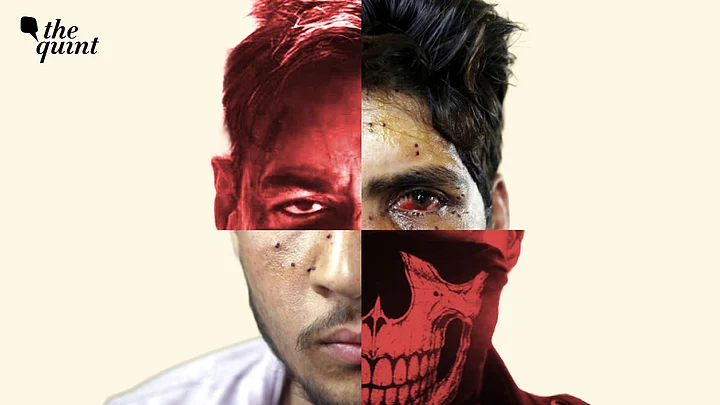
"That single pellet didn't just take the sight from one of my eyes, it took away my dream, my career, and the life I had imagined for myself. People call it 'limited damage,' but for me, it has been a lifetime of pain", Fayaz Ahmad Bhat (name changed) tells The Quint.
A resident of Pattan, Baramulla in North Kashmir, 43-year-old Fayaz was on his way to play cricket when he was struck by a pellet in his eye during the 2016 unrest in the valley following the killing of Burhan Wani. The injury left him with permanent vision loss.
"I remember that day as if it happened yesterday. I still remember waking up to darkness," Fayaz, formely an aspiring cricketer, said. "My cricket bat, my dreams, my future everything disappeared with my eyesight. Losing vision was not just a physical injury, it was the loss of my identity. Every day since then has been a reminder of what was taken from me".Fayaz Ahmad Bhat
So when he heard about the trailer of a new Bollywood film, Chauhaan, trivialising or mocking the pain of pellet gun injury victims, he was more than mildly disturbed.
Directed by Neeraj Yadav and produced by Aanand L Rai and Jio Studios, the two-and-a-half minutes long teaser of the Ajay Devgn-starrer film has sparked a debate about pellet gun victims by referring to pellet gun injuries as "limited damage". The teaser appears to make light of the prolonged suffering and often permanent damage of those like Fayaz who sustained these injuries, including several Kashmiri youth who have lost their eyesight and some who even lost their lives.
Critics and locals feel the trailer wilfully ignores one of Kashmir’s most traumatic recent chapters, and many have since questioned yet again how Bollywood is choosing to portray the realities of Kashmir to wider audiences across India and beyond.
Much More Than Just a 'Pellet'
Fayaz is one of the hundreds of youth across Kashmir who bear the marks of the protests that erupted in the valley in 2016. As the news of Burhan Wani's killing spread across Kashmir, hundreds took to the streets in protest everywhere, including in his hometown, Pattan.
However, Fayaz had not gone to join the protests that morning. "I was carrying my cricket kit to the ground, where I was supposed to play a match," Fayaz recalls. Everything changed within seconds. As the protests intensified, security forces fired tear gas, bullets and pellet guns. Fazay was caught in the crossfire.
"A pellet struck my eye. The pain was unbearable, but the bigger shock came when I realised I would never see the world the same way again. That single pellet did not just injure my eye it ended the life I had imagined for myself. I played for Star 11 Cricket Club as an opening batsman, and people in the area knew me for my game. I dreamed of becoming a professional cricketer. All that is over now," Bhat told The Quint.
According to a spokeswoman for the UK-based non-profit organisation Omega Research Foundation, a military technology watchdog, the "pellet guns" used in the Kashmir valley region by the armed forces to quell protests or control people's gatherings are indeed pump action shotguns. The Indian military refers to it as a "pellet gun".
The ammo for these guns, which contains up to 500 tiny lead pellets that disperse in all directions when shot, is the sole distinction. Hunters frequently utilise them. She claims, "The ammo is not built for crowd control."
Techicalities aside, for pellet victims, the trailer feels like a rejection of a painful reality as thousands were maimed and hundreds left partially or completely blind over the years due to pellet gun injuries.
Like Fayaz, many in Kahsmir have lost one or both eyes to pellet guns, a hollow reminder of the lost dreams of entire generations of Kashmiri youth.
"Hence, when someone calls pellet gun injuries as 'limited damage', it feels like they are mocking our pain. There is nothing 'limited' about losing your eyesight. We survived, but many of us continue to live with lifelong pain, trauma and memories that never leave us. Some wounds never heal," Fayaz said.
The devastating impact of pellet gun injuries on eyesight has also been documented in medical research. A retrospective study conducted by the Department of Ophthalmology at SKIMS Medical College, Bemina, reviewed 20 patients (23 injured eyes) treated between January 2010 and September 2013 and found that nearly 78 percent of injured eyes had open-globe injuries, among the most severe forms of ocular trauma.
More than half of the injured eyes had only perception of light when patients reached the hospital, reflecting the severity of the injuries, while nearly 48 percent were left with a final corrected visual acuity of less than 6/60, indicating severe visual impairment. The study documented extensive eye damage, including corneoscleral tears, vitreous haemorrhage, traumatic cataracts, retinal detachment and retained pellet fragments, underscoring the high risk of permanent vision loss associated with pellet gun injuries.
Reacting on X, Member of Parliament Aga Syed Ruhullah Mehdi said the teaser of Chauhaan "reopens a wound for Kashmiris who still carry the trauma of the years when pellet guns became a grim symbol of pain and permanent loss.”
28-year-old Tanveer Ahmad Bhat (name changed) of Baramulla district had a similar story to tell like Fayaz, after a pellet gun injury changed his life forever, despite his never taking part in any protest.
"I was a student and I had never been part of any unrest. Yet, I was hit by a barrage of pellets. Most struck my body, but three or four pellets pierced my right eye. I was rushed to a nearby hospital, where doctors removed the pellets from my body but told me they could not operate on my eye immediately because it was too dangerous," he recalled.
"The pain in my eye was unbearable. The pellets were still lodged inside, but there was nothing I could do. I kept visiting the doctors, hoping they would remove them, but each time they said my eye was too swollen and the risk was too high. My eye remained bloodshot, swollen and in constant pain," he added, struggling to hold back tears.
Weeks later, doctors finally operated on his eye. They managed to remove most of the pellet bits, but one remained because it had become embedded in the most sensitive part of the eye. "I spent everything my family had on treatment, but my right eye never fully recovered. A layer has formed over my retina, and I can barely see through that eye anymore," he said.
Years later, the physical injury has now become a daily emotional burden.
"My right eye have become so disfigured that small children get frightened when they look at me. I live with anxiety every single day. Let those calling it "limited damage" experience it once. My treatment consumed all our savings, yet I continue to live a life that feels like hell. The injury never healed, it became my life."Tanveer Ahmad Bhat
Pellet guns have been used in Kashmir since 2010 as a crowd-control weapon and more than 10,000 residents have been struck by pellets since then, as per a report in The Hindu. According to government data, 6,000 residents, including demonstrators, were struck by pellets during four months of public demonstrations from July to October of 2016. At least 782 were hit in the eyes, and many lost their vision in both eyes or in one eye, the data show.
An estimated 3,000 people have suffered pellet-related eye injuries in recent years, with many left partially or completely blind. The State Human Rights Commission recorded 3,800 cases of pellet injuries and blindness since 2016, while rights groups say the true number is likely higher because many victims do not report their injuries.
The Pellet Victims Welfare Trust (PVWT) had documented 1,233 victims, many of whom, according to the organisation, experienced severe psychological trauma after losing their eyesight. At least 17 people were killed by pellet guns during 2016 and 2017, according to a BBC report.
It isn't just protests that invite pellet gun injuries. Hiba Nisar, from Kapran village in south Kashmir's Shopian district, was 19 months old when she became the youngest known pellet gun victim in Kashmir in 2018. She had not been attending any protest at the time.
Recalling the incident, her mother, Marsala, said,
"There was an encounter in a nearby village. We stayed inside our home because we believed it was the safest place for us. But then the tear gas shells started landing around the house, and the smoke entered every room. We couldn't breathe. We were coughing, choking and panicking. Hiba was so small; she didn't understand what was happening. She was crying, frightened and struggling to breathe. I held her close and tried to protect her."Marsala
When the smoke became unbearable, they stepped into the corridor to find everyone restless and trying to escape the chaos. Recounting the harrowing incident, Marsala said, "Then I heard what sounded like a gunshot. At first, I thought the bullet had hit Hiba somewhere else. But when I looked at her face, blood was streaming from her eye. I froze. For a moment, I couldn't understand what I was seeing. My little daughter was screaming in pain, crying uncontrollably. It is a sound that has never left me."
Baby Hiba was rushed to the hospital where doctors operated on her in a bid to restore her vision, but there was no guarantee if she could ever see again. Hiba lost her eye and her sight that day.
"She was too young to understand what had happened, but we have lived with that pain every day since," Hiba's parents state.
'Kashmir Ki Kali' to 'Kashmir Files'
A media scholar, reflecting on the movies being made on Kashmir, said (requesting anonymity) that Bollywood scripts have increasingly become extensions of government ideology and reflections of rising nationalist aspirations. Unlike the 1970s and 1980s, when films often engaged with ground-level social issues, recent portrayals have shifted toward war narratives. Before the 1990s, Kashmir was usually shown as the “Paradise on Earth,” with Kashmiris depicted as innocent, hospitable people whose lives revolved around tourism.
After the violent insurgency of the 1990s, that portrayal changed: Kashmir and Kashmiris began to be shown as violent, anti‑national, and threatening.
Over time, this created a widespread perception that the region and its people are as Bollywood represents them. That perception harmed tourism and made communities more vulnerable. Rather than healing old wounds, these portrayals reopened them. The sensationalised, propagandistic framing of violence sells, but it inflames real pain.
Released in 2022, The Kashmir Files sparked nationwide controversy and political debate. While supporters said it brought long-overlooked attention to the 1990 exodus of Kashmiri Pandits, critics argued it presented a one-sided narrative that overlooked the broader complexities of the Kashmir conflict and risked deepening communal divisions. The film received strong backing from India's ruling BJP, with several BJP-ruled states making it tax-free.
Although the film and its makers profited handsomely and parts of the political establishment promoted it as an absolute truth, the film scraped and distorted old wounds, exaggerating events to fit particular narratives. that only only deepen the schism between hearts and homelands for a community that has as yet been unable to return home.
Enduring Trauma
A Government Medical College, Jammu study on the mental health impact of such injuries found that out of 380 pellet‑injury victims examined in the post 2016 uprising period, around 85 percent were suffering from one or more psychiatric disorders, and 325 pellet victims had actually sought treatment for these mental health problems at associated hospitals in Srinagar, indicating a very high burden of psychological morbidity among the injured.
The study also underscores that this picture is likely an underestimation, because many survivors do not consult psychiatrists at all due to stigma around mental health, lack of money, loss of hope in treatment, and the severity of their depression, a large number of pellet‑blinded or injured people are living with untreated trauma, depression, and related psychiatric issues.
"I find the teaser deeply offensive to the people of Kashmir, particularly to pellet victims who have suffered and continue to suffer over the past ten years. Many have sustained lifelong injuries, many have lost their eyesight, and some have even died. Demeaning pellet victims is the worst thing that could have been done, especially by a reputed production house like Jio Studios. We expected them to show greater sensitivity towards the people of Kashmir."Aga Syed Ruhullah Mehdi, Jammu & Kashmir National Conference (JKNC) MP
Aga Syed Ruhullah Mehdi It was also pointed out that apart from trivialising pellet guns, the teaser also contains a communally loaded language such as use of the term 'Pathan'. "There is no Pathan community in Kashmir, and the producers appear to have little understanding of Kashmir's history. The teaser pits one religion against another, which should never have happened. The Central Board of Film Certification must take note of this and take appropriate action," JKNC state spokesperson Imran Nabi Dar told The Quint.
"It is not only about pellet victims; it is also about the language used and what we see as the denigration of Muslims. This demeaning language appears designed to incite communal hatred. That is unacceptable in any civilised society and in a plural country like India. Such content should not become the norm, and appropriate action should be taken."
Phrases like “tear gas,” “limited damage,” “Pellet guns,” and “online masks available” may sound brief, but they reopen the wounds of thousands of Kashmiris.
"I have already spoken about this publicly and expressed my views on social media. Our stand is clear, we will not accept this. Any further decisions will be taken by the government in the coming days," Dar added.
(Umer Farooq Zargar and Ilhak Tantray are independent journalists based in Kashmir, India.)