
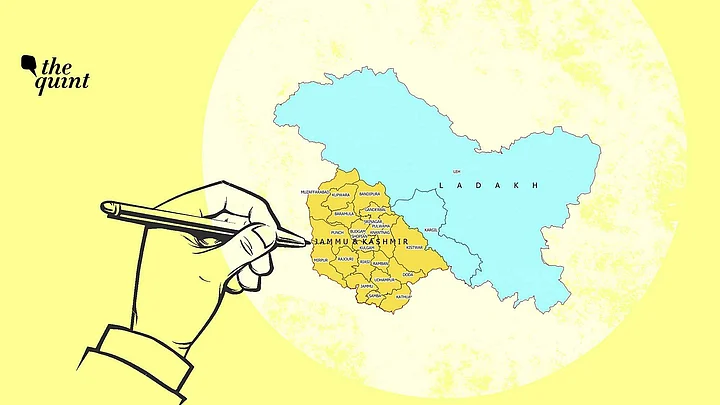
The recent administrative reorganisation of Ladakh, which saw the creation of new districts carved out of Leh and Kargil, has triggered discontent among residents of the latter. Many The Quint spoke with allege that the exercise was carried out without “adequate public consultation”—and has amounted to "ghettoisation of Muslims."
Ladakh, with a population of around 3 lakh, had only two districts—Buddhist-dominated Leh and Muslim-dominated Kargil. A reorganisation had thus been a long-pending demand of the people living in the region. However, the news has failed to bring cheer in Muslim-dominated Kargil where many feel that the reorganisation was communally and politically driven.
The announcement was made by the newly appointed Lieutenant Governor of Ladakh, VK Saxena, who approved the notification for the creation of five new districts on 27 April.
As per the new demarcations, three districts, namely, Nubra, Sham, and Changthang, with headquarters at Diskit, Khaltse, and Nyoma, respectively, have been carved out from Leh district, which has 39.65 percent of the population of Ladakh.
And only two districts—Zanskar and Drass, headquartered at Padum and Drass-Ranbirpura, respectively—have been carved out from Kargil district, with 46.4 percent of the region's population.
Committee vs Locals
The move comes at a time when the region is still on edge following the 24 September violence in which four people were killed and dozens injured.
Ladakh Chief Secretary Ashish Kundra tells The Quint that the districts have been constituted based on the report of a committee which held detailed deliberations with all stakeholders.
The government-constituted New Districts Committee was formed in August 2024, following the directions of the Ministry of Home Affairs to “examine various aspects related to the formation of new districts”.
Headed by Chairman and former IAS officer Pramod Kumar Jain, the committee consisted of four other members who met a number of delegations in both Kargil and Leh. Kundra tells The Quint that the committee's recommendations for reorganisation "considered a variety of geographical, historical, and cultural factors, and not just population.”
Several local leaders and civil society groups in Kargil, however, argue that the creation of new districts has not been based on geography, accessibility, or administrative convenience. Instead, advocate Mustafa Haji alleges that “the reorganisation was done on communal lines, and this is nothing but ghettoisation of Muslims.”
The Quint reached out to Chairman Jain for further clarifications. His response is awaited.
'Areas With Huge Populations Ignored'
Sajjad Kargili, a Kargil-based political leader, tells The Quint that there is a clear disproportionate distribution of new districts where the deserving areas with huge populations (exceeding 40,000) have been ignored—and the areas with less population (between 8,000 and 15,000) have been given district status.
“Take the example of Sankoo and Shakar Chiktan, with a population of over 40,000. The residents of these areas have long been demanding district status, but the administration has instead granted it to areas with populations of less than 10,000,” a Kargil resident, who wishes to remain anonymous, says.
Others like this resident stress that Sankoo and Shakar Chiktan should get new district status—something that they have repeatedly demanded for in their memorandums to the government. These areas lie nearly 130 km from the Kargil district headquarters, making it difficult for residents to access essential administrative services, healthcare, and other government facilities, particularly during harsh winters when connectivity remains severely affected.
Ladakh MP Haji Mohmad Haneefa Jan argues that while granting the district status, the government had asserted that the reorganisation will bring governance to the doorsteps of the people. But there are many far-flung areas in Kargil where people are still suffering from lack of basic amenities.
“Several areas in Kargil still lack road connectivity. During winters, patients have to be carried on charpai (woven cot) to reach medical help. How can such regions be overlooked?” Jan tells The Quint.
Kargil residents allege the committee overlooked key factors such as population size, demographic realities, and principles of equitable representation.
Dr Mohd Jaffer Akhoon, chairman and Chief Executive Councillor of Ladakh Autonomous Hill Development Council, Kargil, argues that delimitation should primarily be based on population, something the recent reorganisation wasn't.
“There are 80 revenue villages in Kargil district and 44 villages in Leh—how does it make sense?" Dr Akhoon asks, adding, “The government should look into the matter seriously and address our demands immediately."
As per the notification, Leh district will now have 44 revenue villages, and Nubra will have 30 revenue villages. Changthang will have 24.
Similarly, Kargil district will have 80 revenue villages; Sham 27; Zanskar 26; and Drass 19.
The residents say that Kargil has now emerged as the largest administrative unit with 80 revenue villages, compared to Leh’s 44.
“We have strong apprehensions that the move could affect employment opportunities and development priorities, leaving these areas (Sankoo and Shakar Chiktan) disadvantaged if their representation and administrative importance are granted.”Dr Mohd Jaffer Akhoon
As per Dr Akhoon, the delimitation committee has informed them that they can’t work on their demands of any new district. “They said, their mandate was limited to creating new boundaries, and that they could not address the demand for a new district,” he says, adding, “However, they assured us that our grievances would be taken up with the higher authorities.”
‘Ghettoisation of Muslim'
At the same time, locals in Kargil point out that despite constituting a larger share of the population, Muslims have been allocated only two districts. In comparison, the Buddhist community, with a smaller population share, has been given five. Advocate Haji argues, “We will be marginalised, and people will continue to suffer from the lack of good governance.”
Leaders like Asaduddin Owaisi, too, criticised the move, calling it yet another attempt at "gerrymandering" in the erstwhile state of Jammu and Kashmir.
Mohammad Jawad, a resident of Shargole in Kargil, says areas with smaller populations that have been granted district status are likely to benefit more, as they will have better access to jobs, and a larger share of funds.
“In contrast, regions with larger populations may struggle, as more people will be competing for limited employment opportunities and resources will have to be spread across a greater number of revenue villages,” he adds.
Haji, however, emphasises that the people aren't against the creation of districts in Leh, but want a balanced and equitable administration across the Union Territory.
Although the exercise was undertaken to restore parity, the disadvantage the residents of Kargil could bear is already leading to residents, some experts point out.
Noor Ahmad Baba, a political analyst from Jammu and Kashmir, says Kargil and Leh had long maintained a certain balance in terms of influence. However, over the past four to five years, this balance had tilted in favour of Kargil due to its larger population. “Now, it needs to be seen whether any corrective measures are taken to ensure a sense of balance and fairness,” he adds.
(Auquib Javeed is an independent journalist reporting on news and politics from Srinagar.)
