
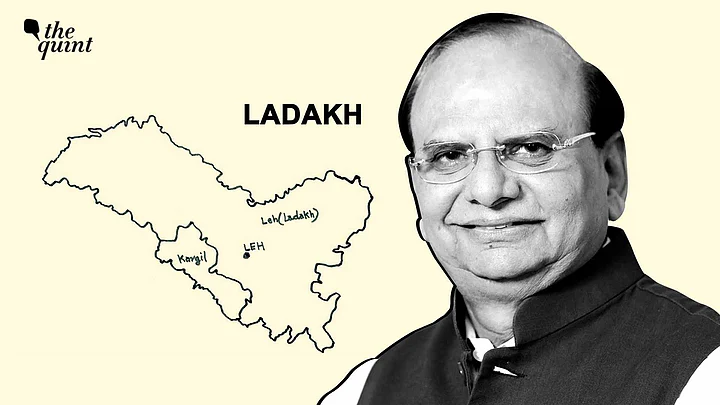
Ladakh, also known as “Moonland of India", is at the trijunction of India, China, and Central Asia, nestled between the barren Karakoram and Himalayan ranges. Literally translating into “La” (Mountain Pass) and “Dakh” (Region), it is also called the “Land of High Passes”.
Historically, it has been highly contested, strategic, and sensitive, owing to tense borders with China along the Line of Actual Control (LAC) with areas like Aksai Chin, Xinjiang, and Tibet. Meanwhile, it is also contiguous with Pakistan Occupied Kashmir (POK) with theatres like Gilgit-Baltistan along the Kargil sector, and with the northern tip with the highest battlefield in the world ie, Siachen Glacier.
Such an hostile neighbourhood with three nuclear powered nations (India, China, and Pakistan) jostling for regional control, makes it one of the most militarised zones in the world.
Borders, Battlefields, and a Permanent Military Presence
Since Independence, all wars with Pakistan (1947-48, 1965, 1971, 1999) and with China (1961 and the recent clashes in 2020) have involved the Ladakh sector. It remains a perennial flashpoint, with all three countries maintaining permanent high-altitude deployments with full-time battle preparedness.
This underlying situation makes the internal situation and the relationship of people in Ladakh with the foundational and constitutional “Idea of India”, critical. Like many border regions, Ladakh, too, is given to people from the minority religious and ethnic denominations, hence susceptible to disillusionment and “othering” in the times of acute majoritarianism, like now.
It is almost equally populated (150,000 each) between Ladakhi Buddhists (in the Northern Leh region) and Shia Muslims (in the Southern Kargil region).
However, as both the Ladakhi Buddhists and Kargil’s Shia Muslims (unlike Kashmiris, they are Balti or Purigpa) are unique and do not share cultural, linguistic, or sectarian affinity across the respective borders. These regions were never given to any form of secessionist tendencies. They have always provided logistical support, humanitarian relief, and local intelligence to the Indian Army, including as recently the 1999 Kargil War or during the 2020 Indo-Pak skirmishes at Galwan Valley, Pangong Tso, and Demchok. Both these native and distinct communities distinguish themselves from their co-religionist Tibetans, Kashmiris, and Pakistanis.
Longstanding Grievances Under the J&K Administration
But, as Ladakh was part of the erstwhile Jammu & Kashmir State (till Jammu & Kashmir Reorganisation Act, 2019), it always felt unrepresented and marginalised. It attributed its underdevelopment, limited authority for governance, and cultural/religious concerns, to its diminished and “deprioritised” status in the larger governance and urgencies of the larger Jammu & Kashmir State.
Ladakh always sought administrative autonomy, protection of its natural resources, and direct access to developmental projects—all of which it always imagined to be forgotten or “seconded” in the J&K State’s larger narrative.
The ushering in of the Ladakh Autonomous Hill Development Councils (LAHDC) in 1990’s triggered demand of an separate “State” from J&K.
On 5 June 2019, Ladakh was made a Union Territory without a legislature (unlike the remaining part of the newly created Union Territory of J&K which retained a legislature). Initially the creation of the Ladakh Union Territory under the direct Central rule via a Lieutenant Governor was welcomed and many hopes were pinned on long-standing demands and accompanying promises.
But like almost all other parts of the truncated J&K State, where Jammu still feels aggrieved and Srinagar still awaits restoration of Statehood, Ladakh’s initial euphoria has also regressed into despair and disillusionment.
Sonam Wangchuk and the Sixth Schedule Movement
Ladakh’s most famous son, Sonam Wangchuk, has been at the forefront of demanding political autonomy, empowerment and protection of local land and culture, especially with the demanded inclusion into the Sixth Schedule of the Indian Constitution.
From protecting tribal land ownership, disallowing outsiders to buy land freely, to demanding control over natural resources, has made the one-time hero of the dispensation at the centre, a virtual persona non grata. His plea that his demands are nothing untoward, but only what were promised safeguards, is snubbed.
Centre alludes to national security concerns in border areas (which require expeditious approvals), as opposed to risking veto powers by local autonomous councils.
But to be fair to Ladakhis, this is hindsight wisdom. Also there is an additional complexity of passing new constitutional and administrative adjustments, as was done for North Eastern States with similar provisions. The government also wants uninhibited control over investments, tourism expansion, and energy projects. Speedy clearances on defense infrastructure, logistics and governance, is at the heart of Centre’s retrospective position.
Today, that executive power vests solely and wholly with the Lieutenant Governor, who acts as the Chief Administrator overseeing all governmental departments, implementing policies and laws, as also supervising the local governance. This arrangement has shifted the historical frustrations from “Srinagar” (from where the ruling Chief Ministers of erstwhile J&K State hailed) to time-serving bureaucrats from “Delhi”.
So much so, that even the traditional rivalry between Kargil and Leh has been put on the back burner with the formation of a joint platform called the Leh Apex Body and the Kargil Democratic Alliance, to pitch for vied constitutional safeguards. Locals feel that “Delhi” has been insensitive, slow, or simply insincere ie, fast to promise but reluctant to honour.
A New Lieutenant Governor, but No Clear Roadmap
This dissonance of a local groundswell cannot augur well for a sensitive, and hitherto peaceful part of a highly-strategic region. The aspired and frustrated voices of the Ladakhi is not novel, but what was agreed in principle, was later denied.
It needs a revived, mature, and creative political engagement, across the partisan aisle that can bring back all stakeholders towards an agreement and compromise that addresses both the local and national concerns. A winning formula that safeguards national interest and that of the locals in not unfathomable as it only requires an honest and genuine effort in political/administrative creativity.
The recently announced gubernatorial changes have led the till now Lieutenant Governor of Delhi, VK Saxena, to move to Ladakh. Unfortunately, the said incumbent’s track record in dealing with contrarian voices (in Delhi) is not very reassuring as a large part of the accusation against the former AAP government in Delhi and its leaders, was led by the same individual.
This had led to long term incarceration of political opponents of “Delhi” (at the Centre), even though much of the accusations has fallen flat, since then. The said individual is also of a corporate/commercial background and not even that of any security or even political significance, as could be imagined to be required, in handling the Ladakhi situation.
Is it “demotion” for the said individual to be sent from Delhi to Leh, or is it part of ushering in fresh thinking to untangle the Ladakhi knots and conundrum? Only time will tell.
Hopefully, Leh is not a punishment posting for the said LG and that there is thought-through thinking and intent behind sending him as the new LG, as Ladakh is just too strategic a place to be relegated to “has-beens”. Ladakhis—both from Leh region and Kargil region—have been first rate patriots and they surely deserve better.
(Bhopinder Singh is a Former Lt Governor of Andaman & Nicobar Islands and Puducherry. This is an opinion piece and the views expressed above are the author’s own. The Quint neither endorses nor is responsible for the same.)
