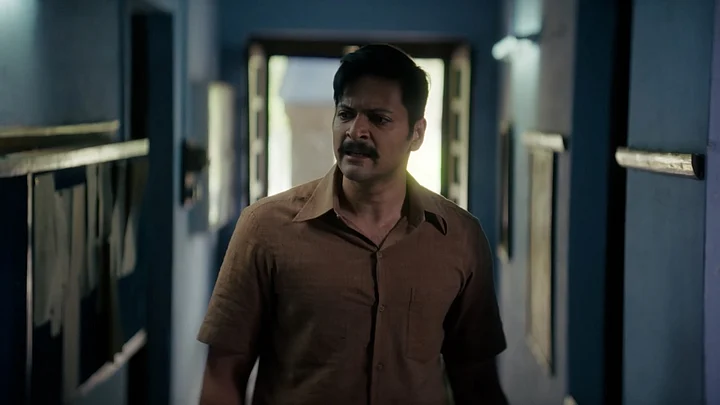
Crime dramas are to Hindi streaming what sports biopics are to Hindi cinema. Both genres have been done to death and each new iteration—besides offering nothing new—plays into the same exhausted tropes we have already seen.
Raakh, the eight-episode crime caper based on the disappearance of two teenagers, does little to buck the trend.
For much of its runtime, it struggles to compel viewers to care about either the missing teenagers or the investigation that follows.
Reconstructing a National Horror
A fictionalised retelling of the infamous 1978 Ranga-Billa case, Raakh opens with the disappearance of Sahil and Suman Arora—a brother-sister duo who go missing on their way to the All India Radio office. Their disappearance puts the spotlight on the police and the city administration.
Ali Fazal plays Jayprakash, the sub-inspector who is tasked with the responsibility of investigating the murder. Rakesh Bedi—still riding on the high of Dhurandhar’s success—plays Jayprakash’s father, Ghanshyam. He brings his son homemade mutton to the police station every night. Ghanshyam uses his food and hospitality as a weapon to win over the police staff.
Sonali Bendre is Mona Arora, a grief-stricken mother who is stuck in denial—she cannot accept that her kids are dead. Aamir Bashir is Colonel Ashok Arora—the father of the missing kids—whose privilege as an ex-army man compels the police to act swiftly.
The rest of the series tracks Jayprakash's efforts to assemble a case from a maze of half-revealed clues and dead ends.
The Difference Between Acting And Pretending
It is important to state that acting and pretending are fundamentally different. All of us pretend in our day-to-day lives. But when professional actors pretend to act, you can’t help but feel disillusioned with the streaming era.
Most of the show’s cast—with the exception of Akash Makhija and Ramandeep Yadav—acts like they know there is a camera filming them.
This is the kind of acting that is acutely aware of itself. The writing amplifies this self-consciousness. Most of the dialogue in the series is expository and explains the plot rather than allowing it to unfold dramatically.
Characters don’t communicate with each other as people do. Instead, they exchange information with the sole intention of informing the viewer about the recent developments: a dead body being discovered, or a thread being uncovered.
Pray, why not let these moments play out organically? Why must everything be spelled out and made too obvious? Why are characters talking to each other like human push notifications delivering plot updates on cue? This is when characters stop being characters and become narrators trapped in a story.
Stars Are Born
It won’t be an exaggeration to say that Ramandeep Yadav and Akash Makhija are the stars of the show. In a cast that is struggling to hold its own, these two newcomers have significantly outperformed their more experienced counterparts.
Yadav and Makhija play Rajjo and Babu, respectively. Both are murderous men—one feeding off the other’s energy—leaving behind a trail of murders spanning multiple Indian cities.
Their performances are impressive in their own right, but they are also aided by roles that are more sharply written than most others in the series.
While Rajjo (Yadav) is more restrained and comparatively less ruthless, Babu (Makhija) is more unhinged; his menacing grin and lack of remorse are deeply unsettling. Bendre and Fazal are convincing in their respective roles, but there are occasional scenes where the illusion breaks. These are the scenes where their performance feels self-conscious.
The Tyranny Of Overexplanation
Another tragic flaw in the series is that it doesn’t give enough to the viewers to chew on. The threads are not engaging enough to warrant serious emotional or intellectual investment.
The pace, particularly in the first few episodes, is painfully slow. By the time you reach the finale and all the loose ends are tied up, the show seems less ‘slow burn’ and more ‘slow poison’.
The show also tends to overexplain many of the moral dilemmas it grapples with. The disappearance of two kids, the systemic apathy, and the inefficiency of the police department are not hinted at or meaningfully dramatised but rather overstated quite a few times. The ideal choice here would have been to allow the viewers to infer the moral tension themselves, or allow them to sit with the discomfort.
The Anatomy Of Grief
It isn't until the fourth episode, Rahu-Ketu, that the true tragedy at the heart of the series comes into focus. A grief-stricken Mona begins to unravel, her grief curdling into rage and often erupting in violent outbursts.
In a gut-wrenching scene, we see the father of the kids, Ashok, break down in a public park shortly after reading the forensic report of his daughter. I found myself far more invested whenever the series shifted its focus to the grief of parents struggling to come to terms with the loss of their children. These moments constitute the show's emotional core, and I only wish they had been given more screen time.
The show effectively portrays the corrosive power of toxic masculinity and how it punishes homosexuality as a form of ‘impure’ masculinity—corrupted by seemingly feminine traits. This is explored through Pyare Mohan (Mukund Pal), a character who is as much a victim of Babu and Rajjo as the children they murdered.
Queerness As Punishment
Pyare Mohan is written as a man who cross-dresses. He performs in drag at a local club to make ends meet. The first time Babu and Rajjo see Pyare Mohan perform at the club, they hurl the most vitriolic, hateful abuses targeting his sexuality.
His effeminate gesticulations are laughed off. Later, Pyare Mohan is sold to another man as a prostitute in exchange for Rs 1,000.
Such is Pyare Mohan’s tragedy that when he manages to escape the deadly duo, he begs the police to let him stay in the jail, for he is afraid that he will be forced to live a life where his dignity is forever negotiable and his survival contingent upon the whims of violent men.
The prejudice faced by gay men is underscored in another scene, where a man recounts the death of Ballu Chooranwalla, another queer character in the series. “Woh alag tha… duniya mein alag hone se bada koi apraadh nahi hai (He was different, and there is no crime in this world bigger than not fitting in).”
While the series is clearly interested in exploring the violence inflicted upon queer people, the show is less successful when it tries to dramatise this violence, which reflects in its treatment of Pyare Mohan. The gaze on Pyare Mohan occasionally veers into the exploitative rather than the empathetic.
I kept waiting for the narrative to offer Mohan an opportunity to reclaim his dignity, but that moment never arrived. The third episode, titled Dhumketu, is particularly difficult to watch for this reason.
Flashes Of Brilliance
The show has its share of memorable moments. In one scene, an astrologer reads Rajjo's horoscope and predicts that he will soon find himself in ‘legal trouble’—a prophecy that is fulfilled when he is arrested later.
A flashback shows Jayprakash's admiration for Dr BR Ambedkar as a loknayak (public hero). It is refreshing, although I wish the series had explored this aspect of Jayprakash’s character in greater depth. Another memorable moment is the haunting scene in which Rajjo and Babu, architects of so much carnage, sit before the Taj Mahal as though reflecting on a friendship forged in violence and sealed in blood.
Though the investigation itself is tedious, the emotional payoff towards the end of the eight episodes makes it seem worthwhile in retrospect. Director Prosit Roy dares to imagine an alternate ending to the Sanjay and Geeta Chopra tragedy.
Raakh is yet another addition to the ever-expanding roster of crime dramas on Indian streaming. While it frequently succumbs to the genre's less-assured impulses—overexplanation, sluggish pacing, and mechanical storytelling—it ultimately finds some measure of redemption in its moving portrayal of grief and a finale that delivers genuine emotional closure.
Raakh releases on Prime Video on 12 June.
(Deepansh Duggal is a film critic based out of New Delhi. His work has appeared in Hindustan Times, OPEN, Outlook, Frontline Magazine and The Economic Times. He has a particular interest in anti-capitalist narratives and films that lie at the intersection of power and ideology.)