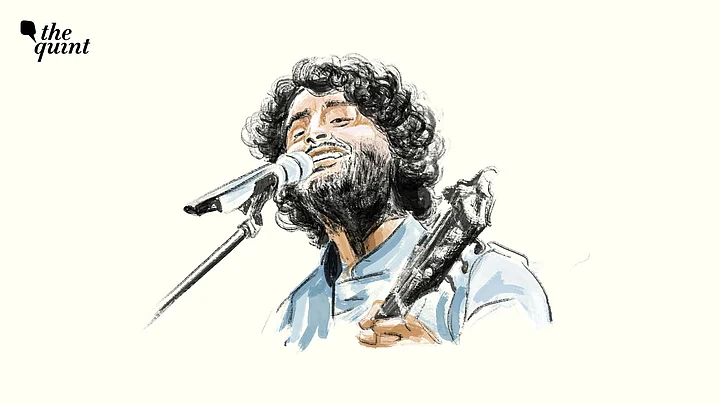
For over a decade, Arijit Singh’s voice has been the emotional shorthand of Hindi cinema. It has struck a chord with people across generations, playing at moments spanning weddings and funerals, first loves and final goodbyes—across cars, college hostels, and family living rooms.
For his millions of fans all over the country, this week brought a devastating news. In a recent Instagram post, Arijit Singh announced he would be retiring from playback singing.
This came just days after the release of the song 'Maatrubhumi' that he sang with Shreya Ghoshal for Salman Khan-starrer Battle of Galwan.
Although the news was baffling to many, the celebrated singer and music producer seemed pleased with his decision. “I am happy to announce that I am not gonna be taking any new assignments as a playback vocalist from now on,” he wrote on Instagram. “I am calling it off. It was a wonderful journey.”
Even as we wonder why Arijit Singh made this announcement out of nowhere, what does this mean for the future of mainstream Hindi music that has become increasingly synonymous with his voice?
How Arijit Singh Entered Bollywood
Born in Murshidabad, West Bengal, in 1987, Arijit Singh started training in Indian classical music at just three. He formally learned Indian classical music, playing the percussion and tabla. At the age of nine, he earned an Indian government scholarship in classical vocals.
Arijit Singh had his first major public moment in 2005 as a participant on the reality show Fame Gurukul. He was only 18 then. Although he did not make it to the finale, his singing left an impression on audiences across the country.
He eventually debuted as a playback singer in 2010 with the Telugu film Kedi. A year later, he broke into Bollywood with the song “Phir Mohabbat Karne Chala Hai Dil,” which he sang with Mohammed Irfan in Mohit Suri’s Murder 2, starring Emraan Hashmi.
However, it was the iconic heartbreak song, “Tum Hi Ho”—which he sang with Palak Muchhal for Suri’s Aashiqui 2 in 2013—that catapulted Singh to national fame. Composed and written by Mithoon, the song became a chartbuster, with Singh’s vocals effectively capturing the profound yearning, devotion, and unconditional love central to the film.
An Illustrious Bollywood Career
Arijit Singh is easily one of the most popular and commercially successful singers in India today. He’s best known for his romantic songs that articulate love, longing, and heartache with an earnestness that feels intimate rather than performative.
Some of his biggest hits include “Channa Mereya,” “Agar Tum Saath Ho,” “Tera Yaar Hoon Main,” “Raabta,” “Kesariya,” “Ae Dil Hai Mushkil,” and “Hawayein”, to name just a few. Over his now 15-year-long career, Singh has sung well over 700 songs across Hindi, Bengali, Marathi, Tamil, and Telugu. He has collaborated with almost every major Bollywood composer, including AR Rahman, Pritam, and Amit Trivedi.
Singh’s vocals effectively capture the emotions at the heart of Hindi film music with an unusual vulnerability that somehow feels both personal and universal. What sets him apart is the way his voice has bridged generations of Hindi film viewers, cutting across rapidly changing musical trends and formats.
Singh has been India’s Top Artist on Spotify for seven consecutive years, reflecting how his music has travelled seamlessly from cinema halls to people’s personal playlists and private lives.
When I lived in Abu Dhabi a few years ago, my 80-year-old Nani visited me largely to tick something off her bucket list: watching Arijit Singh live. I'll never forget his concert at the packed Etihad Arena, sitting next to my Nani, who was singing along to his songs like she was still in school or college.
This is what makes Arijit Singh’s retirement from playback singing such a monumental loss. At the age of 38, he has already won two National Awards and eight Filmfare Awards, and was even awarded the Padma Shri last year for his immense contribution to Art and Music.
The Reason Behind His Decision
Arijit Singh’s announcement, thus, comes at the peak of his career. Yet, his decision was not impulsive, but well thought out. The next day, he provided more context in a post on X.
"There isn't one reason behind this, there are several reasons, plus I have been trying to do this since a long time,” Singh explained. “Finally I have gathered the right courage.”
His explanation points to creative fatigue, overexposure, and exhaustion shaped by algorithmic music production.
In his words, “I get bored pretty quick, thats why I keep changing arrangements of the same songs and perform them on stage. So here is the thing, I got bored."
The second reason is Singh’s desire to return to Indian classical music. “I wanna go back to making music,” he added. “I wanna start again. God has been really kind to me. I am a fan of good music, and in future will be learning more and do more on my own as a small little artist.”
A source close to Singh told The Quint that he is feeling "saturated churning out songs he doesn’t connect with", as practically every major film star and production house wants him to sing a song for each movie they do.
He wants to slow down, nurture his craft, and strengthen his own artistic voice, which is the foundation of his success in the first place. Although this may be painful for millions of fans, this decision seems to be the result of immense soul-searching, reflection, and the need for him to be true to himself.
Despite the grave loss for Hindi music, Singh’s departure could be a wake-up call for the Hindi film industry. It must now contend with what his departure exposes: an increasing creative bankruptcy that relied heavily on a single voice to carry emotional freshness across films, generations, and constantly changing audience tastes.
In this sense, Arijit Singh’s departure from playback singing can mark the beginning of a new chapter, with new voices emerging and a greater emphasis on honesty and genuine artistry.
Fans will not feel the impact of his decision to retire from playback singing immediately. The singer stated that he will not take any new assignments, but he will still fulfill his prior commitments.
This means fans can hear him in songs from the upcoming Tu Ya Mein and O Romeo in February alone. He will also likely still sing vocals for films he already took up, including Bhoot Bangla, Hai Jawani Toh Ishq Hona Hai, Cocktail 2, Tu Meri Zindagi Hai, King, Ramayana Part 1, and Animal Park.
What Will Arijit Singh Do Next?
Singh isn't waiting for any such industry-wide changes to take place. “Just to be clear, I won’t stop making music,” he clarified.
Without the burden of constantly having to do playback singing for every other major Hindi film, the possibilities for Singh’s artistic expression are endless. He could do more international collaborations, like his English-Punjabi fusion “Sapphire” with Ed Sheeran or the DJ Martin Garrix single “Weightless.”
Singh could also compose more music for films, as he did for Pagglait, starring Sanya Malhotra, in 2021, which beautifully evoked the protagonist’s arc of self-discovery. He could even produce more original songs, free from the need to cater to the market forces of Hindi films. This could be great news for India’s independent music scene outside of its film industries.
Either way, with Singh gaining back his artistic freedom, perhaps his best work is still ahead of him. For listeners who grew up, fell in love, and learned to grieve with his voice in the background, this may be worth celebrating, even as Hindi cinema learns what it means to lose a voice that has held generations together.
(Kaashif is a writer and film critic from Mumbai, currently based in London. He is the Assistant Culture Editor of The Polis Project.)