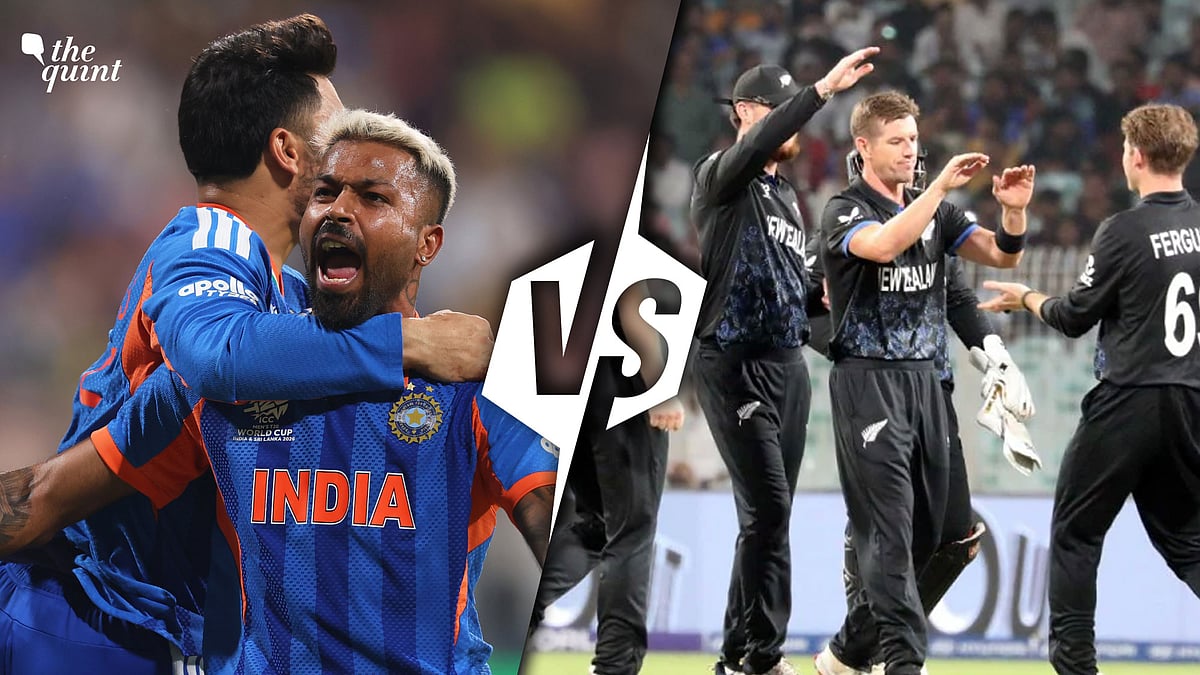
T20 World Cup Final, India vs New Zealand: A Game Which Should Not Have a Loser
T20 World Cup 2026 Final: Unlike life, cricket doesn't do greys. He, who isn't a winner, has to be a loser.
advertisement
New Zealand Do Not Deserve to Lose
In the immediate aftermath of the 2019 ICC ODI World Cup final, New Zealand all-rounder James Neesham tweeted: "Kids, don’t take up sport. Take up baking or something. Die at 60 really fat and happy."
Neesham had taken three wickets in that final against England. Yet New Zealand lost — in a Super Over. Two years later, he featured in the final of the 2021 T20 World Cup against Australia. New Zealand lost again. And only a year ago, they were beaten by India in the final of the ICC Champions Trophy.
In the final of the ICC Men’s T20 World Cup 2026, they do not deserve to lose. Despite the limitations in terms of quantitative strength, New Zealand always ‘arrive’ in ICC events. This will be their fifth final appearance at a white-ball ICC event in the last 11 years — they lost on all four previous occasions.
That they have arrived here is nothing short of a remarkable achievement. That they do so repeatedly is nearly miraculous. For the dejected Brendon McCullum of 2015, for the inconsolable Kane Williamson of 2019, for the heartbroken Trent Boult of 2021, New Zealand do not deserve to lose. If there is a cricketing god, perhaps the ledger of fate still owes the Blackcaps a line of justice.
But India Don’t Deserve to Lose, Either
Virat Kohli, Rohit Sharma and Ravindra Jadeja made a combined 358 appearances for India in T20I cricket. For more than a decade and a half, they were the three pillars holding up the vast Colosseum of Indian cricket. All three retired on the same day — 29 June 2024 — when India defeated South Africa to win their second T20 World Cup title.
Cricket can be ruthless to teams in transition. Ask Sri Lanka or the West Indies, and they will narrate the story in weary detail. Many had expected India to endure a similar phase. Many claimed that a Suryakumar Yadav is no match for a Rohit Sharma, and a Gautam Gambhir is no match for a Rahul Dravid.
Abhishek Sharma made his debut after the 2024 T20 World Cup, and took very little time to establish himself as the number 1 T20I batter in the world. Despite what has been a really underwhelming campaign so far, his career numbers read: 1386 runs in 44 innings, at a strike rate of 188.82. He is the number 1 T20I batter in the world.
Varun Chakravarthy made a comeback in the T20I team after three years post the 2024 campaign. In his first stint, he went wicketless at the 2021 T20 World Cup. Now, with 72 wickets in 44 matches at an average of 16.3, he is the number 1 T20I bowler in the world.
This is a match in which no one deserves to lose. But unlike life, cricket does not indulge in shades of grey. It is binary — what is not white must inevitably be black. He, who is not a winner, is a loser. And sporting history does not remember losers.
Battle of Words Before the Battle of Bat and Ball
The Quint had asked New Zealand captain Mitchell Santner whether he is desperate to ditch the ‘cricket’s good guys’ tag and embrace a villainous perception for a change, by breaking a billion hearts as opposed to metaphorically winning them.
He replied:
Borrowing a line from Pat Cummins, Santner also mentioned that the goal is to silence the crowd in Ahmedabad. To this, Yadav replied:
The Key Players
It goes without saying that regardless of the occasion, Jasprit Bumrah is the biggest threat to the opposition whilst playing against India. He has scalped 10 wickets in this competition at an economy rate of 6.62 — best among those who have taken a minimum of 7 wickets. In a semi-final where 499 runs were scored between India and England at the Wankhede Stadium, Bumrah conceded only 33 runs in four overs.
(Photo: CricViz)
New Zealand, on the other hand, will be reliant on the opening pair of Finn Allen and Tim Seifert, who have combined to score 583 runs in this competition.
(Photo: CricViz)
(Photo: CricViz)
And so the final arrives at its inevitable question.
Can there truly be no loser today? Please?