
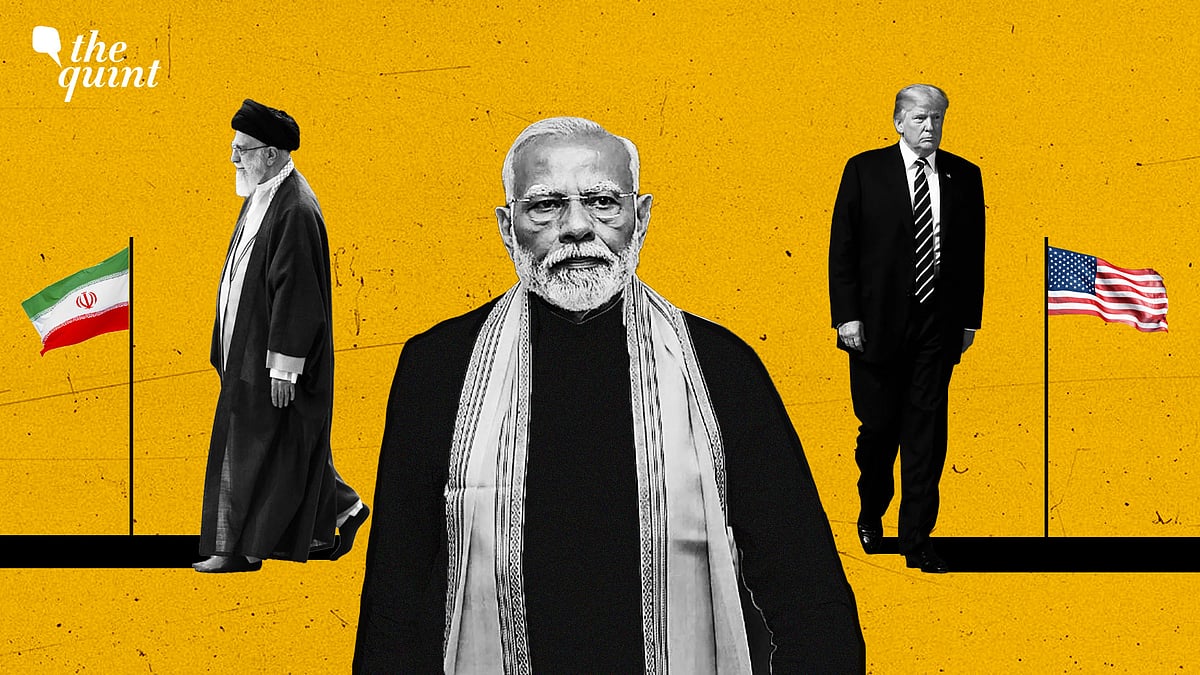
India’s 'Strategic' Silence on Israel–US War Against Iran May Prove Costly
If the Iranian regime continues to be in place, it will not take kindly to India's current position.
advertisement
It is day four of the Israel–US war against Iran, and there is no indication that the Iranian people are about to overthrow the theocratic regime. Despite the heavy losses inflicted on Iran—with the Supreme Leader, Ayatollah Ali Khamenei, together with top military and intelligence leadership, killed on the very first day of the strikes—the regime appears intact.
Iran, caught by surprise while negotiations with the US over its nuclear programme were still underway, retaliated within 24 hours. While Iranian missiles struck Israel, Tehran appears to be concentrating more on targeting US bases in the region. This has translated into attacks affecting the UAE, Saudi Arabia, Jordan, Iraq, Qatar, and Kuwait.
For India, the implications are manifold.
After the Opening Shock
Soon after the war began, The Washington Post reported that, together with Israel, Saudi Arabia too had lobbied with the US to strike Iran. While the country members of the Gulf Cooperation Council have expressed solidarity with each other—with the UAE even recalling its Ambassador from Tehran—it remains doubtful whether such expressions will translate into coordinated military action.
Saudi analysts have alleged that the US has turned its focus to protecting Israel, leaving the Gulf states hosting its bases exposed to Iranian missiles and drones.
US President Donald Trump, too, appears to want a quick end to the war he started. Recent polls show that one in four Americans disapprove of the war—particularly given that both the Pentagon and US intelligence agencies have asserted there was no imminent threat to the United States from Iran.
The US has already suffered casualties, and all this does not augur well for Trump's presidency. From President Trump’s initial maximalist position of regime change in Iran, there has been a shift. Secretary of Defence Pete Hegseth has since clarified that the US is not seeking regime change. Trump is reported to have reached out to Tehran for talks.
Washington’s Shifting Goalposts
Iran, however, does not seem to be in a mood for a ceasefire. Secretary of the Supreme National Security Ali Larijani is reported to have refused negotiations saying there were no red lines left. All this indicates that Iran, no matter how degraded and decapitated, may not see a regime change soon.
For India, the consequences are far-reaching.
At the same time, Indian exporters are already worried as the conflict engulfs major shipping routes and disrupts key infrastructure in the Gulf — a crucial market for Indian exports already reeling from Trump’s tariffs. The stock market has also taken a hit.
Energy Shock and Economic Fallout for India
In this context, Prime Minister Modi's recent visit to Israel assumes greater significance, coming as it did almost on the eve of Israeli strikes on Iran.
India's stakes in West Asia are huge. Nearly nine million Indian expatriates live across the region, remitting significant foreign exchange. Gulf countries are also major sources of foreign investment in India, as well as important destinations for Indian investment.
This perhaps explains why, soon after the outbreak, PM Modi spoke to his UAE, Saudi, and Israeli counterparts, while the Minister of External Affairs also reached out to his Iranian counterpart. Officially, however, India has made no statement regarding the assassination of Iran’s Supreme Leader.
For while a regime may or may not change, geography does not. And Iran is important for India's Eurasian outreach.
Chabahar, Eurasia, and the Connectivity Gamble
India had invested in the Chabahar port not only for accessing the markets and goods of Central Asia, but also as a counter to Pakistan's Gwadar Port developed by the Chinese. While the late Supreme Leader did needle India from time to time, Iran had also played a role in balancing out the threat from Pakistan.
In recent times, Chabahar port became the plank on which India had hinged it's approach towards Afghanistan under the Taliban.
More recently, Iran, together with Armenia, had become a bulwark against the new emerging threat from Turkiye and Azerbaijan. India had even transported military hardware to Armenia through the territory of Iran. And it was through Iran that India could have had a multimodal access to the South Caucuses, where it has been trying to create strategic space for itself, to the Black Sea ports and Europe on one hand, and to the International North South Transport Corridor (INSTC) and the Russian Federation, on the other.
Thus, whether it be Chabahar or Bandar Abbas, Iran would also be imperative for India in its connectivity plans, as repeated crises with the Suez and the Read Sea routes have shown. At least until the India–Middle East–Europe Corridor (IMEC) becomes operational — which is unlikely in the near term — Iran remains indispensable.
This is why till now, through all the labyrinthine twists and turns of West Asia geopolitics, India had followed a carefully calibrated path.
The End of India’s Balancing Act?
This holds true even now. India may have now given up on its plans for the Chabahar port, in which case it will have relinquished valuable strategic space to it's rivals. Countries like Turkiye, Azerbaijan, and China will continue to benefit from the Middle Corridor and the recently mooted Trump Route for International Peace and Prosperity (TRIPP).
If the Iranian regime continues to be in place, it will not take kindly to India's current position. And if a new regime comes to power, India will have to build relations from scratch.
Either way, the war does not bode well for India.
(The author is an award-winning journalist specialising on Eurasian affairs. This is an opinion piece and the views expressed above are the author’s own. The Quint neither endorses nor is responsible for the same.)
- Access to all paywalled content on site
- Ad-free experience across The Quint
- Early previews of our Special Projects
Published: undefined