
Real Story Behind Modi Govt's Stand isn't Israel or Iran, it's UAE
How 'brother' Sheikh Zayed of UAE became PM Modi's closest ally among world leaders.
advertisement
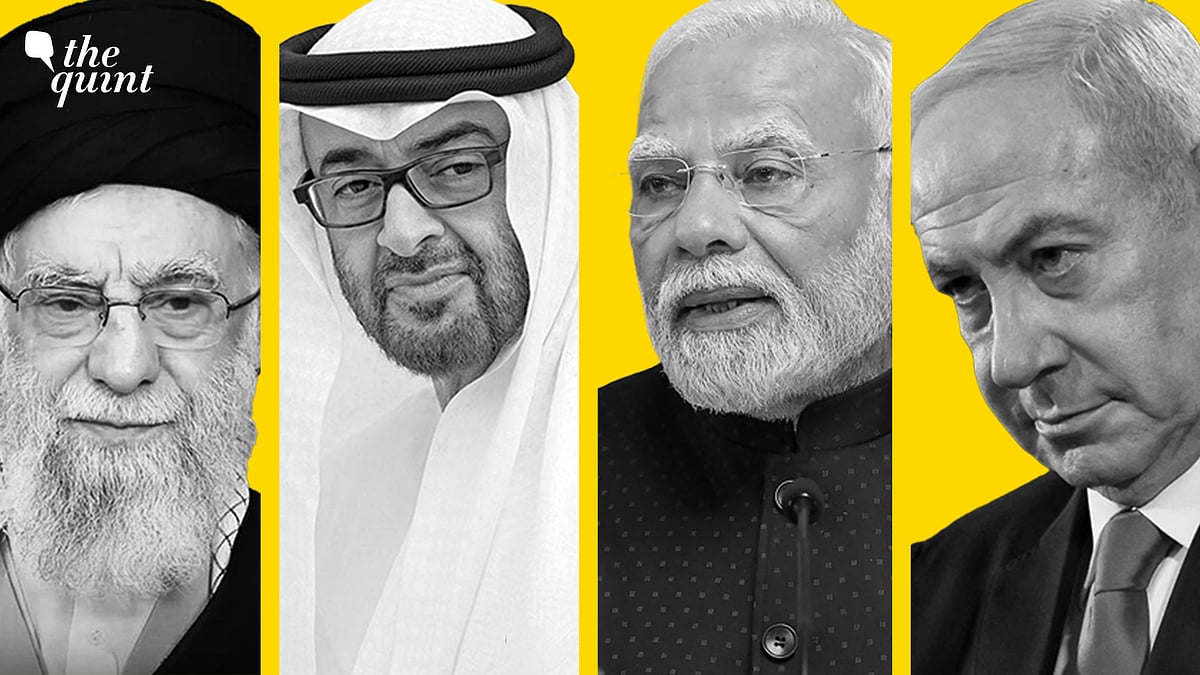
Two phone calls and two meetings lie at the core of India's stand in the ongoing war between Israel and Iran.
The government of India's first public response after Israel attacked Iran and the latter struck American bases in Gulf countries and retaliated against Israel, were two posts on Prime Minister Narendra Modi's X account that provided details of two phone conversations.
The first post was on PM Modi's conversation with President of the United Arab Emirates (UAE), Sheikh Mohamed bin Zayed Al Nahyan.
The second was on his conversation with Israeli PM Benjamin Netanyahu.
The above two posts also went out in Arabic and Hebrew, respectively.
However, if one reads between the lines, it becomes clear that the story behind India's stand isn't Israel. It is the UAE.
Note the difference in tone of PM Modi's posts.
PM Modi refers to Sheikh Zayed as his "brother" as he "strongly condemned" the attacks on the UAE. The PM expressed solidarity with the UAE but stopped short of naming Iran.
PM Modi's post on Netanyahu "conveyed India's concerns over recent developments" and called for "early cessation of hostilities". There was no expression of solidarity. He didn't refer to Netanyahu as his "friend" even though he has done so in the past.
What explains this difference? And what are the two meetings referred to in the beginning of the story?
PM Modi and his 'Brother' Sheikh Zayed
Among world leaders, Sheikh Mohammad Bin Zayed is arguably the one with whom PM Modi enjoys the closest personal relationship. He is the only major leader PM Modi refers to as his "brother". He did refer to Pravind Jugnauth of Mauritius and Sheikh Hasina of Bangladesh as his brother and sister, respectively. But PM Modi has called Sheikh Zayed as "brother" the maximum number of times, and he is the only one among major world leaders that he refers to in this manner.
Everyone else—Vladimir Putin, Donald Trump, Barack Obama, Netanyahu—have been referred to as "friend". Interestingly, Netanyahu has referred to Modi as his "brother" but Modi hasn't done so at least publicly.
This difference is important to understanding India's position on the current conflict in West Asia. India's position is more closely aligned with the UAE than Israel.
Like the UAE, India wants de-escalation. The UAE is Israel's closest ally in the Arab World. However, it is not in favour of the present escalation by Israel, especially in the light of strikes by Iran on its infrastructure.
New Delhi was left slightly embarrassed with Israel launching its attack immediately after PM Modi's visit to Tel Aviv and his speech at the Knesset. Israel presented Modi's presence as an endorsement of its actions and as proof of India's support for it against Iran's Axis of Resistance and the emerging Saudi-Turkiye-Pakistan "Sunni Axis". However, India never openly stated such a position nor confirmed joining any such alliance.
Two Meetings
Two recent meetings are said to have been crucial in bringing India and the UAE on the same page in the build-up to what at that time was an imminent US-Israel attack on Iran.
On 19 January, Mohammad Bin Zayed met PM Modi during a quick visit to New Delhi. Then, PM Modi met the crown prince of Abu Dhabi on the sidelines of the AI Summit in New Delhi exactly a month later.
PM Modi and Sheikh Bin Zayed met on 19 January.
PM Modi's Instagram page
India's official position calling for "end of hostilities" and not openly expressing solidarity with Israel's offensive, needs to be seen in this light.
There is a sense among the Gulf countries under attack from Iran that Israel's aggression put a target on their backs and the US prioritised protecting Israel, leaving them to fend for themselves.
New Delhi sees an opening here to expand its leverage in the region.
A Social Media Trend and Damage Control by BJP
Iran's strikes on Dubai and Abu Dhabi sparked a trend on Indian social media, with many users trolling NRIs based in the UAE for leaving India. A key person who joined this trend was BJP MP Nishikant Dubey who posted on X, "A lesson for those leaving behind their Indian passport to go to Dubai: With Modi ji here, we are safe. It's easy to post long, lengthy things on social media."
This social media conversation coupled with Indian news channels running visuals of the damage in Emirati cities, created a narrative against the UAE.
The BJP went into damage control mode. The BJP's foreign affairs in-charge Vijay Chauthaiwale condemned the anti-UAE comments.
This was significant as the BJP seldom criticises such social media trends.
Soon, many BJP-leaning influencers began putting out posts praising the UAE for "taking care of Indians" during the strikes.
It is a known fact that the UAE has one of the largest Indian immigrant populations. However, what isn't often discussed are India's deeply entrenched economic interests in the UAE.
A sizable portion of India's elite—business leaders, film stars, sportspersons and even politicians—have a base and investments in the UAE. Many of them own properties in the Emirates and have even made Dubai their primary residence.
Any attack on the UAE, therefore, affects the economic interests of a sizable section of India's elite, including those close to the BJP.
This isn't a coincidence but part of the UAE's growth strategy.
Iran's attacks have put this under threat.
Ideological Alignment Between Modi Govt and the UAE
Since the 2010 Arab Spring—popular protests against multiple regimes in the Arab World—the UAE has positioned itself as the centre of the 'counter-revolution' in the Arab world. The UAE has presented this as a 'battle against Islamism'. This further intensified after the US under Barack Obama and later Trump began disengaging from the region.
This is a major point of alignment between the Modi government and the UAE. Securitsation of Muslims has been a key facet in the policies of both governments.
The more recent example of this is the report that India's Ministry of Home Affairs urged states to "closely monitor religious gatherings and sermons", particularly identifying “pro-Iran radical preachers giving inflammatory speeches or attempting to mobilise crowds”.
India and the UAE are also countries that imposed restrictions on protests against the genocide in Gaza. While in India, this has been in the form of crackdowns against pro-Palestine protests in BJP-ruled states, in the UAE there has been a near complete ban on such protests with even wearing a Keffiyeh being seen as a political act.
UAE's Tussle with Saudi Arabia and India's Concerns
Led by the royal family of Abu Dhabi, the Emirate that controls all security and foreign policy matters in the UAE, it has been an increasingly assertive regional player in West Asia and North Africa over the past two decades. It has presented itself as a bulwark against both Iran's Axis of Resistance as well as 'Islamist' movements in different countries.
But ideology isn't a sufficient explanation for the UAE's policy in the region.
The UAE has pursued an assertive foreign policy in several conflict zones, often backing specific armed factions, militias, or separatist groups to increase its own leverage and counter perceived threats. This includes the Rapid Support Forces (RSF) in Sudan, the Southern Transition Council (STC) in Yemen, and the faction led by Khalifa Haftar in Libya.
It has also been accused of backing Somaliland against the federal government in Somalia and Druze separatists in Syria.
Saudi Arabia saw UAE-backed-STC's expansion in Yemen as an effort to undermine regional stability, and it struck STC positions in December 2025 and January 2026. This marked the first major confrontation between Saudi Arabia and the UAE's interests in the region.
Saudi Arabia's efforts to form an axis with Türkiye, Pakistan, and to some extent Egypt, need to be seen as its effort to counter the UAE-Israel Axis while continuing to oppose the Iran-led Axis of Resistance.
This has complicated matters for India.
India has close ties with Saudi Arabia. But if the Saudi-Pakistan-Türkiye axis strengthens, it may be seen as a cause of concern by New Delhi.
This has provided cause for further alignment between India and the UAE.
- Access to all paywalled content on site
- Ad-free experience across The Quint
- Early previews of our Special Projects
Published: undefined