
Neha Bora isn't First to Refuse a Peace Bond, but History May Not Save Her
Neha Bora's case echoes the freedom struggle and the protest movements that followed independence.
advertisement
"Whose peace am I being asked to keep?"
By raising this question, All India Students' Association president Neha Bora has turned what could have been a little-known preventive proceeding before a Special Executive Magistrate (SEM) into a broader debate on protest, public order, and personal liberty.
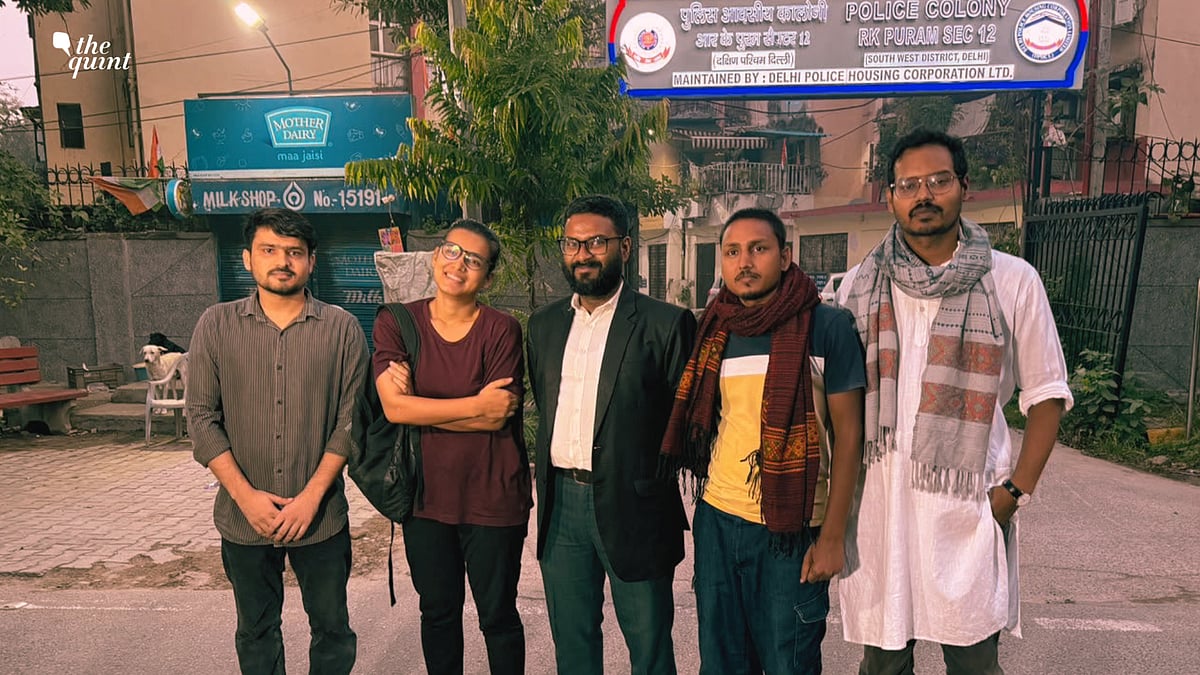
Bora told reporters on Saturday, 24 October, that she had not and AISA would not sign the Rs 10,000 peace bond she was asked to sign after participating in the "Lehra Do Tiranga" march in Delhi on 16 October. She said signing it would "normalise" bonds against dissent.
On Saturday, she appeared before the magistrate, received the papers and was given until October 29 to respond.
Section 126 of the BNSS empowers an Executive Magistrate, who receives information that there is a likelihood of any person to commit breach of peace, cause a disturbance of the public tranquillity or commit a wrongful act which is likely to cause such disturbance, to ask that person to show cause why her security should not be taken for maintaining peace.
Section 135(3) allows the magistrate, once the inquiry has begun, to require an interim bond if immediate measures are necessary, with reasons recorded in writing. At the conclusion of the inquiry, the magistrate must decide under Section 136 whether the need for security has been proved. That distinction is central to Bora's case.
Madhu Limaye Refused Too
An important post-Independence precedent concerns the socialist, Madhu Limaye. In Madhu Limaye vs Ved Murti (1970), Limaye and another political activist were brought before a magistrate in Varanasi in preventive proceedings. The magistrate ordered both to furnish security, which they refused, and thus were detained.
The Supreme Court found that the authorities required interim security by neglecting the inquiry’s safeguards. The Court reasoned that preventive proceedings impinge on liberty, so adherence to procedure was critical.
That decision remains relevant to Bora because it highlights the distinction between the inquiry and an interim bond. Indeed, the Delhi High Court expressly asked the SEM dealing with Bora to keep Madhu Limaye's principles in mind.
The High Court’s judgment in Bora’s case, therefore, suggests that reliance on Limaye may have limits. Limaye won because the process leading to his detention was defective. If Bora receives the material, contests it, participates in a proper inquiry, and the SEM then records reasons for requiring security, the dispute moves beyond the precise problem that arose in Limaye.
Other Precedents Exist
Another precedent was set in the Narmada Bachao Andolan case. Medha Patkar and other activists were held in preventive detention while protesting displacement and rehabilitation. Certain protesters refused to deposit bonds and were detained. Medha Patkar vs State of Madhya Pradesh & Another (2007) offers a closer parallel in protest.
In Patkar, the Court examined the State's claim: Was peaceful protest alone enough to establish that the protesters were likely to breach the peace?
If Bora committed repeated acts of defiance, does that make it likely that she would breach the peace, or does it merely indicate ongoing political activism?
There have been other instances of demonstrators rejecting bonds.
After the revocation of the constitutional provisions related to Jammu and Kashmir in August 2019, the erstwhile bureaucrat and politician Shah Faesal was prevented from leaving Delhi airport en route to Istanbul and was detained under an order passed by an executive magistrate in Budgam when he refused to furnish a bond to keep peace.
The EM directed him to furnish a Rs 50,000 bond to maintain peace; he refused and was detained. He was released from nearly a year-long detention in August 2020, following which he stepped down from politics.
That makes Bora’s declared position potentially more interesting.
Beyond Police Procedural Hurdles
Suppose the next few stages unfold differently. Bora is served with the proof. She makes her response. After reviewing the evidence and respecting all procedural safeguards, the magistrate still decides the peace is likely to be broken and issues the final security order.
But imagine if those routes fail, or she decides not to seek a stay, and still refuses to execute the bond or furnish the required security.
Her objection would then extend beyond defects in the proceedings to the legitimacy of the preventive requirement itself. It would be a wilful rejection of the operative preventive order on the basis that, in her view, compliance would legitimise preventive restrictions against her political protest.
That is where Bora’s position begins to resemble an older tradition of civil disobedience.
Gandhi at Champaran
When Mahatma Gandhi reached Champaran in April 1917 to investigate the grievances of indigo cultivators, Champaran District Magistrate WB Heycock ordered him on 16 April to leave the district by the next available train under Section 144 of the colonial Criminal Procedure Code.
On 16 April, he wrote to the District Magistrate that he was “unable to leave this District” and would instead submit to the authorities by “suffering the penalty of disobedience.”
Champaran was not the form of peace bond which Bora endured. But the idea Gandhi developed became the core of satyagraha: fight the wrongful order, accept the penalty, do not shirk the law, and remain peaceful.
The colonial authorities regularly resorted to security proceedings against Congress and Khilafat workers. Writing on 24 August, 1921, Jawaharlal Nehru described how authorities in Partabgarh asked six young workers to give security and jailed them when they refused.
Independent India retained the machinery of preventive security, although it now operated within a constitutional framework which guarantees speech, assembly and personal liberty.
Under the Constitution, a protester can demand the material relied upon, contest the grounds for requiring security and seek judicial review of the order.
Bora’s Continued Refusal
Bora continues to contest the demand for security during the inquiry. At this stage, the safeguards discussed in Limaye remain relevant. Bora, however, has asserted that the bond "will not be signed" and is challenging the assumption that political protest must be conditional on an obligation to maintain peace.
It remains to be seen whether her declaration would extend to a final order. If SEM reaches a conclusion after a full investigation that security is required and Bora persists with refusal, the case could be pushed into the question of conscientious refusal after a final order.
The statutory consequence is clear: Ss. 126 and 141 of the BNSS state that a peace bond may be issued for up to a year and that a person who fails to furnish the security required by a final order may be kept in custody until the term has expired or until the required security is furnished.
History offers the more complex explanation. From colonial India to modern protest movements, the political force of resisting a preventive undertaking has often come from the protester’s willingness to accept its legal consequences.
If Bora maintains her refusal after an enforceable final order, her stand would raise the further question of whether she accepts imprisonment as an act of civil disobedience.
(V Venkatesan has covered Indian politics, Parliament, and the Supreme Court of India for over three decades. He was Senior Associate Editor with Frontline and later Editor of The Leaflet. He is currently Contributing Editor at Supreme Court Observer. This is an opinion piece and the views expressed above are the author’s own. The Quint neither endorses nor is responsible for them.)
- Access to all paywalled content on site
- Ad-free experience across The Quint
- Early previews of our Special Projects
Published: undefined