
Saksham Tate's Murder Takes 'Honour Killing' Beyond 'Upper-Lower' Caste Binary
How does one explain caste violence perpetrated by OBC groups neither politically powerful nor landholding?
advertisement
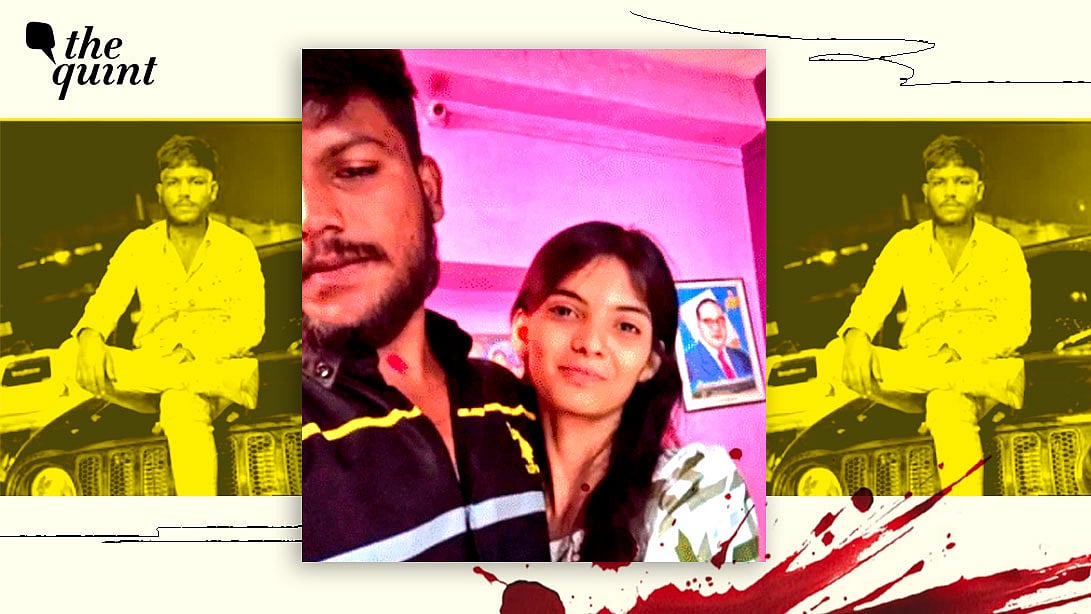
The recent killing of Saksham Tate, a Scheduled Caste (SC) youth in Nanded, Maharashtra, for his relationship with Aanchal Mamidwar from an Other Backward Classes (OBC) community, has triggered a wave of online reactions. Aanchal spoke out with remarkable courage, detailing the role her father and brother played in Saksham’s killing and the motivations behind it.
She underscored how they explicitly invoked his caste identity, his Buddhist religious affiliation, and his Ambedkarite political orientation as justification for their opposition to their relationship.
However, as is often the case after incidents of caste violence against Dalits, a number of the upper caste social media users spread rumours to invalidate the casteist nature of the violence by saying things like "both were SCs", or "the girl was ST", and many other such stories.
On the other hand, certain media platforms sensationalised the tragedy by focusing almost exclusively on Aanchal marrying Saksham’s corpse. Others felt a general sense of anger against lives being lost due to caste.
Shifting Modalities of Caste Identity & Violence
In Maharashtra, caste violence against Dalits is frequently associated with Marathas and Kunbis, who are conventionally understood as dominant due to their substantial political influence, numerical strength, and landholdings.
While a section of the anti-Dalit upper-caste social media users framed the incident as a conflict among “lower castes,” many in the popular Dalit discourse employed the broad binary of Dalits versus caste Hindus. The term caste Hindu is itself vague and expansive, encompassing groups ranging from Brahmins to Shudras.
Its use, common in reportage of OBC-led caste violence in Tamil Nadu, tends to obscure the specific local histories and social configurations that produce such violence.
Recent studies highlight that dominant agrarian castes like Jats and Marathas are undergoing significant economic differentiation. With agricultural stagnation and limited opportunities for diversification, a considerable section within these groups has mobilised aggressively for OBC status over the last decade. If caste violence by these groups has traditionally been attributed to their rural dominance, land control, and political power, how do we explain caste violence perpetrated by OBC groups that are neither politically powerful nor landholding, as in the current case?
While resentment rooted in real or perceived Dalit mobility is evident across caste groups, from rural villages to urban workplaces and educational institutions, this alone is insufficient to explain Saksham’s killing.
Saksham did not come from an economically privileged background, nor did he challenge Aanchal’s family through material claims or social status. Yet, Aanchal’s father and brother allegedly invoked not only his SC identity but also his Buddhist identity and Jai Bhim affiliation.
Between Oppression and the Oppressor
This indicates the need to broaden our understanding of Dalit mobility beyond economics and reservations, while simultaneously acknowledging casteism among OBC groups that lack political or economic dominance.
In Saksham’s case, mobility includes his community’s public visibility, iconography, and assertive presence of Ambedkarite Buddhists in Maharashtra, as well as his close personal relationship with a woman from the Padmashali community.
In response to this larger context, violence against a Dalit man by members of a non-dominant OBC group becomes a means to reassert local caste power. Narrowing the explanation solely to Dalit mobility in an economic sense fails to capture the complete picture of how caste violence operates within local hierarchies.
Additionally, the OBC woman’s honour is tied to the local caste order and to be able to keep her within the moral boundary of caste becomes a community affair and family pride issue. This order is further reinforced by administrative actors and local political leaders, who often align against Dalits.
Beyond the Dichotomy
The upper-caste vs lower-caste dichotomy is useful when discussing representation in government institutions, private sector jobs, resource distribution and aggregate national-level socio-economic disparities. However, it becomes inadequate for explaining caste violence at the local level, especially in regions with minimal upper-caste presence.
Anti-Dalit contempt among different OBC groups in both rural and semi-urban India is a reality. Yet, OBC political mobilisation has largely failed to confront this reality—whether in Maharashtra or in Tamil Nadu, despite the latter’s long-standing discourse on social justice. As the Rashtriya Janata Dal leader Tejashwi Yadav urged Yadavs in Bihar to reject a Samantwadi (feudal) mindset, OBC leaders elsewhere must similarly address caste contempt within their own communities.
As BR Ambedkar cautioned, law is of little use if the social conscience of a nation remains unchanged. Today, the most urgent transformation needed in many local contexts is the social conscience of various OBC groups, so that young Dalit lives are not rendered expendable, and that the Dalits don’t have to live in an ambience of social tensions.
(Sumit Samos hails from South Odisha. He recently completed MSc in Modern South Asian Studies from the University of Oxford. He is a young researcher and anti-caste activist. His research interests are Dalit Christians, cosmopolitan elites, student politics and society and culture in Odisha. This is an opinion piece and the views expressed are the author's own. The Quint neither endorses nor is responsible for the same.)
- Access to all paywalled content on site
- Ad-free experience across The Quint
- Early previews of our Special Projects
Published: undefined