
Kerala Polls: Pinarayi Vijayan's Control Is Costing Him the Narrative
Vijayan’s communicative style has been portrayed as a political issue, depicting a government that does not listen.
advertisement
In democratic politics, power is not merely exercised through governance but performed through presence: through argument, engagement, and the willingness to be questioned.
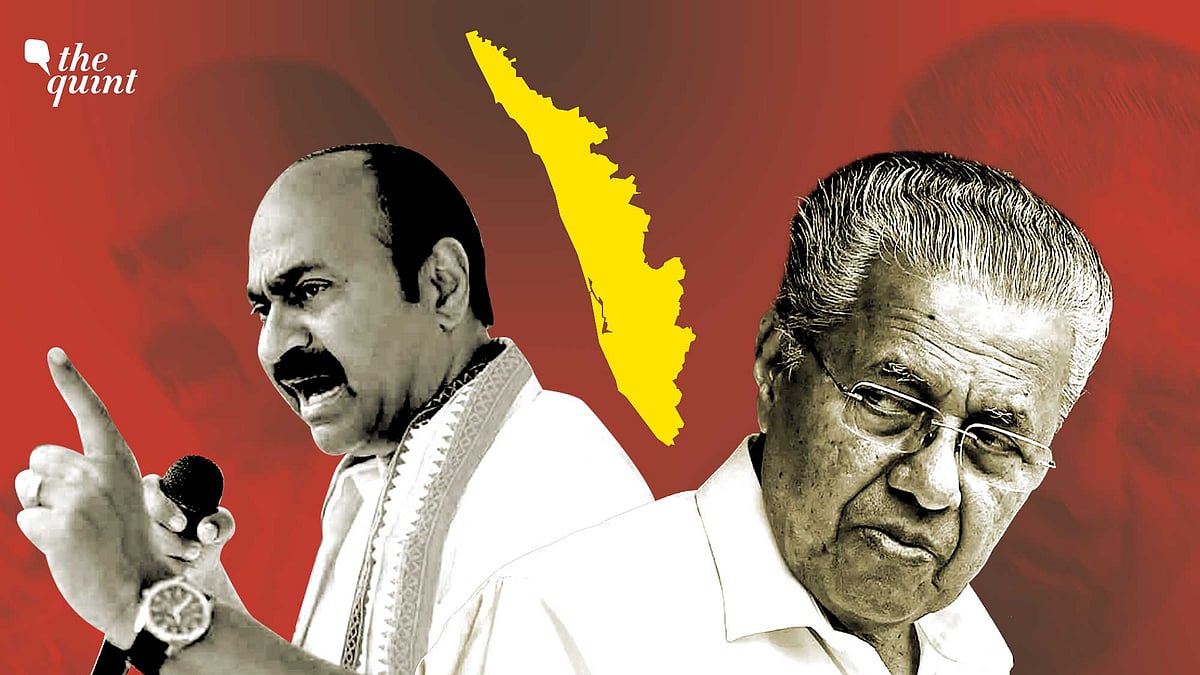
In Kerala’s current electoral landscape, Chief Minister Pinarayi Vijayan appears absent from that performative democratic space. In that absence, the Opposition, led by VD Satheesan, has found its most potent weapon: discourse itself.
This election is not merely a contest of governance records, but, more fundamentally, a battle over who controls the language of politics, and on that front, Vijayan may already be conceding ground.
Leading the Narrative
The symbolic turning point came with Satheesan’s public challenge for a direct debate with the Chief Minister.
Satheesan framed the challenge in unequivocal terms: “Pinarayi Vijayan shall fix the venue and timing for a debate, I will be there, and the people of Kerala can decide the rest.” The statement was designed to foreground the question of accountability. However, the CM declined it.
Vijayan’s refusal to engage was not unprecedented. The Opposition framed the refusal not as adherence to convention, but as evasion. Satheesan’s challenge was less about the debate itself and more about forcing a contrast between a government that speaks to the public and an Opposition that claims to speak with it.
In declining the invitation, Vijayan allowed that framing to take hold.
If the debate refusal raised questions, Vijayan’s recent interactions with the media deepened them. At a press conference that drew wide attention, journalists pressed the CM on his reluctance to entertain questions beyond those posed by party-aligned outlets. The exchange, tense and revealing, underscored the perception that access to the CM is increasingly mediated, selective, and controlled. This followed controversy over the removal of an opposition leader’s interview with Manorama News from Facebook, at the Kerala Police's request.
Scrutiny Integral to Political Legitimacy
Kerala’s political culture has long prided itself on a combative, questioning press. From the Left’s own history of street-corner debates to the state’s vibrant newsroom traditions, scrutiny has been integral to legitimacy. When journalists began openly questioning the Chief Minister’s responsiveness, it marked a shift from adversarial reporting to a deeper scrutiny of power itself.
Equally telling was a widely discussed public interaction in which, when approached by a question from the crowd, Vijayan dismissed it curtly. The phrase “go ask at your home” circulated quickly, not merely as a remark but as a metaphor. It reinforced an image of a leadership style that is authoritative, insulated, and increasingly impatient with dissenting inquiry. Elections are shaped by perception, often formed in such moments of interaction.
This is where the United Democratic Front has found unexpected coherence. It is about reclaiming democratic space through press conferences, public challenges, and open criticism. In doing so, the United Democratic Front (UDF) has emerged not just as a political rival but as a conversational counterpoint.
Perhaps more consequential is the circle of criticism that Vijayan now faces, not just from traditional opponents, but from figures with longstanding associations with the Left.
They often invoke the legacy of participatory politics that once defined Kerala’s Left movement. In districts such as Alappuzha and Kannur, historically strongholds of Left mobilisation, this critique carries particular resonance. The argument is not merely that the government is wrong, but that it has drifted from its own ideological moorings.
Dissonance of Centralisation
This is a subtle but significant shift. When criticism comes from ideological adversaries, it can be dismissed as partisan. When it emerges from within or near one’s traditional support base, it becomes harder to ignore. Figures such as V Kunhikrishnan, contesting from Payyannur after exposing the Communist Party Of India (Marxist) [CPI(M)] martyrs’ fund diversion scandal, and TK Govindan, contesting from Taliparamba after questioning the party’s “political ethics,” illustrate this widening dissent.
Central to this battle lies a deeper transformation within the Left Democratic Front under Vijayan. The CPI(M) has historically drawn strength from decentralised, cadre-driven engagement, a politics rooted in committees and local accountability.
By foregrounding issues of access, transparency, and responsiveness, the UDF has reframed the election as a referendum not just on governance, but on democratic ethos. Kerala’s media landscape, diverse and assertive, has become the primary arena for this contest. Each press conference, each unanswered question, and each clipped exchange feeds into a larger narrative cycle. In an age of instant amplification, moments of perceived dismissiveness travel faster than policy achievements. It is here that Vijayan’s approach appears most vulnerable.
A leader who prefers controlled communication through statements, briefings, and selective interactions, just like the government in the centre, finds himself at odds with a media ecosystem that thrives on spontaneity and scrutiny.
Evadind Performance Evaluation
A further asymmetry lies in the Left Democratic Front’s (LDF) failure to offer a clear, forward-looking articulation of its decade in power. It has neither foregrounded a comprehensive progress report nor presented a detailed manifesto for the next phase, creating a vacuum in policy discourse.
In contrast, the Congress-led United Democratic Front (UDF) has centred its campaign on concrete promises and programmatic direction. Rahul Gandhi has outlined commitments including expanded medical insurance, enhanced elderly care, support for startups, free transportation for women, and targeted assistance for students. This policy clarity, combined with frequent briefings and a willingness to engage, has enabled the Opposition to dominate the conversational space even where policy debates remain complex.
Elections are often shaped before ballots are cast, when narratives harden, and perceptions crystallise. In Kerala, that narrative battle appears to be tilting, shaping undecided voters and forcing the ruling side into a defensive posture.
For the LDF, reclaiming this space requires a shift from control to engagement and from scripted messaging to open dialogue, recognising that in a politically literate state, authority rests as much on argument as on governance. As the election approaches, UDF leaders have reinforced this contrast, projecting a decisive victory of around 100 seats. In this battle of words and silences, the Chief Minister’s central challenge is no longer just policy criticism, but the perception of distance, control, and absence from the conversation.
(Amal Chandra is an Indian author, political analyst and columnist. His debut book, The Essential (2023), was launched by Dr Shashi Tharoor and features a foreword by former External Affairs Minister of India, Adv. Salman Khurshid. This is an opinion piece and the views expressed are the author's own. The Quint does not endorse or is responsible for them.)
- Access to all paywalled content on site
- Ad-free experience across The Quint
- Early previews of our Special Projects
Published: undefined