
Kerala Elections: Suresh Gopi’s Missing X-Factor Exposes BJP’s Limits
BJP has its strongest alliance in Kerala ever but the man who made it happen is barely visible in the 2026 campaign.
advertisement
On the evening of 4 June 2024, something happened in Kerala that no political pundit had considered inevitable and most had dismissed as improbable: the Bharatiya Janata Party (BJP) won a Lok Sabha seat.
Suresh Gopi, the Malayalam film-icon-turned-politician, defeated the Communist Party of India (CPI)’s VS Sunilkumar and the Congress' K Muraleedharan in Thrissur by a margin of 74,686 votes. It was not a squeaker. It was a statement.
Gopi led in six of the seven Assembly segments that constitute the Thrissur Lok Sabha constituency. In Thrissur town, he led by 14,117 votes. In Nattika by 13,945. In Irinjalakuda by 13,016. In Puthukkad by 12,692. In Ollur by 10,363. In Manalur by 8,013. Only Guruvayoor, with its substantial Muslim population and entrenched Indian Union Muslim League (IUML) networks, resisted the wave.
Nearly two years later, the question that defines the BJP’s 2026 Kerala campaign is whether this wave can transfer—from a Lok Sabha election to an Assembly election, from a celebrity to a party, and from a man who is now a Union Minister in Delhi to candidates who must win on their own names.
The Disappearing Star
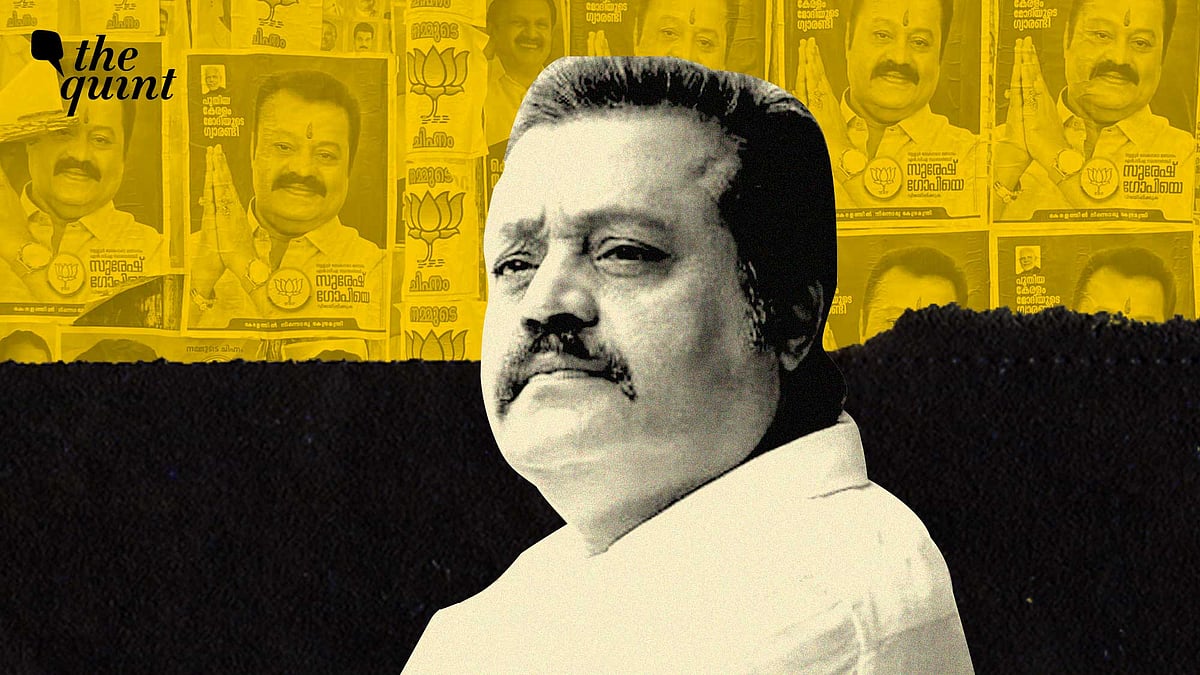
The early evidence is not encouraging for the BJP. Suresh Gopi is conspicuously absent from the 2026 Assembly campaign. Most poll-related posters and hoardings across Thrissur and neighbouring constituencies do not feature him. Since the election schedule was announced in mid-March, the 67-year-old Minister of State for Tourism and Petroleum and Natural Gas has made just four appearances in the seven Assembly constituencies under his parliamentary segment.
The cadre is frustrated by Gopi’s absence, but the party line is loyalty—workers publicly insist there is no bad blood, with some saying it was Gopi himself who pushed for Padmaja Venugopal’s candidacy in Thrissur.
The BJP has fielded Padmaja—daughter of four-time Congress Chief Minister K Karunakaran, who defected to the BJP in March 2024—as its candidate in Thrissur town. In Nattika, it has fielded CC Mukundan, the sitting CPI MLA who was expelled from his party after accusing the leadership of running a “payment seat” and joined the BJP on 16 March.
Prime Minister Narendra Modi held a roadshow in Thrissur on 29 March, signalling that the constituency remains the party’s “ground zero.” But Modi visiting and Gopi campaigning are different propositions.
Adding to the BJP’s complications, the Kerala High Court on 1 April ruled that an election petition challenging Gopi’s 2024 Thrissur victory on grounds of corrupt electoral practices is maintainable—and must proceed to trial. The petitioner alleges Gopi invoked religious sentiments through campaign materials depicting him alongside images of Lord Krishna and the Ram Temple.
The Alliance: Three Partners, Three Logics
The 2026 National Democratic Alliance (NDA) in Kerala is the most structurally ambitious version the party has fielded. It has three components. The BJP contests approximately 100 of 140 seats, anchored by state president Rajeev Chandrasekhar in Nemom and former Union Minister V Muraleedharan in Kazhakoottam.
The Bharat Dharma Jana Sena (BDJS), rooted in the SNDP/Ezhava community ecosystem and led by Thushar Vellappally, contests roughly 12 seats. And Twenty20, the Kitex Group-backed party led by industrialist Sabu M Jacob, brings a corporate-style organisation to Ernakulam district with roughly 12 seats.
But the fundamental question is whether the alliance is additive or merely redistributive—whether these partners bring genuinely new voters or simply reorganise the same 15-16 percent among different organisational labels.
The Structural Barrier
The BJP’s Kerala problem is not its vote share. It is the distribution of that vote share. In 2016, the party won one Assembly seat—O Rajagopal in Nemom—Kerala’s first-ever BJP MLA, polling 10.5 percent statewide. In 2021, it won zero seats, while its vote share actually increased to 11.4 percent.
In the 2024 Lok Sabha, the NDA polled 19.4 percent. In the 2025 local body elections, the BJP captured Thiruvananthapuram Corporation for the first time and won the Thripunithura Municipality. But its statewide local body vote share settled back to 15-16 percent.
The party’s 15-16 percent is spread across 140 constituencies, producing competitive third-place finishes in many but victories in almost none. This creates a self-reinforcing psychology.
Kerala’s voters are acutely aware of the three-way dynamic. In Assembly elections, a significant number of potential BJP voters make a tactical calculation: if the BJP cannot win this particular seat, voting for it risks “wasting” the vote and allowing the less preferred of the two main fronts to win.
This leads to a leakage of 3-5 percent from the BJP to either the Left Democratic Front (LDF) or the Congress-led United Democratic Front (UDF).
The Sabarimala Factor
One issue where the BJP has consistently gained ground is Sabarimala.
The LDF government initially supported the 2018 Supreme Court verdict allowing women of menstruating age into the hill shrine, deploying police to facilitate entry against massive protests. The backlash from Hindu voters across central and southern Kerala was enormous.
In a significant reversal, the Pinarayi Vijayan government has now told the Supreme Court—where the matter is pending before a larger bench—that it supports the traditional restrictions. This is, in substance, the position the BJP has held since 2018.
The trajectory in Pathanamthitta—Sabarimala’s home district—is instructive: the LDF held all five Assembly seats in 2021, the UDF won all five in the 2024 Lok Sabha, and the UDF again swept the district in the 2025 local body elections. That three-election slide suggests the Sabarimala wound compounded rather than faded. Whether the U-turn heals it or merely reminds voters of the original injury is an open question.
The Numbers: What Surveys Say
The Manorama News–C Voter survey, published on 31 March 2026, projects the UDF winning between 69 and 81 seats and the LDF between 57 and 69—a tight race where the NDA’s vote share becomes the decisive variable.
The realistic BJP scenario is 2-4 seats: Nemom (Chandrasekhar, riding the corporation victory), Thrissur town (Padmaja, testing the Gopi residue), and possibly Nattika (Mukundan’s ground network) or a Kasaragod seat.
The best case—5-8 seats—requires everything to align simultaneously: 20 percent, plus the statewide vote share, concentrated in target constituencies, with three-way splits working in the BJP’s favour.
The worst case—zero again—happens if Kerala’s voters once more distinguish between national and state elections, and anti-incumbency consolidates behind the UDF rather than splitting.
The Bottom Line
The BJP is stronger in Kerala today than it has ever been. It has a Lok Sabha seat, a major corporation, an expanded alliance, national leadership investment, and a cadre that is genuinely motivated. But “stronger than ever” still means zero Assembly seats in the last election and 15-16 percent in local body polls. The barrier is not ideological. It is mathematical. And the mathematics of Kerala’s three-front system have resisted every BJP strategy for two decades.
The Suresh Gopi effect is the BJP’s most valuable asset in Kerala. It is also its most fragile one. The man who made the breakthrough is now a minister in Delhi, barely visible on the campaign trail, facing a court challenge to his own election.
His candidates must convert a personal mandate into a party vote, in a state where voters have always known the difference. It is only on 4 May when we shall know whether the barrier finally broke—or whether it simply bent and bounced back, as it always has.
(VK Shashikumar is a former roving foreign affairs correspondent who covered West Asia, and later set up the investigations team at CNN-IBN (now News18). This is an opinion pieces and the views expressed are the author's own. The Quint does not endorse or is responsible for them.)
- Access to all paywalled content on site
- Ad-free experience across The Quint
- Early previews of our Special Projects
Published: undefined