
Professor Shahare’s Suspension Raises Questions About What Jamia Stands For
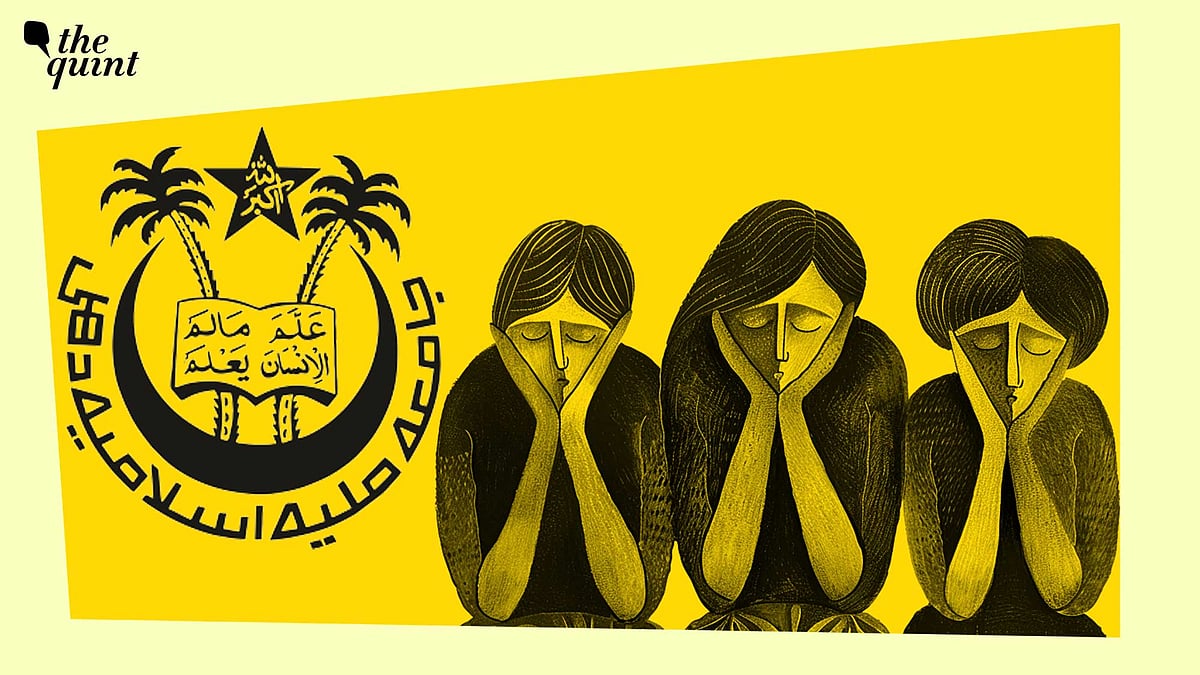
Professor Shahare’s suspension is not an administrative footnote. It goes to the heart of what Jamia claims to be.
advertisement
Hue the aake yahin khemazan woh deewaney
Uthhe the sun ke jo aawaz-e-rehbaraan-e-watan.
(They came and pitched their tents right here, those dreamers, who rose to become the voice of the nation’s conscience.)
These lines from Jamia Millia Islamia’s Tarana are not ornamental nostalgia. They are a reminder of why Jamia was founded and what it once promised. They recall a moment when dissent was not treated as indiscipline but as ethical obligation, when a university could imagine itself as an act of refusal against power. Jamia emerged from the anti-colonial movement as a moral project, one that placed freedom, dignity, and intellectual courage at the centre of education.
It is precisely this inheritance that makes the suspension of Professor Virendra Balaji Shahare, a teacher at Jamia’s Department of Social Work, followed by the filing of an FIR against him, so devastating. His case is not an administrative footnote. It goes to the heart of what Jamia claims to be.
Risky Pedagogy
Professor Shahare’s alleged offence was not provocation, nor propaganda, nor incitement. It was pedagogy. He set a question paper asking students to write an essay on the atrocities faced by Indian Muslims. The question was firmly located within the syllabus of the course he was teaching. It asked students to engage with social reality using academic tools.
I studied at Jamia Millia Islamia during a time when such a question would not have raised eyebrows, let alone FIRs. The campus was far from ideal, but it was alive. Classrooms were argumentative, corridors noisy with debate, and disagreement was not whispered but rehearsed aloud. Jamia’s intellectual culture did not reward conformity. It rewarded seriousness. Teachers demanded rigour, students demanded accountability, and dissent was treated less as performance and more as method.
What made Jamia distinctive was not the absence of conflict, but the presence of solidarity even amid disagreement. You could challenge your teachers and still be defended by them. You could protest against the administration and still find the campus standing with you when lines were crossed. The university functioned, imperfectly but sincerely, as a collective space where power could be questioned without immediately being punished.
I remember this most vividly during the tenure of Najeeb Jung as Vice Chancellor. Those were difficult years. Administrative arbitrariness was real. Student protests were met with suspensions. I was suspended for leading a protest. It was a deeply unsettling moment, one that left me exposed and anxious. Yet, what followed is worth recalling today. I was not isolated. Teachers supported me, some publicly, others quietly but firmly. Students stood united. Solidarity came not only from within Jamia but from campuses across Delhi. What power attempted to fragment, the academic community stitched together.
That ecosystem has weakened. The difference between then and now is not simply one of personalities, but of institutional courage.
A Quiet but Persistent Erosion
Professor Shahare’s suspension does not exist in isolation. It arrives after years of institutional retreat. In December 2019, Jamia’s campus was stormed by police during protests against the Citizenship Amendment Act. Students were beaten inside libraries and hostels. University space, once sacrosanct, was violated without consequence.
Inside classrooms, the erosion has been quieter but equally corrosive. Faculty members speak carefully now, often off record, about being informally advised to avoid subjects such as Kashmir, communal violence, Islamophobia, caste-state relations, and state repression. Talks on Palestine, minority rights, or political violence are cancelled at the last minute, citing vague security or administrative concerns. Student discussions, film screenings, and assemblies that once animated campus life are routinely denied permission.
What was once debated within academic bodies is now resolved through administrative caution and police action. Certain violences may be acknowledged, but not interrogated. Certain truths may be referenced, but not examined closely.
The irony is stark. The course Professor Shahare taught, Social Problems in India, explicitly includes atrocities against women, children, Scheduled Castes, Scheduled Tribes, and minorities. This is not incidental to social work. It is foundational. Social work as a discipline demands engagement with social suffering, with structural violence, with how power operates through caste, religion, gender, and class. To sanitise this engagement is to hollow the discipline itself.
Former students remember this clearly. Ayesha Khan, now working with a grassroots organisation in eastern Uttar Pradesh, recalled, “Professor Shahare never told us what to think. He asked us to read court judgments, government data, survivor testimonies. If our arguments were lazy, he challenged us. For the first time, what we saw around us was allowed into the classroom without being dismissed as anecdotal.”
Rohit Paswan, another former student, said the discomfort his classes produced was deliberate. “He insisted we read caste and religion together. That unsettled many of us because we are trained to treat them separately. But in the field, they are never separate. Without that understanding, social work becomes charity, not justice.”
Among current students, fear now shapes learning. Nafisa Rahman, a second-year student (name changed), said, “After this incident, we keep asking what can be written safely. Not what is accurate or relevant, but what is safe. That question didn’t exist earlier.”
Another current student, Vikram Kumar (name changed), was more blunt. “We are learning self-censorship before we even graduate. That is not education. That is conditioning.”
Much of the outrage against Professor Shahare is cloaked in the language of neutrality. But neutrality in unequal societies often functions as a moral alibi. To demand symmetrical treatment of all suffering, irrespective of history and power, is not balance. It is erasure. Asking students to study atrocities against Muslims does not negate other injustices. It recognises that violence is uneven and that pedagogy must respond to that unevenness.
Overlapping Marginalisations, Wider Patterns
This discomfort is inseparable from who Professor Shahare is and what his teaching represents. A Dalit teaching in a Muslim minority institution, asking students to examine violence against Muslims, embodies a form of praxis that contemporary India finds deeply unsettling. It collapses the silos through which oppression is often administered and resistance carefully managed.
This is not an abstract alliance. In social work classrooms, Dalit-Muslim praxis emerges through fieldwork and lived encounters. Students are sent into neighbourhoods marked by housing segregation, into relief camps after communal violence, into villages where manual scavenging persists alongside mosque demolitions, into families navigating both caste stigma and religious suspicion. They learn, often uncomfortably, that vulnerability does not arrive neatly labelled.
Professor Shahare’s pedagogy, as former students describe it, refused to flatten these complexities. It insisted that caste cannot be discussed without religion, that communal violence cannot be analysed without understanding land, labour, and state power, and that social work devoid of structural critique becomes little more than managed compassion. This insistence disrupts dominant narratives on two fronts. It challenges Savarna liberalism that treats caste as residual and Islamophobia as episodic. And it unsettles majoritarian politics that seeks to pit Dalits and Muslims against one another through selective inclusion and calibrated exclusion.
Historically, Dalit-Muslim solidarities have always been treated with suspicion by power. From anti-colonial struggles to labour movements to contemporary resistance against lynching and disenfranchisement, such solidarities threaten the arithmetic of domination. They refuse the hierarchy of victimhood and reject the invitation to compete for state sympathy. In classrooms like Shahare’s, this history is not romanticised but examined critically, with its fractures, failures, and moments of possibility.
A way that refuses to isolate Muslim suffering as communal excess or Dalit suffering as caste pathology. A way that insists on reading both as products of a political order sustained by law, bureaucracy, and silence.
Jamia’s decline mirrors a wider national pattern. JNU has been hollowed out through administrative restructuring. TISS faces increasing surveillance over research and appointments. Jadavpur University has normalised police presence. The University of Hyderabad continues to watch dissenters long after Rohith Vemula’s institutional murder. Even private universities like Ashoka have witnessed resignations under pressure.
A Loss More Personal
Yet Jamia’s loss feels sharper because it was once different. Dissent was not incidental to Jamia’s identity. It was constitutive. Its current posture reflects an anxiety to align with power rather than serve as a buffer against it.
As an alumnus, this erosion feels personal. Jamia taught many of us that education demanded ethical courage. That learning involved risk. That silence in the face of injustice was itself a form of complicity. Today, syllabi are reread not for intellectual rigour but for legal vulnerability. Conversations end prematurely. Doors close sooner. Silence is mistaken for safety.
And it is about whether Jamia will remember the deewaney who once gathered here to raise the nation’s conscience. If Jamia retreats into fear, it will not stand alone. It will signal something far more troubling: a country where dissent is no longer debated but erased in advance, and where, slowly, even the syllabus learns to remain silent.
When that happens, one must ask, not rhetorically but urgently:
Who will pitch their tents here again?
And who will dare to raise the nation’s conscience?
(Asad Ashraf is an independent journalist. This is an opinion piece and the views expressed are the author's own. The Quint neither endorses nor is responsible for them.)
- Access to all paywalled content on site
- Ad-free experience across The Quint
- Early previews of our Special Projects
Published: undefined