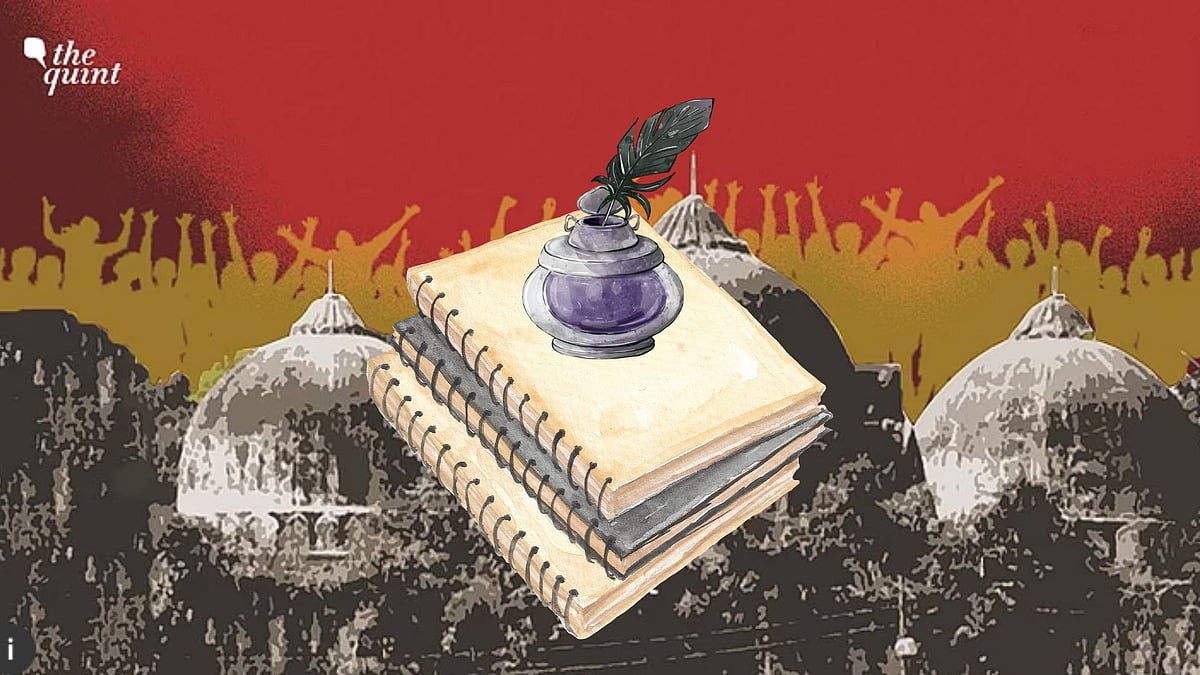
Debris of a Dream: A Muslim Growing Up in the Shadow of Babri Masjid Demolition
From horrors of Babri demolition as a Muslim child to living in normalised hate - tales from a journalist's diary.
advertisement
(The Quint has consistently been the leading news organisation breaking stories on communal violence and hate crimes and carrying out in-depth investigations on communal issues. These investigations involve a lot of work and often come at great personal risk to our reporters who are on the ground. We need your support as we continue to bring out more such investigations and voices from the ground. BECOME A MEMBER and support us.)
There is a specific kind of silence that descends upon a Muslim household when the world outside catches fire. It is not a peaceful silence, nor is it the quiet of contemplation. It is a heavy, suffocating stillness, born of the collective instinct to become invisible. It is the silence of a held breath, a suspended heartbeat. I first heard that silence on 6 December, 1992.
I was five years old. We were living in Gaya, Bihar, a town where history lay thick in the dust. Buddha’s enlightenment, Hindu piety, and Muslim heritage coexisted there in a chaotic, ancient harmony. At that time, my father was not yet the officer he would later become; he was a clerk at Vijaya Bank. He was a man of modest means and immense dignity, a man who believed in the ledger of life as much as the ledgers at his desk. He believed that if you worked hard, played by the rules, and educated your children, India would reward you.
My world was small, secure, and delightfully mundane: the comforting hum of my mother, a homemaker who anchored our lives with the rhythm of her cooking; the playful hierarchy of siblings, with my brother, a year and a half older, and my sister, four years my senior, serving as my guides to the mysteries of childhood.
I watched the adults. Their faces were illuminated by the blue light of the screen, etched with a horror I couldn't comprehend. I did not understand the word "Kar Sevak." I did not understand "Babri Masjid." I certainly did not understand the geography of Ayodhya. What I understood was fear.
I saw it in my father’s eyes. This man, whom I associated with the steady reliability of starched shirts and the smell of ink, looked suddenly diminished. He was no longer just a provider; he was a man keenly aware of his vulnerability. He paced the room, not saying a word, but his silence screamed. My mother held us, her grip tighter than usual, as if she could physically hold us back from a future that had suddenly darkened.
Outside, the air in Gaya felt charged. Rumors flew faster than the wind. "They are coming," someone whispered. "Curfew," said another. At five, I witnessed the dismantling of a structure I had never seen, but I also witnessed the dismantling of my father’s certainty. I didn't know then that the falling domes were the opening notes of a dirge for the India my forefathers had envisioned. I only knew that something broke that day. A glass ceiling of safety shattered, and we were suddenly walking on the shards.
That evening marked the beginning of a dismantling that would continue for the next thirty-three years. Not just of a mosque, but of a dream.
The School of Innocence and its Cracks: Nazareth Academy (1994–2000)
In the years immediately following the demolition, the dust didn't settle; it traveled. But initially, I was shielded. From 1994 to 2000, I attended Nazareth Academy in Gaya.
It was a Christian missionary school, an institution that belonged to an older idea of India: syncretic, gentle, and insulated. In those early years, the debris of 1992 felt distant. The classrooms were filled with the children of doctors, engineers, and civil servants, and our identities were defined by our grades and our games, not our gods. The nuns who taught us moved with a grace that seemed to float above the communal muck that was rising in the country.
However, looking back, there were instances where I felt at odds, moments where the outside world pierced the bubble.
I vividly recall a drawing class. We were given free rein to sketch whatever we liked. As a child who had seen the architecture of my heritage or simply the shapes I saw at home, I began to outline the dome of a mosque. My friend, a boy I shared tiffin and secrets with, leaned over. He didn't speak with malice, but with a strange, childish pragmatism.
He went back to colouring his mountains. I sat there, pencil hovering over the paper, suddenly ashamed of my drawing. Even at that age, the message had filtered down to the children: Muslim symbols are temporary. They are meant to be dismantled.
Global Shadows and Local Fears: Patna Central School (2000–2003)
If Nazareth was a cracked sanctuary, Patna Central School was where the roof blew off. I studied there from 2000 to 2003. The environment was different. It was more urban and more aggressive, but the real shock came from events far beyond the school walls.
First, September 11, 2001.
When the Twin Towers fell, the debris seemed to land in my classroom in Patna. Almost immediately, the atmosphere shifted. The "Muslim" was no longer just a domestic "other" inherited from Partition; he was now part of a global "terror" franchise.
Then came 2002. Gujarat.
I was a teenager then, old enough to read the newspapers, old enough to understand the brutality of what was happening. The smoke from Gujarat drifted into our living rooms in Patna. We heard stories that chilled us to the bone. Stories of neighbors turning on neighbors, of police looking the other way.
The fear I had felt as a five-year-old returned, but this time it was compounded by a teenage realisation: This could happen to us. We were middle-class, educated, and "integrated"—but so were many in Gulberg Society.
This toxicity seeped into my daily life. Islamophobia was hurled freely by students and teachers alike. I was no longer just a student; I was a suspect.
I recall a moment on the playground. A minor disagreement over a game turned into a confrontation. My friends were joking around, but then one of them laughed and shouted to the group: "Hey, don't fight with Asad! Be careful. He will call Osama bin Laden to fight for him!"
The group erupted in laughter. I forced a smile, the "Good Muslim" reflex kicking in. I laughed at the joke that dehumanized me so I wouldn't seem radical. But inside, I was bewildered. I was a boy in Patna who loved cricket. How had I suddenly become the hotline to Al-Qaeda? The teachers were no better, often viewing us with a gaze that was a mixture of pity and suspicion, as if our faith was a latent virus waiting to manifest.
The Label: DAV Panchkula (2003–2004)
My father’s career progressed, and we moved north. I spent a year at DAV Panchkula (2003–2004). The transition from the chaotic warmth of Bihar to the sterile, planned coldness of Chandigarh was jarring.
By this time, my brother was charting a path of brilliance. He was my senior, a star student who would go on to train at IIT Kanpur, the pinnacle of the Indian middle-class dream. My family was doing everything "right." We were educated, aspirational, and contributing to the nation. But in the playground of DAV Panchkula, none of that mattered.
I was no longer just Asad, the brother of an IIT-bound genius. I was a category.
"Mullah."
The word was thrown at me not with curiosity, but with a sneer. It was an act of partition within a classroom. I learned that no matter how well my brother did at IIT, or how well I spoke English, to some, I would always be defined by a history they were taught to hate.
Ambiguity and Terror: Jamia Millia Islamia (2004–2014)
Seeking a space where I could breathe, I moved to New Delhi in 2004. I entered the gates of Jamia Millia Islamia, a place that would define the next decade of my life. I completed my Masters there.
For the first time since leaving home, I felt a sense of belonging. Jamia was a sanctuary. Here, I didn't have to explain why I didn't eat pork. I didn't have to apologize for history. We discussed the world, not as victims, but as intellects.
But sanctuaries in India are fragile. On 19 September, 2008, the Batla House encounter happened in the area adjacent to my university, Jamia Nagar.
The most terrifying part wasn't just the violence; it was the ambiguity. We didn't know the truth. Was the encounter genuine? Was it staged? Were the boys killed actually terrorists, or were they students like us, framed in a cold-blooded calculation? That uncertainty was paralyzing.
I saw friends, brilliant and soft-spoken students, shave their beards in fear. Parents called from small towns, begging their sons to come home. The "secular" UPA government offered little comfort. Their response was confused and hesitant. It was a lesson in the cowardice of the political center. The encounter taught me that even in our safest spaces, we were being watched. We were citizens on probation.
The Reporter’s Notebook: 2014 and the Death of the Dream
In 2014, the same year Narendra Modi ascended to power in a seismic political shift, I started my career as a journalist.
I entered the profession with stars in my eyes. I believed that journalism was the mirror of society. I thought that by telling the truth, I could make a difference. Instead, I became an obituarist of the secular republic.
The writing style in my notebooks changed. It was no longer about policy or development; it was about blood and identity.
FIELD DISPATCH: DADRI, UTTAR PRADESH (2015) The air in the village smells of damp earth and suppressed rage. A man is dead: Mohammad Akhlaq. Beaten to death with bricks over a rumor of beef in his fridge. I stand outside his house. The police are not securing the crime scene to find the murderers; they are securing the meat to send it for forensic lab testing. The priority of the state is clear. The meat is the victim; the man is the accused. Later A Union Minister arrives, not to comfort the grieving family, but to drape the coffin of one of the accused in the national tricolour. The mob has been deputized.
FIELD DISPATCH: ALWAR, RAJASTHAN (2017) The highway is busy. Pehlu Khan, a dairy farmer, was returning home with cattle he had purchased legally. He had the papers. But papers don't stop a lynch mob. The video of his assault is circulating on phones in the dusty tea shops nearby. It is being watched like entertainment. In the police station, the narrative is being twisted. The FIR is not against the mob that killed him; cases are being filed against the victim for cattle smuggling. The victim is criminalized in death.
The Tightening Noose: Triple Talaq and the Verdict (2017–2019)
As the lynchings continued on the streets, a different kind of dismantling was happening in the courts and parliament. It was a legal encirclement that sought to redefine the Muslim presence in India.
The government moved to criminalise Triple Talaq. Let me be clear: I held no brief for the practice of instant divorce. It was arbitrary, patriarchal, and contrary to the spirit of justice. I, like many Muslims, believed it had no place in a modern society. But the government’s sudden zeal to "save" Muslim women felt less like feminism and more like a strategy to demonise Muslim men.
The irony was suffocating. While Muslim men were being lynched on trains and highways, the state was pretending to be their women's savior by threatening to jail their husbands. The legal logic was baffling: if the Supreme Court had already declared the divorce void, why was the husband being sent to prison for three years? It wasn't about gender justice; it was about finding another legal avenue to criminalize Muslim men, feeding the stereotype of the "barbaric Muslim male."
And then came the final blow.
November 9, 2019. I sat in front of the television, the air in the room thick with the same anxiety my parents had felt in 1992. The Supreme Court was delivering its judgment on the Babri Masjid title suit.
The judgment was a masterclass in judicial acrobatics. The Court acknowledged that the placement of idols in 1949 was a "desecration." It acknowledged that the demolition in 1992 was an "egregious violation of the rule of law." Yet, in its final order, it awarded the land to the very side that had committed these illegalities.
The dream of a secular India, the dream my father worked for, was finally and officially laid to rest.
From Citizenship to Survival: The Winter of Hope (2019–2020)
We were barely allowed to mourn the judicial burial of the mosque when the government opened a new front: The Citizenship Amendment Act (CAA) and the National Register of Citizens (NRC).
It was an existential pincer movement. The Home Minister’s "chronology" was clear: first the CAA, then the NRC. They wanted to demand papers from a people whose homes are often washed away by floods, whose archives are eaten by termites.
But from this existential dread, something miraculous was born. Shaheen Bagh.
It began as a small sit-in by the women of a working-class neighborhood. It grew into the most significant civil rights movement in independent India.
FIELD DISPATCH: SHAHEEN BAGH, DELHI (JAN 2020) It is the coldest winter Delhi has seen in decades, but the women are not moving. These are not professional activists; they are the 'Dadis' (grandmothers) and mothers who have spent their lives inside homes. The irony is blinding. The same government that claimed to "save" Muslim women from Triple Talaq is now terrified of them. They sit holding pictures of Ambedkar and Gandhi. They sing the national anthem with a fervor that reclaims it from the nationalists. "They ask for my papers," an 80-year-old Bilkis Bano tells me. "I was born here, my father is buried here. This soil is my paper." For a brief, blinding moment, it feels like the India of my dreams is fighting back.
Shaheen Bagh was a reclamation. It dismantled the stereotype of the "mute, oppressed Muslim woman." But hope in New India is a dangerous thing.
Then, the dam broke. The Northeast Delhi Riots.
FIELD DISPATCH: NORTHEAST DELHI (FEB 25, 2020) I am walking through streets that look like they have been carpet-bombed. Shiv Vihar. Mustafabad. The air smells of burning rubber and flesh. I see a school turned into cinders, its library books ash on the floor. I see a mosque vandalized, a saffron flag planted triumphantly on its minaret. It is a haunting reenactment of 1992, but this time in the capital of the republic. While the American President visits Delhi a few miles away, here, citizens are being hunted in their own neighborhoods. The police, the guardians of the law, are either absent or complicit.
The riots were followed by the COVID-19 lockdown, which was used to dismantle the protest sites. The spirit of resistance didn't die, however; it migrated. Later that year, the Farmers' Protest erupted on the borders of Delhi.
The farmers went back home as victors. The women of Shaheen Bagh were sent home as suspects, many of their student leaders thrown into jail under anti-terror laws. The contrast was the final lesson: In this new India, resistance is possible, but the price of that resistance depends entirely on your last name. We shouted the same slogans, but they got a repeal; we got riots.
The Final Loss (2021)
It was under this accumulation of grief—the lynchings, the verdict, the crushed hope of Shaheen Bagh, the ashes of Northeast Delhi, and the bitter realization of our unequal citizenship—that my father’s spirit finally broke.
My father, the clerk who became an officer, the believer in the system, passed away in 2021.
He died a disillusioned man. In his final days, the optimism of the Nehruvian generation had faded from his eyes. He would look at the news—the shouting anchors, the hatred—and simply change the channel. "What is the point?" he would ask.
He passed away knowing that the India he served had been replaced by something unrecognizable. His death was the severing of my last link to the hope that things might get better.
The Era of Bulldozers and Consecration (2022–2025)
After his death, the void in my personal life mirrored the deepening void in the nation. The years that followed were not about shocking acts of violence, but about the cold, bureaucratic normalization of hatred.
In 2022, the gates of education were slammed shut for Muslim girls in Karnataka simply because they wore the Hijab. I watched visuals of girls pleading to enter their colleges, only to be mocked by boys in saffron scarves. Education, the very ladder my father had climbed, was now conditional.
And finally, the circle that began in 1992 closed in January 2024.
The Prime Minister consecrated the Ram Temple in Ayodhya on the very spot where the Babri Masjid once stood. The entire nation was awash in celebration. The media called it a "civilizational awakening." For me, and for millions like me, it was a day of mourning observed in silence. The noise outside was deafening, but inside, it was just the echo of that winter evening in Gaya. The dismantling was complete.
The 2024 General Elections followed, where the highest office in the land referred to us as "infiltrators" and "those who have more children." The hate was no longer dog-whistled; it was broadcast through microphones.
We had moved from being citizens to suspects, and now, to unwanted guests in our own home.
A Recent Journey on the Vande Bharat
It is with this heavy baggage, thirty-three years of it, that I traveled recetly. I am no longer the confused child or the bullied student. I am a journalist. But the debris follows me.
Recently, I was travelling on the Vande Bharat Express. It is the shining symbol of "New India."
A fellow passenger in my coach, a bearded man wearing a skull cap, boarded from the same station as I did and was headed to Delhi. He did not have a physical ID, so when the TTE asked for one, he showed the digital version on his phone. Everything seemed perfectly in order. The TTE nodded and moved on.
The officers, to their credit, behaved with courtesy. They checked his digital ID, found everything valid, and asked him to continue his journey.
Yet the woman was not satisfied.
After half an hour, she again summoned the police, this time asking them to inspect his bag. The man quietly unzipped it in front of everyone.
“Please check,” he said, with a tired dignity. “These are just clothes and a book, nothing different from what you would carry in your own luggage.”
Still, she insisted on a more thorough search.
I sat there, watching. I wanted to intervene. I wanted to use my voice. But 'wisdom' held me back. I remembered just another day when I was abused and called a "terror apologist" by a celebrity TV anchor for expressing my anxieties on Twitter. The trauma of that public shaming acted as a gag order on my conscience. I feared that if I spoke, I would become the next target.
So, I sat in silence.
And in that moment, watching a harmless man repeatedly prove his innocence for no reason other than his appearance, I was reminded once again that this is the everyday price of being a Muslim in India.
As we were about to deboard at Nizamuddin station, I walked up to the man and asked if he needed any help or if he wanted me to report the incident. He simply smiled, a smile devoid of anger but filled with a terrifying resignation.
“For us, these things are normal,” he said.
He picked up his bag and walked away into the crowd, disappearing into the capital of a republic that had promised him equality, leaving me standing on the platform with the debris of that promise.
(The writer is an independent journalist based in New Delhi, writing this piece from the dual perspective of a professional and an Indian Muslim.)