
Houthis’ Entry Into Iran War Could Hit India’s Oil and Gas Supply Harder
The Houthis can obstruct shipping in the Bab-el-Mandeb Strait, delivering a double blow to the global economy.
advertisement
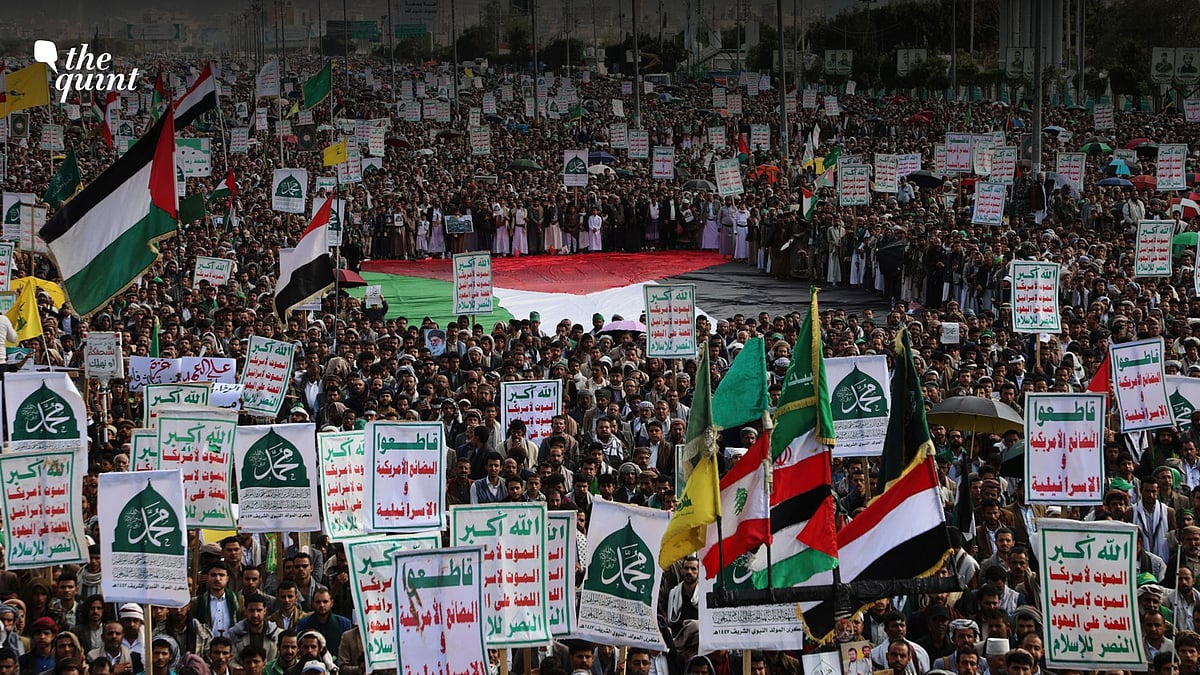
Over the weekend, the Iran-backed Houthis in Yemen announced they had launched a missile at Israel. This marked the group’s first attack on Israel since the Gaza ceasefire last October. Less than 24 hours later on Sunday, 29 March, the group announced launching another barrage of cruise missiles and drones. This has laid to rest all speculation on whether the Houthis would come to Iran's aid.
Since the joint US-Israel war on Iran began a month ago, the Houthis had remained remarkably quiet.
When Houthis Aligned With Hamas
The Houthis—belonging to the "twelver" Shiite sect, which appeared in the 1990s in Yemen—has been faithfully nurtured, armed, and supported by Iran throughout the country's civil war.
This allowed it to oust the legitimate government of President Abd Rabbuh Mansur Hadi in Yemen, who is now confined to a sliver of territory in the south. Iranian help also allowed it to force the Saudis and Emiratis, who had militarily intervened in Yemen in support of the government, to ultimately seek a ceasefire, with the Emiratis withdrawing totally from the country.
Attacks by Israel, the US, and the UK on them had proved futile, and finally a ceasefire with the US was reached last year.
What Can the Houthis Do?
Despite not being in the fittest of military health, their attacks over the weekend signal that Iran was probably waiting, instead of playing all its cards at once. As expectations of a US ground assault grow, with some 50,000 US troops assembled in the region, and Israel and US continue to pummel Iranian cities to not just cripple the military structure, but also the nation's economy, Iran may now be playing its Houthi card.
“We are in joint coordination with our brothers in Iran, Lebanon, and Iraq,” Mohammed Mansour, deputy information minister in the Houthi-run government, told Al-Araby Television on Saturday, 28 March, adding, “Every step we take is carefully calculated to be effective and to increase the pressure on Israel and the US."
The announcement has sent shock waves around the world. Before we analyse why, let us see the weapons the Houthis have in their arsenal to contribute to the war.
On 31 March, jointly with the US, Israel delivered devastating attacks on Isfahan. A few days ago, it killed Alireza Tangsiri, the head of the IRGC's navy in Bandar Abbas. But the Israeli Defence Forces (IDF) are also taking a hammering from Hezbollah in the north, where it has lost personnel, armaments, and had hundreds displaced from their homes. The IDF has warned that its forces are close to an internal collapse, with its troops fighting continually for over 900 days since the war with Hamas began in 2023.
During this time the Houthis demonstrated their ability to launch direct attacks on Saudi Arabia, including on Saudi Aramco. Ultimately, in 2022, both sides signed a ceasefire. Therefore, the group can, in conjunction with Iran's other proxies, target US bases in Saudi Arabia, as well as target Saudi energy infrastructure, which it has the wherewithal to.
However, the Houthis may not choose this course of action as Iran has succeeded in majorly attacking Saudi infrastructure, energy facilities, and US bases there. Recent estimates show that the Saudis have been targets of at least 723 drones and missiles. Moreover, the Houthis are in the process of conducting negotiations with the Saudis since the signing of the ceasefire with them. These include payments and reparations, and the Houthis may not want to jeopardise these negotiations by targeting the kingdom.
Economic and Environmental Impact
According to the environmental organisation 350.org, the world has faced a loss of $111 billion because of rising energy prices due to the current war in the last one month alone. And India has not been immune.
This disruption will affect other supply chains, too. The stock market has taken a major hit—and the Indian rupee has plummeted to an unprecedented low of 95 to a US dollar.
In 2023, when the Houthis began targeting shipping in the Red Sea, they had succeeded in cutting the Red Sea freight traffic by 44 percent within just three months, significantly pushing up both travel time and cost. Oil prices had also increased, according to reports based on Clarkson Research data.
The Red Sea is a major global maritime route. One of the biggest, it handles almost 12 percent of global shipping, channeling 50 ships daily with cargo amounting to anywhere between $3 billion and $9 billion.
The Strait of Hormuz Problem
The closure of the Strait of Hormuz has already rendered the major energy-producing states like Saudi Arabia, the UAE, and Qatar to halt their supplies through the strait. Some of them like Bahrain and Qatar have declared force majeure. Saudi Arabia and the UAE are now majorly depending on the alternate route through the Red Sea for their exports.
The closure of this alternate chokepoint could send oil prices soaring to as high as $200 dollar per barrel, as well as create further disruptions in global supply chains, threatening both energy and food security across the world, and increasing hunger and poverty.
According to the latest Moody's analytics, India is one of the worst-impacted countries, and its GDP may drop by as much as 4 percent if the conflict drags on. The spectre of the closure of the Bab-el-Mandeb Strait now looms large and is very probable.
The closure of the Strait of Hormuz and targeting the infrastructure of the UAE and Saudi Arabia—until now top tourist hotspots as well as trade and financial hubs—are all part of the strategy. Closing the Bab-el-Mandeb Strait would complement this, imposing a cost on every region. This is sure to lead to further escalation of the conflict. For India, the signs are ominous.
(The author is an award-winning journalist specialising on Eurasian affairs. This is an opinion piece and the views expressed above are the author’s own. The Quint neither endorses nor is responsible for the same.)
- Access to all paywalled content on site
- Ad-free experience across The Quint
- Early previews of our Special Projects
Published: undefined