
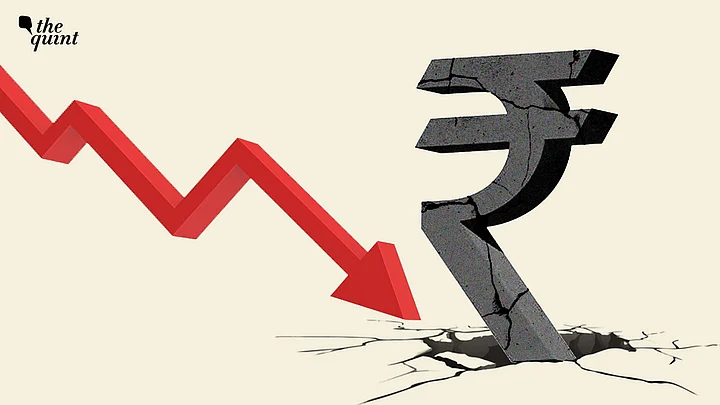
For the first time ever, the rupee breached 95 to a US dollar on Monday, 30 March 2026, a fall of over 11 percent over the exchange rate of Rs 85.4 to a dollar on 31 March last year.
The rupee has been in a free fall for the last six months. In March 2026 alone, it has gone down nearly 4 percent.
I wrote a piece on 23 December 2024, barely 15 months ago, when the rupee had touched 85 to a dollar. It appeared to me that the rupee will touch 100 to a dollar by the end of the Modi 3.0 government in 2029. But the rupee seems to be in a big hurry. It is galloping towards touching 100 anytime now.
The question now is—which month of the first quarter of financial year 2026-27 will it do so?
But why is the rupee falling so badly? Is the Reserve Bank of India (RBI) helpless? And is there a bottom?
RBI’s Real Firepower
The RBI's Foreign Exchange Reserves (FER), as on 20 March 2026, amounted to $698.3 billion, falling by $11.4 billion in a week.
Interestingly, the RBI’s Foreign Currency Assets (FCA)—which excludes gold, Special Drawing Rights (SDRs), and India’s reserve position in the International Monetary Fund (IMF)—at $557.7 billion increased by $2.1 billion. The fall in gold’s value by $13.5 billion to $117.2 billion caused all the damage.
Ths FCA is the RBI’s real firepower. Using gold for rupee exchange management is impossible, especially for India, as so much odium has been attached to gold sales made in 1991, that the RBI won't think about selling gold even in its dream.
The RBI’s fascination for the purchase of gold in the last four years, and the big rally in gold prices, has materially reduced the FCA’s share in the FER. In the last week of March 2022, India’s FER was at $619.7 billion, and the FCA, at $553.7 billion (almost similar to now), made up nearly 90 percent of the FER. Currently, the FCA form less than 80 percent of the total FER.
While an increase in the quantity of gold stock and its prices (from $1,900 per ounce in March 2022 to $4,450 an ounce currently) has made the gold value in FER jump up from $42 billion to $117 billion currently, it has made the RBI firepower to intervene in foreign exchange markets to stabilise the rupee that much.
Gita Gopinath, former first deputy managing director of the IMF, while praising the RBI’s ‘strong reserves’ in recent days, has advised to keep its ‘power dry at this time’, despite the Israeli-US war on Iran mauling oil, gas, and currency markets.
Reserves and the Indian Psyche
There is a big psychological factor at play in India that makes the RBI not dip into reserves. India was at its most vulnerable in 1991 when it didn't even have $10 billion in reserves. Understandably, we wanted to build adequate reserves as insurance against this vulnerability.
When reserves reached $100 billion in 2003-04, India felt adequately covered. Soon, in 2007-08, reserves crossed $300 billion, where it stayed for the next four-five years. Reserves, however, were found to be quite inadequate during the taper tantrum in 2013. India had to launch the costly Foreign Currency Non-Resident Bank or the FCNR(B) deposit scheme to collect $26 billion.
In 2017-18, we had more than $450 billion in reserves. Yet, an episode of rupee instability struck in 2018-19 when the additional cost of oil purchases (crude had gone beyond $80 only) and the withdrawal of about $50 billion by foreign portfolio investors (FPIs) made the government and the RBI contemplate raising $50 billion in forex deposits/bonds.
Currently, we have reserves of about $700 billion—and FCA of $550 billion. Yet, the RBI finds it difficult to dip into it for stabilising the rupee. In the last few months, the RBI has actually been shoring up its FCA by swap operations—buying dollars now to sell dollars later. Such swaps are of about $80 billion. Effective FCA is fewer to that extent.
The RBI reserves—its firepower—are quite wet. Gita Gopinath need not worry; the RBI will not use its reserves.
Are the Reserves Adequate?
How can we know whether India’s FCA is adequate?
For decades, the FCA adequacy has been measured in terms of how many months of imports it can finance. Coverage of 10-12 months was considered quite comfortable.
For 2024-25, India’s FCA of $567.5 billion could finance nine-and-a-half months of merchandise imports of $720.2 billion, and FER of $668.3 billion could finance about 11 months of imports.
Merchandise import cover, however, is a very inappropriate marker.
India’s overall imports (both merchandise and services) of $915.2 billion in 2024-25 were financed by more than 90 percent by India’s exports of $825.3 billion. Our surplus in other current account items (like remittances) had reduced the Current Account Deficit (CAD) to only $23.3 billion in 2024-25. India needed only about 4 percent of its FCA to finance this CAD.
Such demand should cause no worries. Even if CAD spirals to $100-150 billion in a year, India’s FCA is more than a match.
What is a Right Marker?
India’s FCA/FER have been built essentially by surpluses in capital account. Capital account flows have not only financed the CAD, but also built up reserves.
There are two big volatile constituents of our capital account—foreign debt and portfolio investment.
Most of what constitutes foreign debt—external commercial borrowings, trade debt, NRI deposits, etc—become costlier for Indian borrowers when the rupee falls. Their hedging costs also go up, and refinancing becomes difficult. Fresh inflows stop. Holders of foreign debt start looking to pay them off, and get out.
For FPIs, their investment in Indian equities and debt in rupees lose big when stock markets plummet (as is currently happening)—and the rupee depreciates. This year, with the rupee depreciating by about 11 percent, FPI investments have given large negative returns. No wonder FPIs have sold over Rs 1 lakh crore worth of equities in March alone.
The ratio of the total foreign debt and the portfolio liability of India and its foreign currency assets is a much better market for rupee-dollar exchange rate.
India’s foreign debt is about $750 billion. The FPIs stock of portfolio investment is also about the same level. Together, volatile foreign debt and portfolio investment assets are about $1.5 trillion. This is about 2.7 times of the RBI's FCA. This is a big vulnerability. A ratio of more than one for this volatile liability to the FCA should worry Indian policy makers and the RBI.
What Lies Ahead?
The damage to oil and gas production infrastructure in West Asia, which produces more than 20 percent of global oil and 30 percent of global natural gas supplies, is extensive and unlikely to recover anytime soon, even if the war stops in a month’s time.
Iran has successfully weaponised the Strait of Hormuz, and is recovering a toll charge (currently $2 million per ship which may be jacked up) from every oil and gas supply from West Asia.
Oil is likely to stay elevated and might average at $100 per barrel in 2026-27. India’s oil bill will shoot up massively as every $10 per barrel increase adds about $50 million a day.
FPIs don’t see good in Indian markets for the foreseeable future. With the rupee tumbling, they will continue to sell.
Foreign direct investment (FDI) inflows are close to zero. This is unlikely to change given our choice of preferring imports from China instead of Chinese investments in India.
The import bill will go up. And not only for oil and gas, as India scrambles to buy these at any price to keep its domestic constituency unruffled, but also because of India’s enormous needs for importing solar energy equipment and digital products and machines.
Tough times are ahead. Rs 100 to a dollar is as good as done. Watch out for whether the rupee depreciates by another 10 percent in 2026-27.
(Subhash Chandra Garg is the Chief Policy Advisor, SUBHANJALI, and Former Finance and Economic Affairs Secretary, Government of India. He's the author of many books, including 'The $10 Trillion Dream Dented, 'We Also Make Policy', and 'Explanation and Commentary on Budget 2025-26'. This is an opinion piece. The views expressed above are the author’s own. The Quint neither endorses nor is responsible for the same.)
