
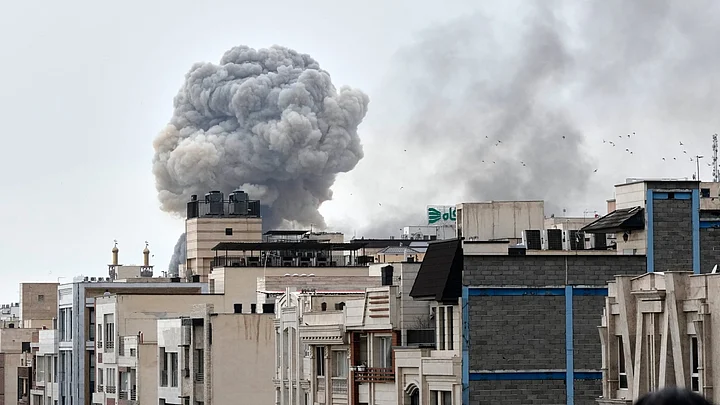
At a time when the world is undergoing a significant churning with overlapping conflicts, from Ukraine to Gaza, from the Red Sea to lingering tension in Indo-Pacific, it is often tempting to see each of these crises as distinct.
Yet, when seen together, they rather reveal a pattern that contemporary conflicts are rarely isolated events. They are sustained systems. The Israel-Iran confrontation fits well within this landscape.
For decades, the Israel-Iran conflict has been explained through a familiar vocabulary: deterrence, balance of power, security dilemma, strategic rivalry. These concepts are not without value. They help make sense of escalation, restraint, and the logic of state behaviour. But they also do something more limiting; they confine our understanding within the very framework that sustains conflict.
When ‘Peace’ Masks Persistent Hostility
Recent developments make this limitation increasingly visible. Missile exchanges, calibrated military signalling, and rising regional instability suggest that the Israel-Iran relationship has entered a more overt and dangerous phase.
Yet, even when tensions appear to subside, there is no genuine calm. Hostility does not disappear; it is reorganised. What is often described as 'peace' is, in reality, a pause within an enduring condition of confrontation.
To understand this persistence, it is useful to rethink what we mean by war itself. War is not simply an event or an outbreak of violence that disrupts normalcy. It is part of a broader system. In the Israel-Iran context, this system operates through multiple, interconnected layers: military infrastructures built around perceived existential threats; political narratives that mobilise fear; alliances structured through opposition; and media discourses that reproduce the image of the “enemy”.
Even in the absence of direct confrontation, this system remains active through proxy conflicts, covert operations, sanctions, and strategic signalling.
Negative Peace vs Positive Peace
War, in this sense, is not a breakdown of politics. It is politics, extended and embedded. Seen from this perspective, ceasefires and de-escalation efforts appear less transformative than they are often presented. They may delay confrontation, but they rarely dismantle the underlying structures that make conflict possible.
As long as these structures remain intact, the conditions for renewed hostility persist. This is where the work of peace theorist Johan Galtung offers an important intervention. Galtung distinguishes between “negative peace” or the absence of direct violence and “positive peace,” which involves the presence of justice, equality, and institutional conditions that reduce the likelihood of conflict over time.
Most policy efforts in the Israel-Iran context focus on achieving negative peace: preventing escalation, managing crises, and maintaining a fragile deterrence equilibrium. While necessary, these efforts are inherently limited. They do not address the deeper drivers of conflict, including structural inequalities, regional power asymmetries, and entrenched ideological antagonisms.
Galtung’s concept of “structural violence” is particularly relevant here. Political and economic arrangements like sanctions, exclusion, and uneven development can generate long-term grievances and instability without producing immediate, visible violence. These conditions quietly sustain conflict, ensuring that even periods of calm remain precarious.
The Power of Narratives and Identity
Yet, structures alone do not explain the endurance of this rivalry. The conflict is also sustained by narratives. Both Israel and Iran are embedded in powerful narrative frameworks that cast the other as an existential threat. These narratives are reinforced through political rhetoric, media representation, and education systems. Over time, they become part of everyday common sense, shaping how societies perceive risk, security, and compromise.
In moments of crisis, these narratives intensify. They narrow political imagination, making negotiation appear risky and compromise seem like betrayal. Conflict, therefore, is not only strategic—it is also deeply cultural and psychological, operating at the level of identity. There is also a temporal dimension that is often overlooked.
Much of the analysis of the conflict is driven by immediacy, focused on recent attacks, retaliations, and ceasefires. But the Israel-Iran rivalry is sustained across generations. Historical memory, collective trauma, and inherited suspicion continue to shape contemporary attitudes.
Young people on both sides grow up within these frameworks, often inheriting the conflict before they have the opportunity to question it. Without a transformation at this level, through education, cultural exchange, and the reworking of collective memory, even the most successful diplomatic agreements risk being temporary.
Rethinking the conflict also requires moving beyond the assumption that states are the only meaningful actors in international politics. Neither Israel nor Iran is internally uniform. Within both societies are diverse constituencies with different priorities, some invested in ideological confrontation, others more concerned with economic stability, social well-being, and global engagement.
Recognising this internal diversity opens up alternative pathways for engagement. Civil society initiatives, transnational networks, and digital forms of interaction can create spaces for dialogue that bypass official hostility. In an increasingly interconnected world, such interactions matter more than is often acknowledged.
Rethinking Peace Itself
All of these points lead to a deeper conclusion: the Israel-Iran conflict is not just a geopolitical contest, it is also an ontological challenge. It forces us to reconsider what we mean by peace.
Peace cannot be reduced to the mere absence of war, nor to a fragile equilibrium maintained through deterrence.
It must be understood as a condition in which the use of violence becomes unnecessary, not because it is prevented, but because it is no longer seen as legitimate or effective. Achieving this requires more than military restraint. It demands political imagination and institutional innovation. It requires transforming the structures that sustain conflict, challenging the narratives that legitimise it, and investing in long-term processes that reshape how societies understand each other.
This is neither easy nor immediate. But it is necessary. Because the real challenge is not simply to end the current phase of violence. It is to create conditions in which future violence becomes increasingly unlikely. Only then can peace move beyond being a temporary interruption—and become a lasting reality.
(Pulkit Buttan is a PhD scholar at the Tata Institute of Social Sciences, Mumbai. Vyas Muni is an Assistant Professor at GLA University, Mathura. This is an opinion piece and the views expressed are the author's own. The Quint does not endorse or is responsible for them.)
