
US Hits on Indian Vessels a Wake-Up Call for India's Sleeping Maritime Diplomacy
India has chosen to deflect public outrage rather than reprimand the US, writes Manoj Joshi.
advertisement
India has been forced to assume the role of bystander in the ongoing West Asia crisis. Inevitably, this has also meant that we have had to bear collateral damage.
India chose what can only be called an “US-Israel-leaning neutrality” in the war. Coming from a country that prided itself with its ability to maintain friendships across the tangled dividing lines in the region, this was an unfortunate development whose consequences are still unfolding.
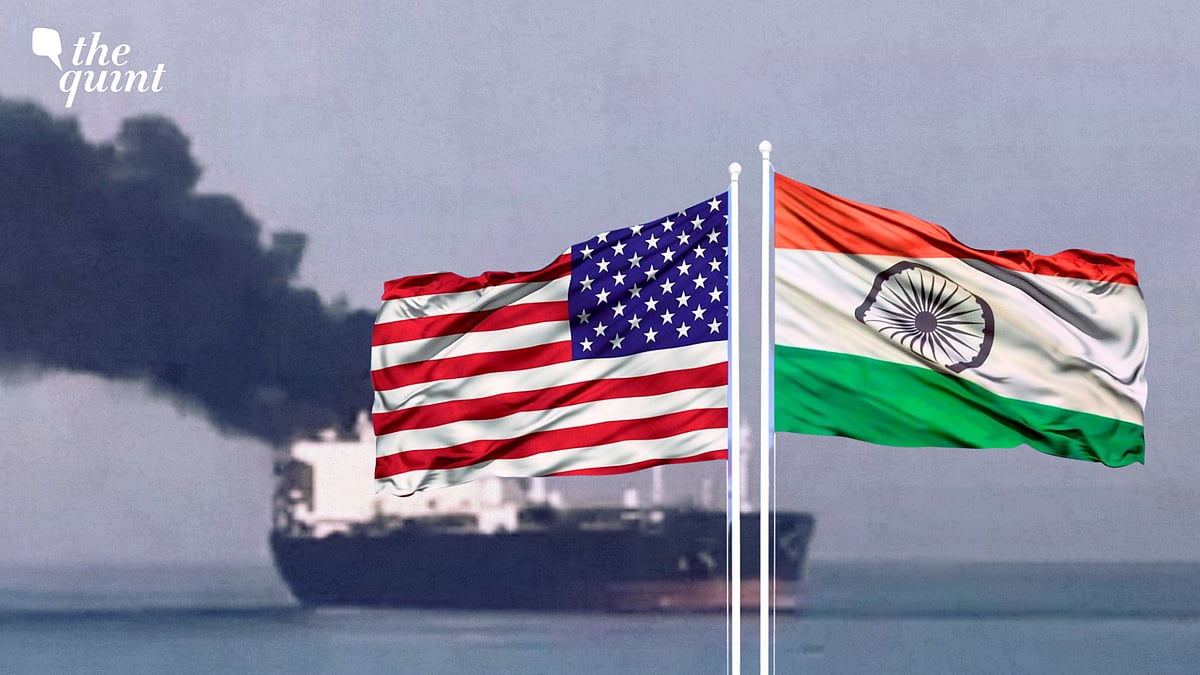
Nothing has brought out the Indian predicament better than last week’s attacks on ships crewed by Indian sailors in the Gulf of Oman.
This is evident from the episode in which Indian Navy personnel in Kochi removed a US-made Hellfire missile from the hull of a Greek-owned vessel on Wednesday, 10 June.
The ship, Olympic Life, is a Marshall Islands-flagged tanker that was sailing from Fujairah, a port in the Arabian Sea and outside the Strait of Hormuz area, to Kochi. So, the question is why was the tanker targeted in the first place?
India's Response Remains Deflective
In a bizarre statement on Friday, 12 June, while attacking Iran for falsifying the terms of the prospective US-Iran deal, US President Donald Trump referred to “their (Iranian) totally rebuffed drone attack last night against Indian ships leaving the Hormuz is TOTALLY UNACCEPTABLE.”
As of now, no one knows what he is talking about. Is Trump blaming Iran for the three attacks, two of which have been acknowledged by the US CENTCOM?
Recall the US torpedoing of IRIS Dena, which was returning from a flee review in Visakhapatnam in March, at the onset of the war. New Delhi provided humanitarian assistance and issued an anodyne statement, calling on “all sides to exercise restraint” and avoid escalation.
India cannot afford to be a spectator in the developments in the Gulf. Approximatley 50-55 percent of its crude oil, LPG, and LNG come through the Strait of Hormuz, as do significant amounts of sulphur—a feedstock for sulphuric acid, feedstocks for nitrogen-based fertilisers like urea, and ammonia, as well as copper, aluminium and helium gas.
On Wednesday, the Ministry of External Affairs (MEA) had summoned US Charge D’Affairs Jason Meeks and lodged protest after an attack on a commercial vessel. “We condemn the attack on the commercial vessel Settebello off the coast of Oman earlier today,” the MEA said in a statement. “Of the 24 Indian crew onboard, 21 Indians have been rescued thus far and 3 Indians are reportedly missing.“
Later, unfortunately, the three were declared dead, generating outrage across the country. Not surprisingly, the statement omitted to name the US as the party responsible for the attack. This is even though the US CENTCOM had explicitly taken credit for it.
Repeated Targeting
A day earlier, the US forces had disabled another ship, the Palau-flagged Marivex, which had 24 sailors, all Indian nationals, aboard. According to a CENTCOM statement, the ship moved from Oman towards Iran, breaching the American blockade.
The US used a fighter aircraft to fire a precision missile to disable the ship’s steering system. The US termed the ship “non-compliant”, and said it was one of seven ships it had dealt with in the same way. All the sailors of the Marivex were rescued with the help of Omani authorities.
The term “non-compliant” refers to the vessels not complying with American orders, and has no force in international law.
In the case of the Settebello, the US claimed that the ship was trying to breach their blockade by transporting oil from Iran. But the Dubai-based company, which manages the tanker, contested the US claim. It said the ship was merely anchored in the Gulf of Oman when it was struck, and it was not “non-compliant” with anything.
It had been in this position for the past 10 days or so and had conducted no manoeuvres, and that it had received no prior communications from the US forces.
In the case of the Marivex, the MEA noted the targeting and the Indian consular support to the crew, but it did not name the US.
It was only after Settebello was attacked that the MEA spokesman directly named the US Navy as the source and the US Deputy Chief of Mission was summoned to lodge a formal protest. But the written text of the statement remained vague.
The Attack on Jalveeer
Finally, in the case of the latest attack on the Jalveer, the MEA was more specific. It said Meeks had again been summoned to South Block, and a strong protest was lodge “regarding continuing attacks by US naval forces on vessels carrying Indian mariners in the Gulf of Oman.”
The MEA expressed its “deep concern” at the use of “lethal and deadly force against civilian shipping”—and termed such actions as “unacceptable.”
He said that “such lethal actions against commercial shipping are not justified.” Jaishankar was, no doubt, reflecting the deep anger in India over the developments in the Gulf.
The American response was equally blunt and not very helpful. According to the American readout of the conversation, “Secretary Marco Rubio stressed that all commercial vessels should immediately comply with orders from US forces as they seek to uphold peace and security in the Strait. He underscored that violations of the US blockade and the illicit transport of Iranian oil will not be tolerated.”
The Wikipedia lists 43 ships being attacked by Iranian forces between 1 March and 14 May, and it lists 13 ships attacked by the US forces from 1 April when it began its blockade, till the attack on Jalveer.
Such attacks have been justified by the attacking forces as enforcing their respective blockades. In these cases, the attacking military claims the vessel repeatedly failed to comply with orders.
An Illegal War
Actually, let’s be clear: the US-Israeli war on Iran is illegal under international law. Hence, any consequent actions, like the US blockade, are also violative of the law.
The Iranian action to block transit passage is also clearly illegal and this has been underscored by the United Nations Security Council Resolution 2817, adopted on 11 March, condemning the Iranian attacks on its Gulf Cooperation Council neighbours.
An earlier resolution protecting commercial shipping in the strait was vetoed by the China and Russia. Given what were clearly illegal actions, New Delhi needs to demand compensation and accountability wherever appropriate, rather than merely lodge protests.
(The writer is a Distinguished Fellow, Observer Research Foundation, New Delhi. This is an opinion piece, and the views expressed are the author's own. The Quint does not endorse or is responsible for them.)
- Access to all paywalled content on site
- Ad-free experience across The Quint
- Early previews of our Special Projects
Published: undefined