Will He, Won’t He? India's Choices as Trump Ups Ante on Iran With 25% Tariffs
'One can't say Trump's threat of attacking Iran is purely theoretical,' says ex-Ambassador to the US Navtej Sarna.
advertisement
Along with upping the ante on military action against Iran in the last few days, US President Donald Trump has espoused his tried and tested pressure tactic to weaken the country's regime: tariffs.
"Effective immediately, any country doing business with the Islamic Republic of Iran will pay a tariff of 25 percent on any and all business being done with the US,” Trump took to Truth Social to say on Tuesday, 13 January. "This order is final and conclusive."
Trump's threat has come in response to massive protests which have gripped Iran over the rising costs of living, and have reportedly claimed over 2,000 lives so far. The president has vowed military action against Tehran if its security forces "violently kill peaceful protesters".
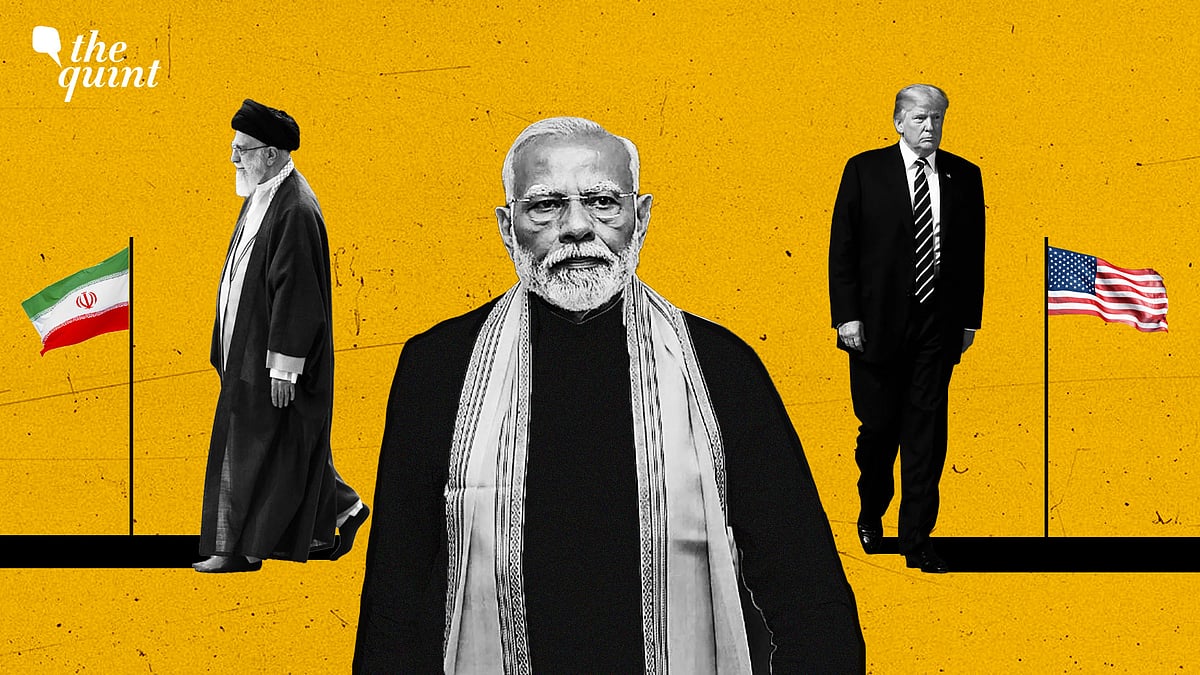
The tariff threat has brought India into the crosshairs of the conflict. New Delhi not only enjoys healthy trade ties with Tehran, albeit vastly downgraded since 2019, but also views Iran as a significant geopolitical partner owing to its strategic location in West Asia.
Economic Costs for India
Trump's latest economic threat over trade with Iran has brought out the possibility of tariffs on Indian goods being increased to a whopping 75 percent. While the initial tariff was pegged at 25 percent, the US doubled the rate to admonish India over its continued trade with Russia amid the Ukraine war.
Increasing that rate by a third will bring further humiliation to New Delhi, which has been eager to improve ties with the US by inking a trade deal.
"India doesn't have many good options," Manoj Joshi, Distinguished Fellow at the Observer Research Foundation, tells The Quint. "Iran used to be the fourth largest oil supplier to India, but due to pressure from Trump we stopped the import of Iranian oil in 2019."
Total bilateral trade between the two countries in financial year 2024-25 stood at $1.68 billion, a massive decrease from the high of $17.03 billion in 2018-19.
"Iranian oil is the closest source of oil to India. So for New Delhi, accessing their oil and gas would have been hugely advantageous," Joshi adds.
After 2019, however, New Delhi was able to diversify its oil trade by stepping up its import of Russian crude. Now, with Venezuelan oil also expected to enter the market in the medium-to-long-term, and India's Gulf supplies intact for now, the economic cost to New Delhi will be cushioned by the relatively low bilateral trade it currently has with Tehran.
Cost To India More Strategic, Less Economic
In May 2024, India and Iran inked an agreement for the former to operate the Shahid Beheshti terminal of the strategic Chabahar Port, which gave New Delhi unimpeded access to trade with land-locked Afghanistan and Central Asian republics: Uzbekistan, Kazakhstan, Kyrgyzstan, Tajikistan, and Turkmenistan.
The signing of the agreement, which came 22 years after the idea was first floated in 2002, was seen as a major diplomatic victory for India as it meant it could bypass Pakistan to trade with Central Asian republics.
Pessimistically speaking, if any reprisal by the US against India leads to New Delhi further downgrading its ties with Tehran, the Masoud Pezeshkian regime may view this as a symbolic humiliation and consider retracting approval for India to operate Chabahar.
However, experts suggest that such a move by Iran would be akin to shooting itself in the leg.
"Closing off the Strait of Hormuz wouldn't just be an India-specific issue, but would have a much wider impact. So for Iran to take that step would involve the wrath of many countries. Given that Tehran needs as much support as possible amid pressure from the US, such a move would be self-defeating," says Harsh V Pant.
There are several other projects in Iran of which India is a part, such as the International North-South Transit Corridor, which links New Delhi to Russia via Iran and Azerbaijan. Further, the India-Middle East Economic Corridor was announced at the G20 Summit in India in 2023, which is still in the works. Once built, it will connect India with not only countries in West Asia but also in the EU.
Another geopolitical advantage Iran offers India is that it is one of the few Islamic countries in the world and members of the Organisation of Islamic Cooperation (OIC) that has consistently taken a pro-India position when it comes to disputes with Pakistan, particularly over the sovereign status of Jammu and Kashmir.
Hence, distancing itself from Iran due to US pressure would be a big gamble for New Delhi.
"At this stage, it is very difficult to talk about the impact on India unless we know where exactly US-Iran tensions are heading," Navtej Sarna, former Indian Ambassador to the US, tells The Quint.
What Are Trump's Options Regarding Iran?
Amid the protests in Iran, the phrase "regime change" has been doing the rounds in political circles. The possibility of toppling Iran's Supreme Leader Ayatollah Ali Khamenei's regime has come into the spotlight with renewed vigour, especially aftet US forces "captured" former Venezuelan President Nicolas Maduro on 3 January.
Boots on the ground: Practically, the US has avenues to send troops into Iran, given the many bases the country has across West Asia. Qatar houses the Al Udeid Air Base, which is the largest US base in the region with 10,000 active troops stationed there. Even apart from Qatar, the US has thousands of soldiers spread across a number of countries, including Syria, Iraq, and the UAE.
However, is the US likely to send boots on the ground?
"While it's not impossible, I feel it's improbable," says foreign policy specialist Aditi Bhaduri. "The capture of Maduro has brought with it several challenges. Then, the US is also tackling with issues pertaining to Greenland and its NATO allies. With all these taken together, Washington may not take the call to deploy forces in Iran."
In fact, Trump has himself criticised the actions of former US President Jimmy Carter, who had deployed troops in Iran following the 1979 Islamic Revolution, which deposed the then pro-West Shah Mohammad Reza Pahlavi.
Trump said in an interview with The New York Times earlier this month that the operation "destroyed [Carter's] entire administration".
"I don't know that he would have won the election, but he certainly had no chance after that disaster," he added in the interview, indicating his opposition to deploy forces in the country.
There are several other complications as well. What the US achieved in Venezuela is far more difficult to replicate in Iran, which has the 9th largest military force in the world and is almost twice as large as the South American country in terms of surface area.
"If the war breaks out, Iran may not get the backing of other Arab countries. But it will go down fighting, even if to a superior military power," West Asia expert Sanjay Kapoor tells The Quint.
Launching strikes: Given the risks of a ground invasion, launching strikes seems like a more viable option for the US if the situation in Iran continues to worsen.
In June 2025, the US government had launched Operation Midnight Hammer, under which missiles struck Iran's nuclear facilities in Fordow, Natanz, and Isfahan. The strikes took place during the 12-day conflict between Iran and Israel.
Iran had retaliated against the strikes, reigning missilies upon the US' Al-Udeid Air Base in Qatar. However, Tehran had informed Washington about the strikes beforehand so that the conflict doesn't spiral out of control.
Further, here have been several indications from the US government that it is moving away from the possibility of military action in Iran.
For instance, White House Press Secretary Karoline Leavitt said while addressing the press on Monday, 12 January, that strikes were "one of the many, many options that are on the table", highlighting the preference of diplomatic channels. However, experts suggest that a lot would depend on the events unfolding over the next few days.
"It's not like Trump is talking about invading or taking over Iran. At the moment, a military strike is an option. But when we speak of what sort of military strike, there are dozens of options. We can't say that Trump's threats are purely theoretical because the US had bombed Tehran just a few months ago," Navtej Sarna tells The Quint.
A Reuters report quoted sources as saying that the country was on "high alert" following the possibility of US intervention in Iran. Iran's chief cleric Khamenei had also vowed to take action against his bitter rival Tel Aviv, a key Washington ally, if attacked.
"Iran's response will first be against Israel," says Harsh V Pant.
Meanwhile, India has taken a cautious line regarding the tensions in the West Asian country. Addressing a press conference on Monday, 12 January, Foreign Secretary Vikram Misri said that India is "closely monitoring" the situation.
"We are watching the developments in Iran… We have a significant community of expatriate Indians and also students from India in Iran," he said.