
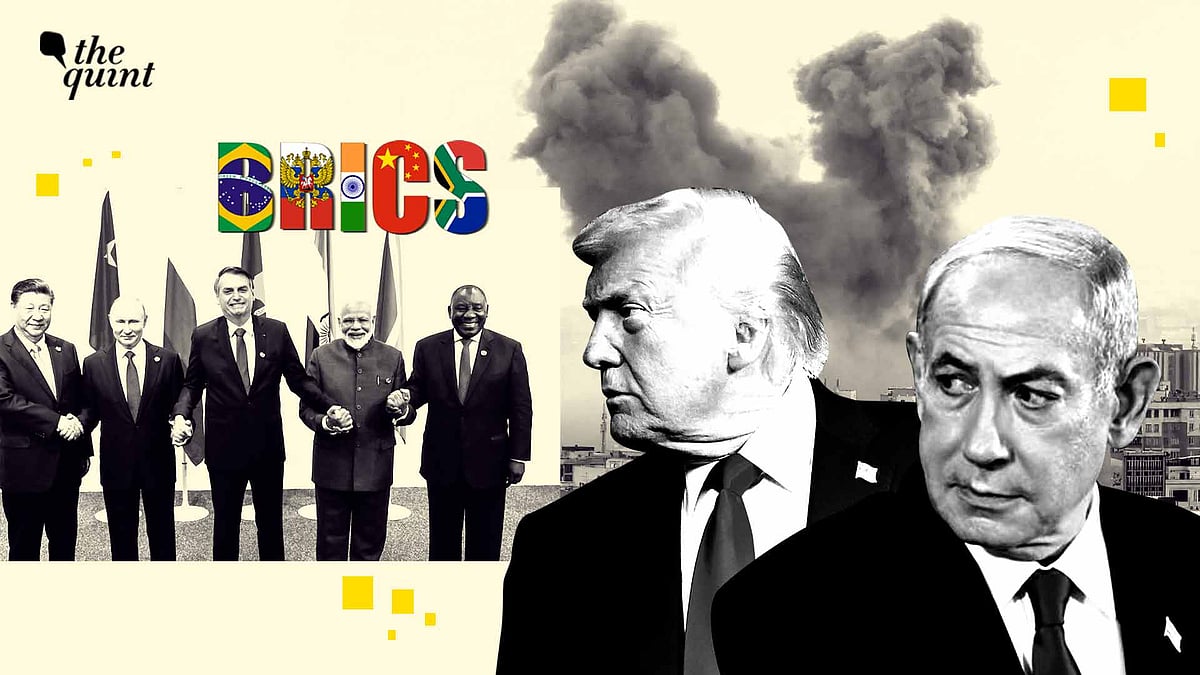
Caught between US, Iran, and Russia, Can India Keep its Commitment to BRICS?
India is expected to host the BRICS this year. Will the summit survive the Iran war?
advertisement
When Iranian Supreme Leader Ayatollah Ali Khomenei was killed on the second day of the US-Israel's war against Iran, what wasn't acknowledged by scores of analysts is that Iran is not only a member of BRICS, but also that of the Shanghai Cooperation Organisation (SCO).
These groupings may not be military alliances. But the SCO—primarily an anti-terrorism partnership in the region—issued a strong statement condemning the US-Israel strike, which it said violated Iran’s sovereignty.
India, along with China and Russia, is part of the SCO. Unlike the June 2025 war with Iran, when New Delhi downplayed the Israeli bombing, this time India backed the SCO's statement.
What does this war then mean for the groupings—and the commitments—that India has made? India is also expected to host the BRICS Summit this year. Will the summit survive the Iran war and how the BRICS countries have treated the war-ravaged country?
Tehran Miffed with New Delhi?
Six days after the Ayatollah's death, the Indian government made amends and asked Foreign Secretary Vikram Misri to sign the condolence book at the Embassy of Iran in Delhi. It is learnt that the delay in India issuing an official response to the Iranian Supreme Leader's killing stemmed from confusion at the top.
Though India has pivoted itself towards the US under President Donald Trump at the expense of its non-aligned, and more recently, strategically autonomous partners, many in foreign policy circles believe that move was made too hastily. It has buttressed the impression that India yielded to American pressure amids fear that its efforts at energy self-sufficiency could be badly hit. Worse, India’s attempts to host a non-controversial and inclusive BRICS Summit could be grievously hit too.
India has not only moved closer to the US, calling itself “essential partner”, but New Delhi has also purportedly opted out of the Chabahar Port agreement that was given to them on highly favourable terms.
Chabahar Deal, Naval Aggravations
The Chabahar Port deal allowed India to bypass Pakistan and forge trade ties with Central Asian countries. After the US withdrew all favours extended to India from the standpoint of Chabahar, India quietly withdrew from the deal fearing retaliation if it continued to stay with the Iranian port at Sea of Oman.
Adding insult to injury for India's reputation, the Iranian sailors affected by the attack floated in the high seas for a while until they were rescued by the Sri Lankan navy. India, which is seen as a guarantor of peace in the Indian Ocean, did nothing, compelling the Iranian foreign minister to ruefully claim that the sailors were Indian guests.
Compelled by these circumstances where India was seen as violating all norms related to humanity, India has now offered refuge to Iranian sailors from another ship that had come for the fleet review exercise.
The implications of the Indian government’s indifference to Iran is being felt on New Delhi's attempts at energy self-sufficiency. Analysts estimate that some 38 ships laden with both goods as well as crude oil are being held up in the Persian Gulf. These containers were destined for India, but Iran is not willing to help due to New Delhi’s pro-US shift in recent weeks. Iranian sources allege that India provided key intelligence to the US on certain issues.
India Must Mind its Head with Russia
The closure of Strait of Hormuz is already causing a severe oil crisis globally. India is giving an impression of breathing easy, especially after the US' 'permission' to New Delhi to buy from Russia. But it should not count its chickens till they are hatched. India was buying crude oil from Russia when the US imposed tariffs on New Delhi. The US has made it amply clear that India will get relief on its 50 percent tariff only if it stops buying oil from Moscow.
Quite apparently, the Russians are also upset with India. A strong votary of BRICS and de-dollarisation, Russia realises that the war against Iran has changed India’s priorities. Increasingly, Russia is playing with a weak hand against the US. India is not buying its weapon system and consciously distancing itself from multilateral bodies that Russia and China crafted.
There is a view among the BRICS members that if India does not postpone the summit to next year, it would likely have perfunctoriness written all over it. A senior diplomat from a BRICS country told this writer, "India will not take any hard issue against the West. It will talk on issues that do not rankle the West."
In some ways, it is like what a Brazilian economist had claimed in Rio de Janeiro last year when he said that India cannot be trusted as a BRICS partner, as it is a trojan horse of the West, an “outlier”. Harsh words these, India has an opportunity to prove him wrong and take on Trump and Bibi Netanyahu.
(Sanjay Kapoor is a veteran journalist and founder of Hardnews Magazine. He is a foreign policy specialist focused on India and its neighbours, and West Asia. This is an opinion piece. All views expressed are the author’s own. The Quint neither endorses nor is responsible for them.)
- Access to all paywalled content on site
- Ad-free experience across The Quint
- Early previews of our Special Projects
Published: undefined