
When the Police Serve Power, Who Protects the Citizen?
When officers fear their political masters more than the Constitution, ordinary citizens pay the price.
advertisement
The true test of a police force is not how effectively it can control a crowd, but how confidently a citizen can stand before it without fear.
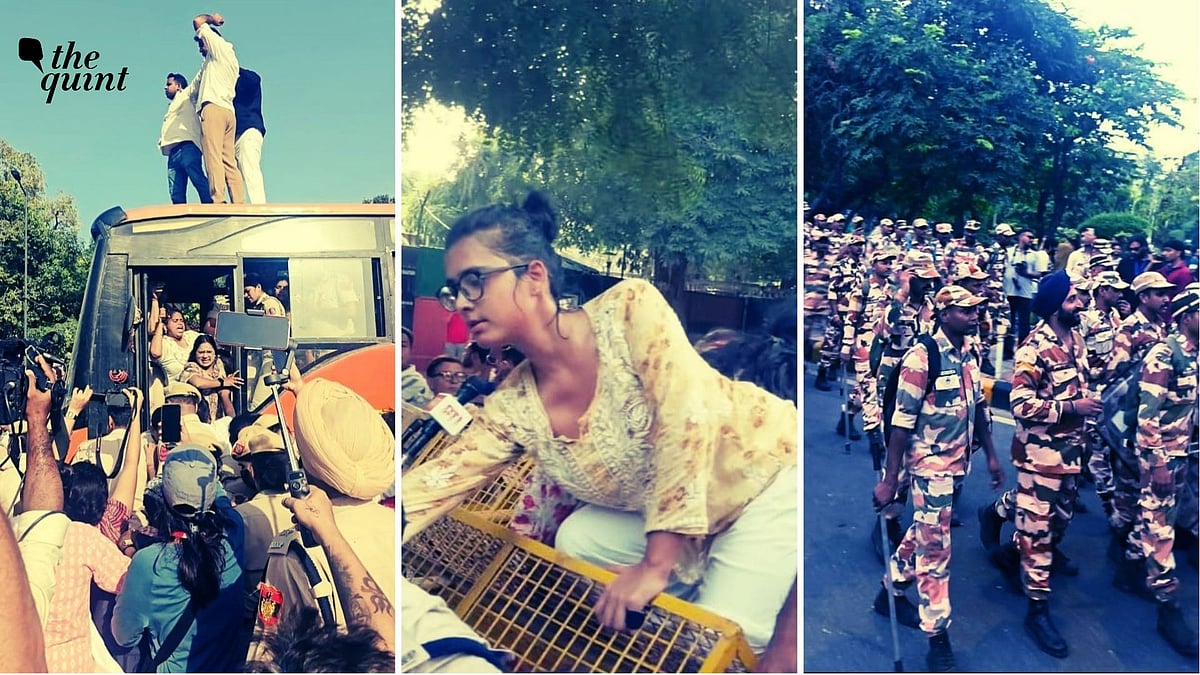
There are images that ought to stop a democracy in its tracks—women being manhandled in public; uniformed personnel appearing to wield authority with unrestrained aggression; and vigilantes seemingly taking the law into their own hands while those entrusted with enforcing it appear accommodating, indifferent, or unwilling to intervene.
If the visuals surrounding recent protests in Delhi bear out these concerns, they are not merely instances of questionable crowd management. They expose a deeper crisis of constitutional trust.
Delhi Police is no ordinary police force. It operates in the national capital, home to Parliament, the Supreme Court, foreign diplomatic missions, the national media, and the institutions through which India presents itself to the world.
When citizens begin to fear the institution meant to protect them, the damage extends far beyond the immediate confrontation.
The police have a legitimate responsibility to maintain public order. Protests cannot become a licence for violence, intimidation, or unlawful obstruction. Officers must sometimes act firmly in difficult and volatile circumstances.
But firmness is not arbitrariness, and the restoration of order cannot, by itself, establish that the law has been upheld. The relevant questions are whether force was necessary and proportionate, whether intervention was impartial, and whether those exercising authority remained accountable to the law.
The distinction is fundamental—a police force may possess the power to compel obedience, but it must earn the public's trust in its authority.
The Indefensible Arithmetic of Whataboutery
Whenever allegations of police excesses arise, a familiar defence follows i.e., the protesters were unruly; they defied restrictions; they obstructed roads; and they provoked the police.
Such conduct, where established, may warrant lawful consequences. It does not answer the question of whether the police acted lawfully themselves.
The conduct of protesters and the conduct of the police are not interchangeable moral or legal categories. A protester who breaks the law must face the law. A police officer who exceeds lawful authority must also face the law. One violation cannot excuse the other.
Indeed, the argument that the police should be judged by the same standard as protesters misunderstands the very nature of public authority. The police are not merely another party to a confrontation.
Police Must Stop Deflecting
This obligation becomes especially acute when women and students are involved. Their dignity does not become negotiable because they are protesting, resisting authority, or advancing an unpopular cause. Nor does the uniform confer immunity from the standards of decency and proportionality that the law demands.
Equally disturbing is the apparent indulgence of vigilantes who presume to dispense their own version of justice.
These incidents warrant independent scrutiny, not instant verdicts. Images can be disturbing, but their full context and the conduct they depict must be established. Yet, neither should the need for verification become an excuse for institutional defensiveness.
Credible allegations demand credible investigations. Constitutional restraint is not weakness. It is the discipline that distinguishes lawful authority from brute power.
Cops Independent by Law but What About Practice?
Beneath the immediate controversy lies a structural problem that India has long acknowledged but struggled to resolve i.e., the political control of policing.
An elected government is entitled to determine lawful policy priorities and demand professional performance. But political oversight is not a licence to direct policing according to partisan convenience.
When citizens begin to believe that decisions about protests, detentions, permissions, and the use of force are shaped by the preferences of the ruling dispensation, rather than by consistent legal principles, the credibility of the institution suffers.
Whether political interference has occurred in any particular incident must be established through evidence. The larger institutional concern, however, is undeniable—can a force convincingly demonstrate impartiality when its professional independence remains vulnerable to political influence?
The Supreme Court's landmark 2006 judgment in Prakash Singh v Union of India sought to address precisely this vulnerability. Its directives envisaged safeguards against unwarranted political interference, more stable tenures for police leadership, institutional oversight, and independent mechanisms for dealing with complaints against the police. Yet, implementation has remained uneven, and the struggle over transfers, postings, and executive control has persisted.
These are not arcane administrative questions.
Police reform, therefore, is not simply about better equipment, more personnel, or sophisticated crowd-control technology. It is about institutional independence. A technologically advanced police force can still be institutionally vulnerable if professional judgment is subordinated to political expediency.
The contradiction is striking—governments invoke the authority of the police to restore order, while the reforms designed to protect policing from improper interference remain unfinished.
The Capital's Credibility at Stake
Delhi's particular significance makes this failure of trust especially consequential. Foreign diplomats observe how democratic institutions function beyond official statements. Journalists observe how power responds to scrutiny. Citizens observe whether constitutional rights survive contact with authority.
A protest in the national capital is thus more than an inconvenience to be managed. It is a test of the State's confidence in its own legitimacy. A government secure in its constitutional mandate should be able to tolerate criticism without treating dissent as disloyalty.
A professional police force should distinguish peaceful protest from unlawful conduct without blurring the distinction between the two.
When that distinction appears to weaken, the consequences travel. Citizens may become reluctant to approach the police for help. Protesters may begin to regard the exercise of constitutional freedoms as a personal risk.
Journalists may question the space available for scrutiny. And observers abroad may wonder whether India's democratic promise is matched by its institutional practice.
The immediate confrontation may end. The apprehension it produces can endure.
The Uniform Must Answer to Constitution
It would be unfair to reduce an entire police force to the conduct of individual officers or a single episode. Police personnel undertake difficult and often dangerous work. Their authority is indispensable, and their lawful actions deserve recognition. But the demands of the job make accountability more necessary, not less.
The answer to criticism cannot simply be that officers were doing their duty. Citizens are entitled to ask whether that duty was performed lawfully, proportionately, and independently of partisan considerations.
Accountability must also travel upwards—where warranted. Scrutiny should extend beyond the officer at the barricade to the instructions, policies, and institutional pressures governing the operation.
Delhi Police must be judged not merely by its capacity to disperse a crowd, but by whether its conduct leaves citizens more confident in the constitutional order. The government, in turn, must be judged by whether it enables professional policing or leaves the force vulnerable to the political preferences of those in power.
A protest will disperse. Barricades will be removed. The news cycle will move on. But if citizens leave an encounter believing that the law is something to fear rather than trust, and that the police serve power rather than the Constitution, the damage will outlast the spectacle.
The gravest failure of policing is not losing control of a crowd. It is losing the confidence of the citizen. In the national capital, that failure should concern the entire Republic.
The remedy is neither greater coercion nor louder assurances. It is a police force insulated from improper political interference, accountable for its conduct, and disciplined by the constitutional restraint its authority demands.
The ultimate test is simple—when a citizen encounters the police, do they see the impartial face of the law, or the partisan shadow of the government?
(Bhopinder Singh is the former Lieutenant Governor of The Andaman and Nicobar Islands and Pondicherry. This is an opinion piece and the views expressed are the author’s own. The Quint neither endorses nor is responsible for them.)
- Access to all paywalled content on site
- Ad-free experience across The Quint
- Early previews of our Special Projects
Published: undefined