(Trigger warning: Narrations of assault against a female journalist.)
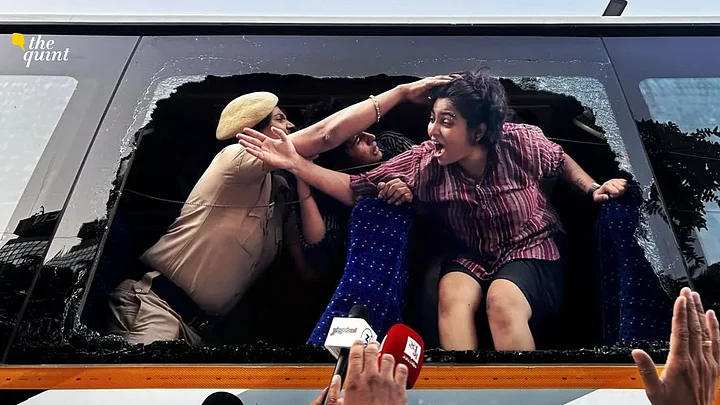
At about 6:00 pm on Sunday, 4 October, as a bus carrying several detained female protesters near Jantar Mantar started moving, independent journalist Deeksha Sinha was inside when she spotted her friends outside through the window. As it was a Volvo bus with sealed windows, Sinha hurriedly grabbed a pen and a piece of paper from the woman next to her and wrote in bold letters: “THE POLICE OFFICERS LIFTED MY SHIRT.” She then wrote down the contact number of the woman next to her so that her friends could find her once she was taken away.
An independent journalist and former employee of The Quint, Sinha had already allegedly faced assault at the hands of Delhi Police officials earlier on Sunday, 5 October, as protests against CEC Gyanesh Kumar rocked the national capital. Two hours earlier, at about 4:00 pm, Sinha had faced a similar ordeal at the hands of female police officers. As scores of Aam Aadmi Party (AAP) leaders were being detained by the Delhi Police, officers also tried to detain Sinha.
“I kept asking them why they were dragging me. I showed them my camera, I told them I am from the media. But they refused to listen. Some cops lifted my shirt up. And another male officer was mocking and said "hahaha, ye toh mahila hai," said Sinha, visibly shaken.
She was eventually allowed to get off the detention bus. But it was only the beginning of a traumatic day for Sinha as she tried to navigate her way as an independent journalist.
'Tried to Snatch My Camera, Broke my Mic...'
A few kilometres away, another group of protesters led by All India Students’ Association (AISA) president Neha Bora, activists Yogendra Yadav and Anjali Bhardwaj, and members of several student unions had reached the roundabout near Le Meridien and Shangri-La Eros hotel, attempting to breach the barricades and make their way to the Jantar Mantar protest site. Despite being deeply affected by what had transpired at India Gate, Sinha, along with her DSLR, headed to the location.
It was the third consecutive day that the Delhi Police, without offering a plausible explanation, had not only denied permission for the protest but had also subjected protesters to a severe crackdown, detentions and alleged brutality.
Moments later, protesters breached the police barricades and managed to move a few metres ahead, prompting the police to use greater force against them. Bora and Yadav were detained, while physical force was used against scores of others. Female protesters physically blocked the vehicle that was trying to take Bora away. Others were dragged by the police and pushed into buses brought in for detentions.
“I went right in front of the bus where they were pushing people inside. I was near the entrance of the bus, and then a policewoman noticed that I was constantly taking videos, so she started snatching my camera from behind, very brutally with a lot of strength. I tried with all my strength to save my camera because obviously it has a lot of footage and it is very important to me. For over two minutes that tug-of-war went on but I did not let it go. Then, that policewoman's hand landed on my shotgun mic. So, she just snatched it and like ripped it off my camera. My mic was gone. And then, they pushed me inside the bus,” Sinha recalled.
Sinha said she kept telling the officers that she was an independent journalist, but they refused to listen. Sinha, who is diabetic, said she eventually began feeling dizzy and had to lie down on the floor of the bus for a while. By this point, she had already lost her phone, her glasses and one of her shoes.
“I was seeing the women around me being manhandled and how,” she said.
“The female police officers, they just grabbed me. Like, they completely lifted me up, and I just completely lost it. I was like, ‘Why are you lifting me? Just kill me. Punch me in the face, yaar. Just fucking kill me. It’s okay. Hit me. There is no point surviving in this country, okay?’”
Sinha then narrated that while she was being lifted by female officers, one of them allegedly tried to unbutton her trousers.
“When I was feeling dizzy, other protesters kept telling her that it’s a medical emergency. A female cop gave me water but I again asked as to why she was giving me water, I was so frustrated I said just please kill me once and for all. She then said that they don’t mean harm, but we should think about our future,” she said.
Protesters then broke one of the bus windows from the outside.
“I was really scared. At first, I thought the bus was being attacked from the outside. But then, it was other protesters who broke the window,” she said. A police officer told those inside the bus that they would open the door and let them go, but asked them not to jump out of the window. “But her seniors refused to open the door. Eventually, all the people in the bus unitedly pushed open the doors of the bus to escape,” she said.
'I See Female Journalists Repeatedly Facing This On The Ground'
Sinha, who has covered several stories from the ground, including agitations such as the Cockroach Janta Party protests, says she has repeatedly seen female journalists, especially independent journalists, having a much tougher time than their male counterparts.
“What I have sensed, and also heard some police officers saying outside the Parliament Street police station on the first day (2 October) of protests, is that they observe whether you just have a phone and a small mic. One senior officer was telling another, "Arey, yeh log journalist thodi hai. Yeh YouTube wale log hai. Yeh kya hai, sirf video bana rahe hai." This particular statement, this temperament reflects in the entirety of the police forces,” she said.
"In the name of protocol and women safety, they have deployed female police officers. But what are even female officers doing? They are shoving people, grabbing them bu their necks, and manhandling. They are also blindly following orders - shove anybody in front of you into buses,” she said.
“When I was trying to jump off the bus, the female police officer said I shouldn't because there are shreds of broken glass and it was their duty tomprotect us. Is this how they want to protect us?”
Sinha says the attitude of the police towards independent journalists is also reflected in sections of the general public. After the first incident with the police at India Gate, Sinha spoke to The Quint on camera about what had happened. As the video, along with pictures and clips of her trying to jump off the bus, went viral on social media, Sinha said she was also deeply affected by the comments she received online.
“'Ek camera leke khud ko journalist samajh rahe hain...' said one comment. In another comment, one person said: 'She's ready to jump on, uh, men, and then she will be the one who will file rape complaints against them.' It does not even make sense.”
Sinha sustained multiple bruises on her body during the several altercations she had with the police.
Delhi Protests Marred With Allegations of Assault
Sinha’s account is among scores of allegations that the Delhi Police has faced over the past several days of protests in the national capital. The CJP has also been actively protesting to demand the registration of a First Information Report (FIR) against ACP Vivek Bhagat, who has been accused of shoving and sexually assaulting a woman journalist.
Over the course of the protests, several female protesters have accused police officers of using excessive force and manhandling them, with some also alleging that they were threatened by male officers.
On 4 October, several female protesters were also detained after 5:00 pm, raising questions over whether legal safeguards governing the detention and arrest of women were followed.
Speaking to The Quint, CPI(M) leader Brinda Karat on Sunday narrated how she had sat with the journalist at Parliament Street police station for four hours, demanding that an FIR be registered against ACP Bhagat.
“They had the impertinance and the guts to tell me that the case has been transferred to Crime Branch but an FIR will be registered if they get video evidence. The woman was sitting right with me. What do you mean by video evidence? Now we have to tell our girls that make reels of where you are being pressed and harassed?”
Bora, too, has accused the Delhi Police of detaining her on 4 October and taking her to Narela in an unmarked vehicle that had no woman police officer inside. After being released from detention, Bora said in a video message that despite the alleged brutality, the police had not “defeated” them.
The Quint has reached out to the Delhi Police a day before publishing this article via emails and social media for a response to the allegations made by Sinha and several other female protesters regarding the alleged excessive use of force. This article will be updated if and when they respond.