
Kashmir to Jantar Mantar—Can Democracy Justify Blinding Protesters with Pellets?
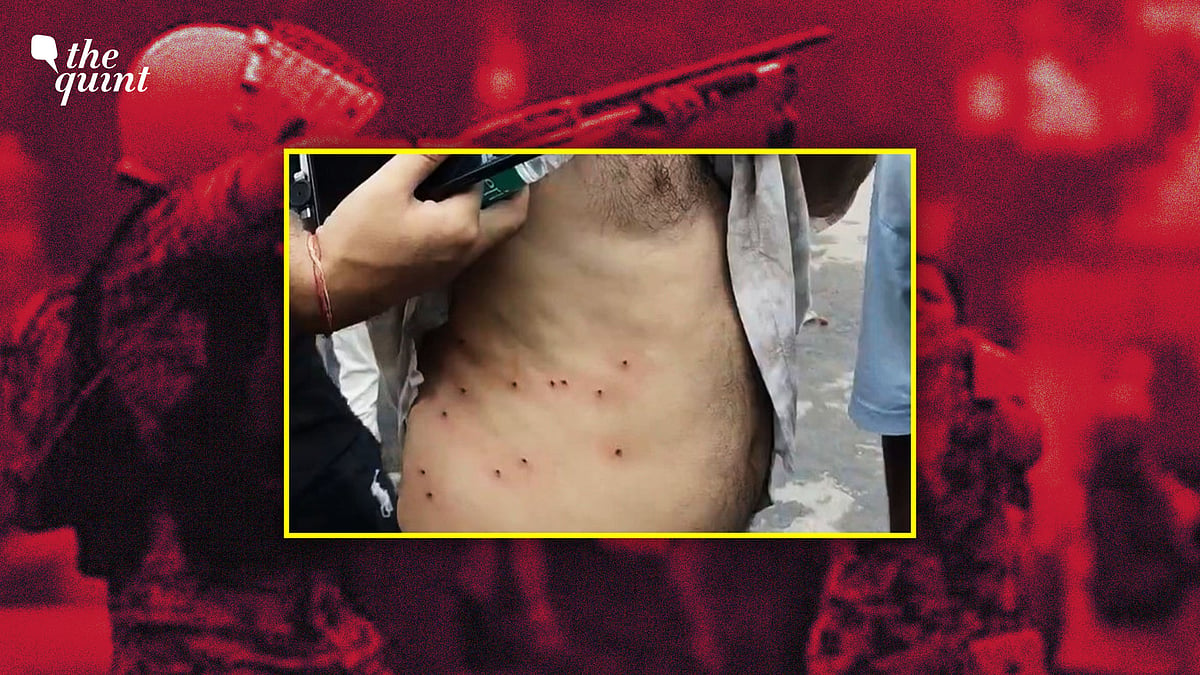
The Delhi Police maintain that only lathis and tear gas were used. The injuries, however, sketch a different story.
advertisement
The recent protest at Jantar Mantar has once again revived a troubling question for Indian democracy: can the State deploy a weapon that predictably blinds its own citizens in the name of maintaining public order?
The Delhi Police maintain that only lathis and tear gas were used. The screaming injuries, however, sketch a different story. In the days following the 20 July protest, surgeons at Lady Hardinge Medical College in New Delhi removed metal fragments from the face and neck of 25-year-old protester Shaikh Irshad Mansoori. Another protester, 19-year-old Sahil Lochab, underwent surgery to remove pellets.
They were among more than a hundred people—most of them students and first-time protesters—treated after police stopped the Cockroach Janata Party (CJP)'s 'Sansad Chalo' march near Parliament. At least three young citizens returned with pellet injuries.
What Place Does Such a Weapon Have in a Democracy?
The moral priority of the State, which was on full display on 20 July, could be best captured in the following words of Sant Kabir, "He who inflicts pain on the helpless to show his power fires arrows into his own soul. The iron pellet may pierce the eye of the poor, but the sigh of the broken reaches the heavens."
Long before constitutions and human rights treaties came to dominate the nation's political life, Indian thought recognised a simple moral principle that a weapon which strikes indiscriminately loses its claim to justice. India has a rich and glowing philosophical tradition which draws a distinction between force directed at a legitimate target and force incapable of distinguishing combatant from bystander.
The use of pellet guns in the heart of New Delhi revived a question that many believed belonged only to Kashmir: can a democratic republic deploy such a weapon for policing anywhere at all?
Pellet-firing shotguns were introduced in Jammu and Kashmir in 2010 as a supposedly less-lethal alternative to bullets. Human Rights Watch documented at least 17 deaths and well over a hundred cases of blindness between 2016 and 2019. Studies from Government Medical College, Srinagar found that more than half of pellet-related eye injuries resulted in permanent visual impairment, while Amnesty International described their use as an unprecedented episode of mass blinding. The problem is inherent in the weapon itself.
Neither Fair Nor Reasonable
A Constitution is tested not by how it treats the obedient, but by how it treats those who dissent. The State may regulate protests, but it cannot answer peaceful assembly with force that foreseeably blinds or permanently disables citizens. The real question is not whether the police acted under an internal protocol, but whether deploying a weapon designed to scatter metal pellets across a crowd is fair, reasonable, and proportionate.
The Supreme Court has already provided the framework to answer that question.
In Modern Dental College and KS Puttaswamy v Union of India, it held that every restriction on a fundamental right must pursue the triple test of legality, necessity, and proportionality.
In Anuradha Bhasin v Union of India, the court applied this standard while reviewing restrictions in Jammu and Kashmir.
Earlier, in the Ramlila Maidan case, it held that even an unlawful assembly does not lose its dignity and that police may use only such force as is strictly necessary and proportionate.
India's constitutional commitments are reinforced by international law.
The International Covenant on Civil and Political Rights, the UN Code of Conduct for Law Enforcement Officials, and the UN Basic Principles on the Use of Force and Firearms require force to be necessary, proportionate, and used only as a last resort, while emphasising non-lethal alternatives and accountability. A weapon that cannot be accurately aimed, and whose predictable consequence is permanent blindness, sits uneasily with these standards.
A Complete Ban on Pellet Guns
Other democracies have confronted this reality.
Chile suspended the routine use of pellet guns within a month after the 2019 protests left hundreds with eye injuries, including the blinding of Gustavo Gatica. Northern Ireland's baton rounds killed 17 people, including eight children, prompting calls for safer alternatives.
In France, LBD40 launchers left protesters with permanent eye injuries, leading to demands for their suspension.
India's institutional response has been markedly different. More than a decade after pellet guns entered its policing arsenal, neither the courts nor the government has squarely examined whether a weapon that predictably blinds citizens can satisfy the constitutional requirements of necessity, proportionality, and the least restrictive means.
Parliament and state legislatures must also create stronger democratic channels for dissent, because grievances ignored by institutions eventually spill onto the streets.
The Constitution was written by a generation that endured lathi charges, imprisonment, and bullets under colonial rule. It promised that independent India would govern differently through restraint, necessity, and respect for human dignity.
A republic faithful to that promise cannot accept a weapon whose predictable consequence is permanent blindness as a legitimate instrument of democratic policing.
(Zain Haider is an Advocate practising before the Supreme Court of India and has represented the petitioner in the Supreme Court in the pellet gun case concerning Kashmir. Bhanu Pathania is an Advocate practising before the Supreme Court. This is an opinion piece and the views expressed are the author’s own. The Quint neither endorses nor is responsible for them.)
- Access to all paywalled content on site
- Ad-free experience across The Quint
- Early previews of our Special Projects
Published: undefined