
Why So Many Different Indias Suddenly Found Each Other at Jantar Mantar
The most significant outcome of this protest is the massive interest in politicisation that the Gen Zs have shown.
advertisement
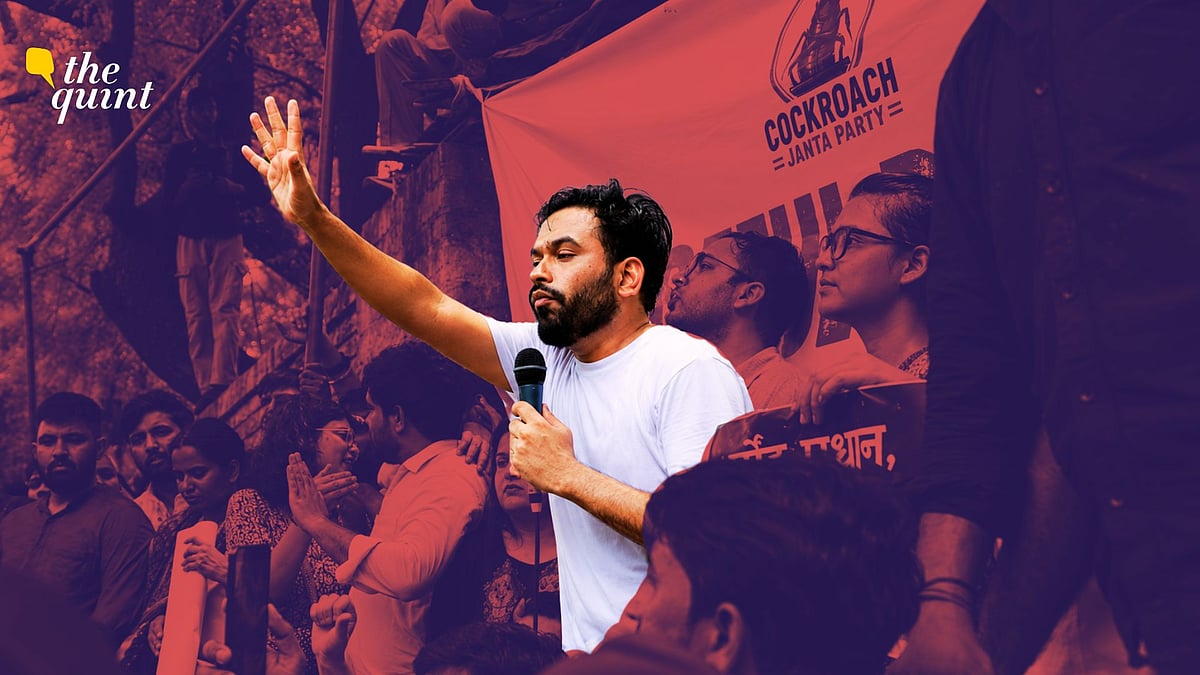
When everything seems to crumble down, people desperately hold on to something that gives them hope. In those moments, they don’t look for the most perfect option, the most morally correct option, but something that sails them through those moments. This is exactly what has transpired in India with the Jantar Mantar protests, which the Abhijeet Dipke-led Cockroach Janata Party (CJP) triggered as a response to the NEET paper leaks and suicides of students.
In the 2024 general elections, when the Bharatiya Janata Party (BJP) could not reach a majority on its own, many believed that it was the party’s end times. Thereafter, since it managed to hold together the government through alliance partners, it was assumed that Narendra Modi and Amit Shah’s centralised power would diminish. Yet, over the next two years, not only did they win several state elections but also managed to break up oppositional parties that seemed like a challenger to the BJP.
The Special Intensive Revision (SIR) process of electoral rolls continues to disenfranchise millions of marginalised populations. Adivasi communities are evicted forcefully by the police in many BJP-ruled states. Violence against Muslims and Christians by Hindutva-affiliated groups has increased manifold. Lakhs of public schools are getting closed down. Gig workers' protests are suppressed, and judicial, media and bureaucratic powers of upper-caste lobbies aligned to the BJP are given free hand to further delegitimise the demands and grievances of vast sections of the people.
A Protest Larger Than its Founders
One of the reasons is because Delhi is the center of all media attention, and the other is a structural reason where people in India don’t see the sufferings and grievances of different castes, tribes, or religions as their own. This apathy is multiplied if these groups happen to be from marginalised and antagonised groups.
In short, people in India have not been able to develop a broader sense of commons. This is precisely why categories like working class, Dalits, Bahujans, and Muslims—despite the deprivations and discrimination they face—not only get delegitimised by groups that are hostile to them, but also do not come together among themselves with the force and numbers as their political and ideological advocates make it appear in their utterances.
On the other hand, since 2014, it has usually been the upper-caste lobbies close to the BJP and their big media house partners who have time and again decided what is to become a national issue and what is supposed to be a commons. Anyone or any group who tried to go against these projects has been labelled as "traitors" to the country and those disturbing the so-called harmony of society. One needs to see the emergence of the CJP, which became an unconscious agent bringing together scattered enclaves of anti-BJP sentiments, in the light of these developments over the last 12 years.
Many senior commentators saw it as an Anna Andolan in the making that was bound to fail, while sections of the Left and Ambedkarites chastised it for lacking an ideology—and not having an understanding of structural change. But, amid these scepticisms, leaders like Chandrashekhar Azad, Dipankar Bhattacharya, and activists like Neha continued to make their presence felt in the Jantar Mantar protests, maybe understanding the dire need of keeping the BJP out.
What the protests have turned out to be is beyond the CJP and paper leaks now. The protestors at Jantar Mantar are largely common people from different parts of the country who are appropriating the protest for their own grievances and anger against the BJP and the education system. Most people, while vocal about the NEET paper leaks, seemed to echo a common sentiment, and that is the removal of the BJP and not just the resignation of Education Minister Dharmendra Pradhan.
The people there are largely raw masses who are not bound to one or the other ideology—some are chanting Inquilab, some Jai Bhim, while others are chanting Vande Mataram. Maybe it is this fluidity of ideologies that has allowed different people to come together in a common space against the BJP.
That would be overestimating the CJP and putting it on a pedestal it might not have sought. While Anna Andolan was led by a group of senior and well-known bureaucrats, activists, and advocates, who seemed capable of forming a new political party, this is a far less loosely coordinated protest by young students who are not confined to the CJP or any one political party. Since the protests started, leaders across party lines have come to extend their solidarity, and yet the issue of paper leak has not become the possession of anyone.
A New Political Commons
There is also an interesting aspect of the protest in contrast to the Anna Andolan—and that is the symbolic acceptance of BR Ambedkar’s portraits and the blue colour representing the mainstream Dalit movement, which would not have been possible during the Anna Andolan that many upper-caste students joined while being disappointed with the Congress giving in to OBC reservation.
At the same time, this spontaneous outpouring of people in building a commons—howsoever momentary it might be—could not be built when Anitha, a young Dalit student from Tamil Nadu who fought against NEET in the Supreme Court and eventually committed suicide in 2017, triggered massive protests in Tamil Nadu.
They are active users of social media and aspire for a better life away from the hard manual labour their parents did—and yet, do not find dignified employment in urban cities. This constituency is not interested in the nitty-gritty of Left-liberal discussions that one sees among urban activist circles, nor do they closely relate to the politics of lower castes that articulate the deprivations and struggles of their parents' generation.
The most significant outcome of this protest is the massive interest in politicisation that the Gen Zs have shown. Simultaneously, many floating upper-caste Hindus have become part of this protest against the BJP, who might otherwise be very suspicious and antagonistic towards Left student and Dalit politics.
One can also see certain misogynistic posters directed towards Prime Minister Modi. It is this coming together of contradictory sets of people that makes the Jantar Mantar protest a generative site for political and ideological encounters. It is definitely not a structural change moment, but a desperate unity of the people who felt defeated time and again—and many of whom have been facing profound existential difficulties due to the ruling government.
They cannot afford to wait for a perfect moment for structural revolution, nor can they pin their hopes on any oppositional party to be strong enough to challenge the BJP, and hence they decided to jump into this without being delusional about a grand overhaul.
What Comes Next?
Ideologically, there is a palpable pattern of anti-Hindutva sentiment among a section of protestors, but to what extent all of them will stand for specific Muslim grievances, only the future will tell. For now, the crowd seemed to be amicable to each other. They are distributing food, water, medicines, fanning each other, and actively volunteering to manage the crowd amid the loud sloganeering and occasional music playing in groups.
Regardless, this moment has definitely undermined the legitimacy of the BJP in the imagination of a section of Gen Z and given some hope that the party is not invincible despite its brutality through police and media machinery.
(Sumit Samos is a researcher and anti-caste activist and his research interests are Dalit Christians, cosmopolitan elites, student politics, and society and culture in Odisha. This is an opinion piece, and the views expressed above are the author’s own. The Quint neither endorses nor is responsible for the same.)
- Access to all paywalled content on site
- Ad-free experience across The Quint
- Early previews of our Special Projects
Published: undefined