
The Cockroach Janta Party, and Why Revolution Will Not Be a Google Form
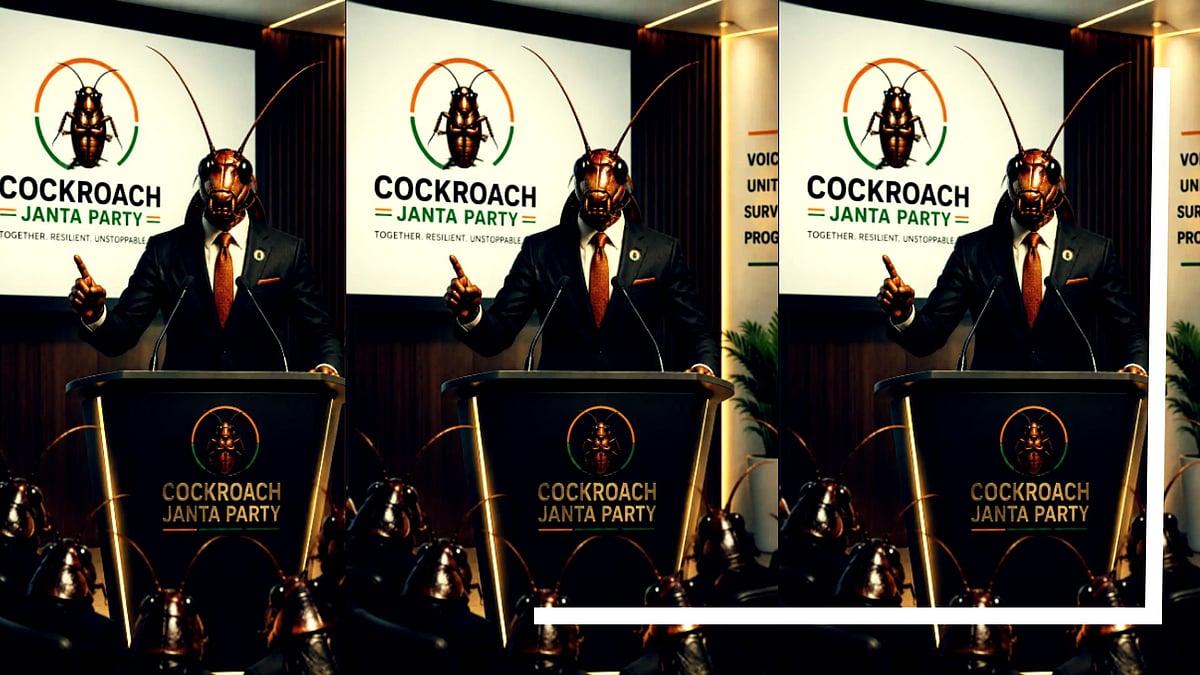
Cockroach Janta Party is not a movement. It is not even a party. Not yet. But it is also not nothing.
advertisement
India has always produced some of its sharpest political theatre in the most unexpected moments. It was in a Lahore courtroom in 1931 that Bhagat Singh laughed as his death sentence was being read out. It was during the Emergency's press and political censorship that a generation of socialist leaders was born in JP’s shadow. It was in the wake of the 2011-12 Anna Aandolan that its complicated child, the Aam Aadmi Party, took shape.
He clarified that he meant something narrower: law graduates with fraudulent degrees, perhaps. But, by that evening, a 30-year-old former social media strategist named Abhijeet Dipke had already posted a question to his followers: "What if all cockroaches come together?"
And within 72 hours, the Cockroach Janta Party (CJP) had amassed over 3,50,000 members via a Google Form and 11 million Instagram followers.
So far, so good.
But what I just described is not a party. It is not a movement or a revolution. Not yet, at least. But it is also not nothing.
The Grammar of Insult
To understand the gravity of this moment, one must understand what it feels like to be a young Indian in 2026. Twelve years into the Modi government, the economy's promised dividends have concentrated with startling efficiency among those who were already wealthy.
Youth unemployment hovers in the double digits by conservative estimates. Then there are the exam scandals, from the NEET fiasco of 2024 to successive paper leaks that have destroyed the aspirations of millions of students who spent years and family savings preparing. And presiding over all of it, are India’s institutions. A judiciary increasingly seen as reluctant to bite the hand that feeds its post-retirement escapades, a Parliament that barely functions or has any teeth beyond viral reels of some MPs.
This is the vocabulary the establishment has long used in private, gone public. The entire apparatus of Vikasit Bharat was suddenly revealed, in one careless sentence. It revealed what the system actually thought of the young people it was developing. Not citizens. Not even subjects. Just pests.
This Is Not Bangladesh. But What Is It?
Almost immediately after the CJP began gathering momentum, journalists made the obvious regional comparison. First with Bangladesh, where a student-led uprising began as protests against a quota system for government jobs, and escalated, with extraordinary speed, into a movement that forced Prime Minister Sheikh Hasina to resign and flee the country. And second with Nepal, where youth-led street protests have periodically reshaped the political order.
Were we watching the subcontinent's next domino?
Abhijeet Dipke answered this question with more force than he has applied to most questions. In a post addressed directly to the press, he wrote: "...Do not insult or underestimate the Gen-Z of India by making such comparisons. The youth of this country are far more mature, aware, and politically conscious than many give them credit for. They understand their constitutional rights and will express their dissent through peaceful and democratic means."
The CJP's official Instagram account amplified the message: "Gen-Z isn't asking for chaos—they're demanding accountability, awareness, and change through democracy."
This statement deserves serious analysis.
Dipke is right. India is not Bangladesh. Its institutions are more complex: a federal democracy of 1.4 billion people, with a Supreme Court, a Constitution, a free press however beleaguered, and a tradition of electoral accountability that, for all its distortions, has removed governments at the state and national level within living memory.
But here is where Dipke’s argument falls short: Bangladesh's youth did not overthrow Hasina because they were politically immature. They did it because the democratic means had been comprehensively captured. The courts rubber-stamped her government's actions. The press was throttled. Elections were managed. The lesson of Bangladesh is not that street protest is primitive; it is that street protest becomes the instrument of last resort when institutions stop functioning.
The uncomfortable question, then, is that if you look at the trajectory of Indian institutions over the last decade, the electoral bond scheme, the pattern of CBI and ED deployment against opposition figures, the Supreme Court's long queues for constitutional matters, at what point does faith in "peaceful democratic means" become maturity and not accommodation?
Performance Theatre and Its Uses
Currently, the Cockroach Janta Party is a performance theatre. And I do not mean it as a dismissal. Performance theatre is a political form with legitimate history. Safdar Hashmi's Jana Natya Manch staged plays in factory courtyards that told workers the truth about their conditions. The Tamil theatre traditions that fed into Dravidian politics shaped a regional political identity that has endured for seventy years. Satire and cartoons have always been a form of political counter-speech, a way of saying the unsayable under conditions where saying it directly is costly or impossible.
But performance theatre becomes political theatre only when it connects to organised power. The question of whether the CJP wants to do that is one its founder has not yet answered clearly. His statement about "peaceful democratic means" is the vocabulary of a party intending to contest elections. But contesting elections seriously, as distinct from contesting them symbolically, requires things that no Google Form can provide. It requires money, cadres, and local leadership.
You Cannot Meme Your Way Past an Ideology
The BJP is not, at its core, a party of circumstances. It was not born from a single outrage or a viral moment. It was the electoral expression of an ideological project called Hindutva. Since 1925, the Rashtriya Swayamsevak Sangh (RSS) had been cultivating the consensus for this project. When the BJP rose to dominance in the 1990s and again, more completely, after 2014, it did so on the back of a century of patient ideological labour. It had a theory of India, who belonged to it, who embodied it, what its civilisational destiny was.
This is not a statement about memes but about the nature of ideological politics. The Congress Party, which once had an ideology, Nehruvian secularism, non-alignment, a particular vision of the developmental state, lost not primarily because of corruption or dynastic decay, though these accelerated its decline.
It lost, at a fundamental level, because it had emptied itself of ideological content over the decades, leaving only the shell of power-seeking where the substance of conviction had once been.
The CJP's manifesto, good as some of its specific demands are, is similarly structured around negation: against judicial cronyism, against party-switching, against PM CARES opacity, against Ambani and Adani. Negation is necessary. It is not sufficient. The CJP, as it stands, has no such ideology. It has energy, which is not nothing. It also has wit, which in politics is a form of intelligence.
The Rotten Place and Its Inhabitants
Cockroaches, the biologists say, are among the most resilient organisms on earth. They have survived mass extinctions. They adapt. They persist in conditions that would kill almost anything else. In choosing to embrace the insult rather than reject it, the CJP's members have, perhaps without intending to, made a claim about endurance.
It requires the slow, grinding, unexciting work of building institutions at the grassroots: unions, ward committees, legal aid networks, honest journalism, patient electoral organisation. It requires an ideology capable of offering India's youth not just a reason to be angry but a reason to imagine a country worth building.
- Access to all paywalled content on site
- Ad-free experience across The Quint
- Early previews of our Special Projects
Published: undefined