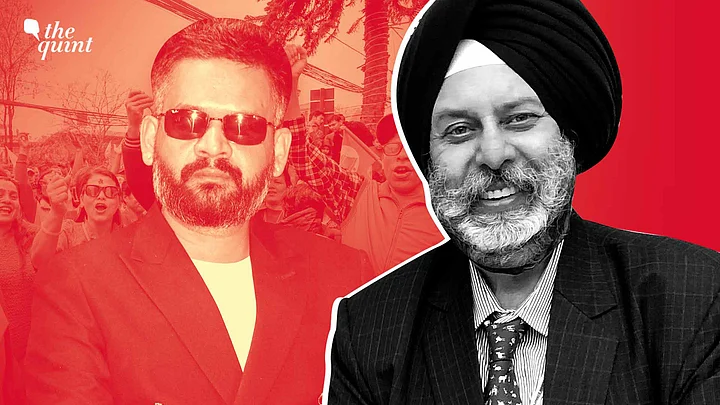
"Balen Shah's win in Nepal is akin to the Aam Aadmi Party (AAP)'s victory in the 2015 Delhi elections," says Manjeev Singh Puri, former Indian Ambassador to Nepal, as the Rastriya Swatantra Party (RSP) secured a landslide victory earlier this month, in the first election following the Gen-Z protests that rocked the country in September last year. The party won a total of 182 out of 275 seats.
With that, 35-year-old Balen Shah, a youth icon and former rapper, became Nepal's prime minister, taking oath in the swearing-in ceremony held on Friday, 27 March.
In an exclusive interaction with The Quint, former Ambassador Puri says that the RSP's win is largely due to Balen Shah's charisma and the risk he took by going up against former prime minister KP Sharma Oli on his home turf. He also speaks about what the RSP's win means for ties between New Delhi and Kathmandu.
Edited excerpts from the interview:
The RSP were touted as the favourites going into the Nepal elections. But do you think anybody was expecting a landslide victory?
The general expectations were that the RSP would do well and would be the leading party. But nobody was talking about a landslide. People did think that the Communist Party of Nepal (Unified Marxist–Leninist) [CPN(UML)] and the Nepali Congress would also pick up a reasonable amount of seats.
Doesn't the result remind you of the AAP victory in Delhi in 2015? The word in Hindi is 'leher,' or wave. The message is clear: 'Let's give the RSP a chance.' And so, therefore, that swing has resulted in these results. I don't know when the final votes will be counted, but they've done pretty well in counting so far, even if you look at the victory margins in some seats.
"It's a clear tilt by the people. The feeling on the ground is, 'We need change. You orchestrated it. Take charge and do it. Make Nepal better.'"
Balen Shah beat former PM KP Sharma Oli on his home turf. Would you say this is the end of the latter's political career?
To the people of that age, it's very difficult to come back. But for the establishment lot, the CPN(UML), Congress—I would say that's not the case. They have to bide their time; they have to build themselves and take things forward. So, it shouldn't be considered that those parties are over and out. Do remember, in a country like India, the Congress was reduced to 40-odd seats in the Lok Sabha. And then they went on to win almost 100 seats in 2024. So, you know, these things do happen. In democracies, established parties have their own place. But yes, at the moment, the people of Nepal are very clear: 'We need change'. It's a hope that the RSP has created. Voters have responded by saying, 'The baton is yours.'
But yes, I wil say that while Mr Oli may not have been able to stop Balen Shah, it could have been a tough fight because he's an old war dog in that area.
"Without a doubt, Balen Shah's charisma has hugely helped. When he took the decision to take on Mr Oli, many people said, 'Why take such a risk when you have a rising political career?' But I suppose you don't succeed in politics till you take a risk."
Ahead of the elections, the Gen-Z anger was directed towards the old political masters of Nepal. Several traditional parties had put up fresh faces to lead them ahead of the polls to take the focus off them. Going by the results, do you feel the younger voters felt that this was just a ploy, and that power eventually rested in the hands of Nepal's old hands?
I think the best example is Gagan Thapa, who represents the next generation of the Nepali Congress. Not that he's a 20-year-old, but he's a youngster by the standards of the people who were leading the country for so many years. He lost to the RSP's Amresh Kumar Singh, who used to be an old hand of the Nepali Congress before becoming an independent candidate and then switiching to the RSP in 2026.
Now, he isn't really a spring chicken; he's around the same age as Gagan. My understanding is that people identified change with the RSP and said we are going with them irrespective of their candidates. This is the result of the wave created by Balen Shah, [RSP President] Rabi Lamichhane, and others.
Impressive as the RSP's victory may be, do you feel that their election campaign and eventual win rode on populist measures? The RSP very smartly tapped into the issues central to young voters like unemployment and welfare policies. But as we have seen in the past, populism dies down over time, and governments have to face ground realities. Is the RSP up to the challenge?
Realities come home. And the RSP will have to understand the ground realities in Nepal. The realities of governance are a little different from the realities of electioneering. The example of the AAP in Delhi is the most obvious one. The only difference in the case of Nepal is that the RSP won national elections, and the establishment is now with them. Establishments work on a very simple basis: whoever wins gets anointed. That wasn't the case in Delhi.
Having said that, they have to deliver. And that will be easier said than done. Nepal is in a difficult situation. This is a country where remittances are a very important element; that gets complicated because of what's happening in the Gulf right now, just as it was when the COVID-19 pandemic had hit.
Secondly, Nepal has two huge neighbours vying for a major global position among themselves. It would appear this is an opportunity, but actually it's a very tough call.
"Nepal is not a country endowed with huge resources. Yes, they have hydropower. But it takes time to deliver. People want their aspirations to be delivered on instantly. So we'll have to wait and watch."
You drew parallels between the RSP and the AAP. I would like to ask you about parallels between Nepal and Sri Lanka. Both countries were rocked by youth-led protests: Sri Lanka a few years ago and Nepal just last year. After these protests when the elections took place, two fresh faces came out of nowhere and nabbed victory: Anura Kumara Dissanayake in Sri Lanka and Balen Shah in Nepal.
I'm glad you brought this up. Let's look at countries which India has civilisational ties—Pakistan and Bangladesh, of course, but that's a different story and we'll leave them out for now. If you look at the north of India, it's Nepal.
Similarly, all of us sitting in Delhi don't tend to think too much about what's happening in Tamil Nadu. But Sri Lankan politics looms large. So you're absolutely right. Both Nepal and Sri Lanka have had a similar kind of state of affairs—huge diasporas, remittances being very important, et al. So this parallel is very correct.
As they say, streets can bring about change. But after that it's about the people who come in after the change to take charge. The Sri Lankans seem to be managing things well under very challenging circumstances. Now, in this Gulf War, their challenges will be equally as high as the Nepalese, who also have high a dependence on remittances. But if they are able to keep people convinced that their minds and hearts are in the right place, people will continue to back them. But they have to deliver.
As far as relationships in the neighbourhood go, this is a challenging time for India. At this crucial juncture, what does the RSP's victory mean for India-Nepal ties going forward, considering that China has also been making inroads into Nepal by stepping up economic cooperation? Will we see any indication of the future of India-Nepal ties based on which country Balen Shah visits first after being sworn in?
I think we should get over which country leaders visit first; that's a relic of the past. But you've asked a billion-dollar question. Firstly, Balen Shah studied in India. He has Madhesi roots, but that's long forgotten. Now everybody knows him as a rapper, former Kathmandu mayor, and a good Nepali in every sense. But in India, there's some sense of relief. KP Sharma Oli was perceived as the leader who stoked anti-India sentiment and gave a segue to China. It's a simple and straightforward perception.
In India people simply tend to say, 'Nepal toh hamaara hai (Nepal belongs to us).' The Nepalese, not from today but right from the advent of their country 150 years back, are very conscious that they are a separate country. This kind of identity politics is unlikely to fade.
In fact, in my last few visits to Nepal, I saw people in the government wearing the traditional Nepali dress. These are people I've known since I was posted as Ambassador there, and I've never seen any of them wearing the traditional attire. Lovingly, I asked one or two of them, 'I used to see you in western casuals. What happened?' They said, 'Hum Nepali hain' (laughs).
I mean, look at the photos of Balen Shah. Every single one shows him dressed in traditional attire. This is a conscious effort. They want to make the point, "We are Nepali." This element of identity politics not only needs to be formally respected and regarded by India, but actually respected and regarded. This is the most critical element, and we need to build links with people.
Other than that, Nepal's economy will be challenged. The Chinese may try to make inroads, but India has the best opportunity.
"We should open up with the Nepalis, do more trade, and be more willing to engage with Kathmandu. Whatever few apprehensions we have, we should set them aside for now. We must understand that they have to play their politics also. If they don't, they will become the butt of criticism for their domestic base."
(This article has been updated.)