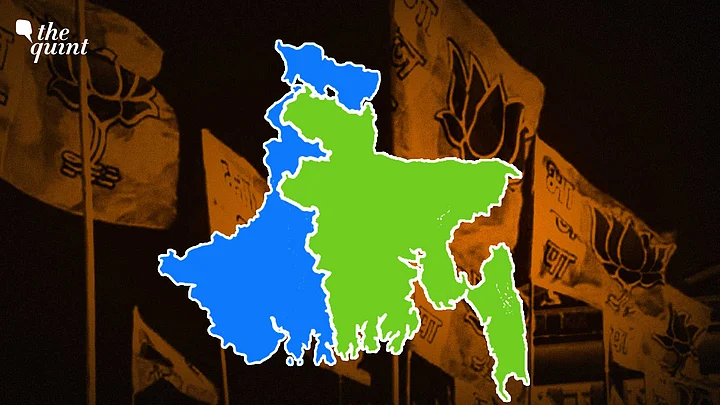
The triumph of the Bharatiya Janata Party (BJP) in West Bengal marks a fundamental rupture in the fragile geopolitical equilibrium that has governed the eastern edge of the subcontinent since 1947.
For decades, the 2,200-kilometre frontier between India and Bangladesh—the longest and arguably most porous international border in the region—was managed through a sophisticated, if cynical, double-game.
New Delhi would publicly laud Dhaka as a cornerstone of its "Neighbourhood First" policy while privately grumbling about undocumented migration. Dhaka, in turn, would flatly deny the existence of such flows while quietly cooperating on counter-terrorism and connectivity.
This arrangement, built on a mutual understanding of political theatre, allowed for a decade of unprecedented strategic warmth. However, with the BJP now commanding both the narrative and the machinery of the border, the theatre has been replaced by a grim, ideological realism.
The fiction of the "friendly frontier" is fraying, and in its place emerges a securitised relationship where human movement is no longer a secondary irritant but the primary organising principle of bilateral ties.
At the centre of this transformation is the "infiltration" narrative, a term the BJP has wielded with surgical precision to fuse anxieties regarding national security and demographic change, coupled with religious identity into a potent electoral elixir.
When Border Politics Became State Policy
In the past, authorities in Dhaka could afford to dismiss such rhetoric as campaign-season bluster designed to galvanise voters in the Hindi heartland. But the conquest of Bengal, a state where the history of partition is not a memory but a lived, daily reality, signals that these utterances have graduated from stump speeches to state policy.
The rhetoric is no longer just about winning votes; it is about defining the boundaries of the Indian citizen against the "outsider." This shift explains why, in the immediate wake of the election results, Bangladesh’s border forces were observed quietly fortifying positions near Jashore.
The official line from Dhaka emphasised routine vigilance, but the subtext was a frantic preparation for "push-ins"—the forced, informal deportation of individuals deemed "illegal" by Indian security forces.
Bangladesh is literally waking up to a reality where its primary strategic partner now views a significant portion of the Bengali-speaking population through a lens of inherent suspicion.
End of the Buffer
The historical buffers that once shielded the relationship have dissolved. Previously, the Trinamool Congress government in Kolkata acted as a vital, if volatile, shock absorber.
Driven by its own electoral dependencies and a secular-linguistic identity, the provincial administration resisted the more aggressive citizenship drives and "deportation" manoeuvres proposed by the Centre. That barrier is gone.
For the first time in the history of the republic, the political ideology governing New Delhi is perfectly aligned with the administration overseeing the Radcliffe Line. This alignment effectively domesticates Bangladesh within India’s internal electoral cycle.
Every border skirmish, every anecdotal report of a migrant crossing a fence, and every communal flare-up in a Bangladeshi village now carries immediate, exploitable value for the BJP’s political machinery. The border has been transformed into an ideological object. It has become a physical proof of sovereignty and a civilisational bulwark against what the ruling party describes as demographic encroachment.
This hardening of the Indian stance poses an existential challenge for Bangladesh's new leadership and its future democratic aspirations.
Dhaka’s New Asymmetry of Power
Under the long, autocratic tenure of Sheikh Hasina, the bilateral bargain was lopsided but functional. Hasina provided India with sweeping security concessions, cracking down on separatist insurgents, and granting transit rights that had been frozen since the 1965 war. In exchange, India offered a degree of diplomatic protection and, crucially, kept the migration issue on the back burner.
Today, the new administration in Dhaka, led by Tarique Rahman, finds itself in a far more precarious "asymmetry of power." It cannot afford a rupture with its dominant economic neighbour, yet it cannot survive politically if it is seen as a passive recipient of India’s demographic cast-offs.
To accept the Indian premise of mass "infiltration" would be to surrender national dignity and admit to a failure of sovereignty. Dhaka is thus trapped in a pincer movement between economic dependence and the necessity of national defiance.
The diplomatic machinery of the two nations reflects this growing imbalance. India has moved away from treating Dhaka as a standard diplomatic posting, instead deploying a political heavyweight like Dinesh Trivedi who can navigate the corridors of power in New Delhi as easily as the border outposts of Bengal.
The appointment of such a figure, with deep roots in the BJP’s political ecosystem, suggests that India-Bangladesh relations are no longer the exclusive preserve of career bureaucrats but are managed through the prism of political necessity.
Bangladesh, meanwhile, remains wedded to a traditional model of professional diplomacy that, while competent, lacks the "political oxygen" required to influence the current climate in New Delhi. This was most evident during recent periods of unrest under the interim administration of Muhammad Yunus, where the Bangladeshi envoy M Riaz Hamidullah struggled to shape the narrative as Indian media and political figures hardened their stance.
Communication had become reactive, a series of defensive postures against an increasingly assertive Indian agenda.
The Absence of Incentives
Ironically, this Indian obsession with "illegal migrants" comes at a time when the economic incentives for migration have been radically upended. Bangladesh is no longer the "basket case" of the 1970s; it has, by many metrics, become one of the better performers of South Asia.
On indices ranging from female labour participation and infant mortality to life expectancy and GDP per capita, Bangladesh has frequently outpaced India. The simplistic image of the impoverished migrant fleeing to a prosperous India is a relic of the past, yet it remains the cornerstone of Indian political discourse because it serves a specific ideological function.
The "infiltrator" is a necessary ghost in the machine of Hindu nationalism, providing a tangible enemy against which the nation must be defended.
This disconnect between economic reality and political narrative suggests that the tension is not a problem to be solved through better data or economic development, but a permanent feature of the new regional order.
The danger for Dhaka is not necessarily the logistical nightmare of mass, state-sanctioned deportations—a feat that would be legally and physically impossible on a scale of millions. Rather, the threat is a "slow-burn" normalisation of coercion.
This involves a permanent state of suspicion directed at Bengali-speaking Muslims near the frontier, sporadic and arbitrary detentions, and the persistent threat of "push-ins" that poison the social fabric of border communities.
Such practices do not require a change in law; they only require a change in atmosphere, and the recent election has provided that in spades. For the people living in the shadow of the fence, the border is no longer just a line on a map but a site of constant negotiation with a state that views their very presence as a demographic threat.
From Shared Frontier to Security Flashpoint
Ultimately, the BJP’s victory in Bengal has converted the border from a shared responsibility into a unilateral instrument of Indian domestic policy. As the rhetoric of the campaign trail hardens into the policy of the state, the strategic optimism that once defined the relationship is being replaced by a pervasive mistrust.
South Asia’s frontiers have always been combustible, but the fusion of majoritarian politics with border management has created a particularly volatile mix. For years, Dhaka hoped that the shouting would stop once the votes were counted.
It is now becoming clear that for the new masters of the Indian landscape, the shouting is not a means to an end, but the policy itself. The "Gold Era" of bilateral ties, as it was often called by diplomats, has ended, replaced by an era of securitised suspicion where the simple act of crossing a line can trigger a national crisis.
In this new reality, Bangladesh must learn to navigate a relationship where it is no longer just a neighbour, but a central character in India’s own internal drama of identity and belonging.
(Faisal Mahmud is a Dhaka-based journalist. He was posted as the Minister (Press) of Bangladesh High Commission during the interim government’s period. This is an opinion piece and the views expressed are the author's own. The Quint neither endorses nor is responsible for them.)