
What About Right to Privacy? VPN Ban in Kashmir Raises Questions
Unionists in Kashmir argued that “the majority must not be penalised for the mistakes of the few.”
advertisement
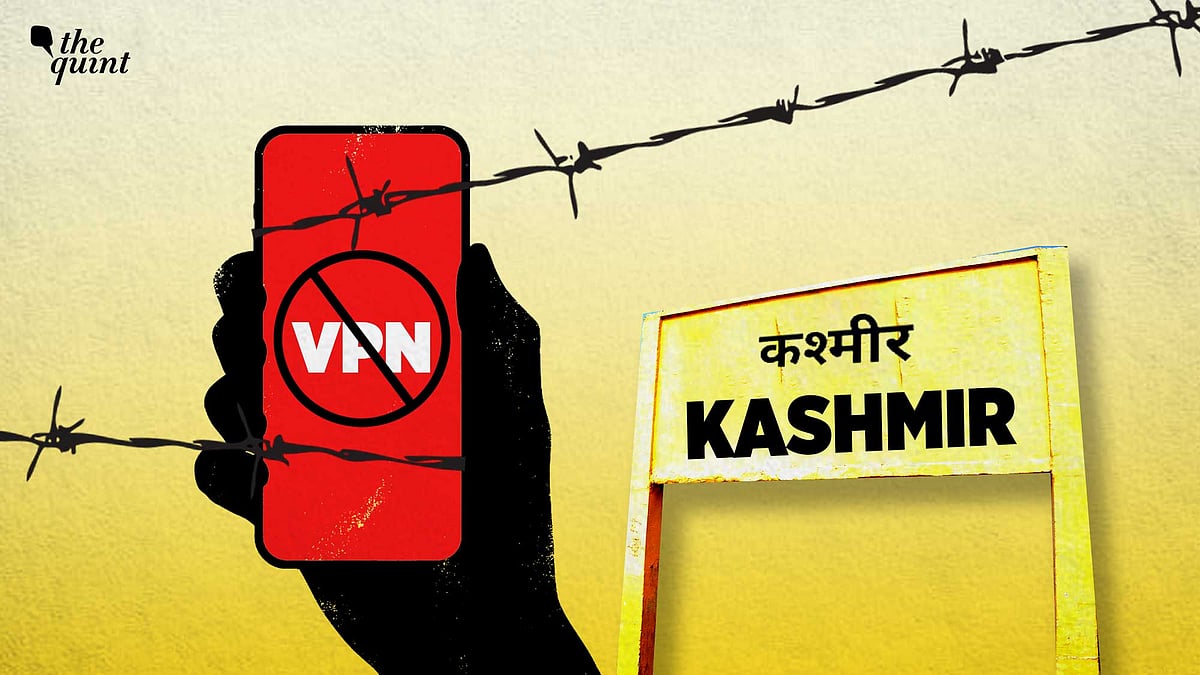
In a purported bid to strengthen Jammu and Kashmir's security grid, authorities in the region have placed a blanket ban on the use of the Virtual Private Network (VPN) services across all major districts.
Chenab, Kashmir, and Pir Panchal have seen heightened militant activity since the abrogation of Article 370 in Jammu and Kashmir, top security sources told The Quint, adding that in wake of the deadly Pahalgam terror attack and the Red Fort blast last year, they are working to further strengthen the region's security grid to "avoid untoward incidents".
Asif, a resident from South Kashmir, said that security personnel were invading privacy while checking mobile phone devices during routine frisking on the Srinagar-Jammu highway.
“Looking for VPN installation is one thing, but invading citizen privacy and checking family pictures in the mobile phone gallery is quite another. This isn’t a security matter... it is an invasion in privacy,” Asif told The Quint.
Terror Networks Use VPN, Say Cops
The security sources revealed to The Quint that they have credible inputs about highly trained and tech-savvy militants and their supporters using VPNs to stay in touch with their “handlers across the border”.
They added that the VPN service is often “misused by terrorists” to avoid surveillance, as it masks their location, enables encrypted communication, and even allows them access to blocked websites and messaging platforms, thus making it harder to track “terror-related activities”.
Inspector General of Police (IGP) Kashmir Range, VK Birdhi, said that the police will continue monitoring the situation.
Among various security agencies, there seems to be a consensus that “anti-national elements regularly use various applications such as Signal and Telegram to keep communication channels open with their handlers across the border.”
“The ban on VPNs was enforced after it was observed that terrorists were misusing these services and using encrypted applications to share information with the enemy country. This had made it difficult for agencies to trace the locations of militants, often hiding in forested areas of Kashmir, the Pir Panjal range, and the Chenab Valley,” a top source informed The Quint.
Anshul Garg, Kashmir’s Divisional Commissioner, said that the security situation in Jammu and Kashmir remains “highly dynamic”—and it was being “regularly assessed by the police and district administration”. He added that some of the recent “anti-national activities for which anti-social elements have been found using encrypted networks” prompted the district authorities to review the security situation.
In separate orders, the district magistrates in four districts of the Kashmir Valley banned the use of VPNs, invoking Section 163 of the Bharatiya Nagarik Suraksha Sanhita (BNSS), 2023.
A cybersecurity expert, wishing anonymity, told The Quint,
Over the past year, authorities have banned VPN services across several districts in the Pir Panjal Range and the Chenab Valley to enhance “surveillance and counter-insurgency measures."
After the annulment of Articles 370 and 35A in August 2019, security agencies said they have been observing that “terrorist activity has gradually shifted from the Kashmir Valley to the Pir Panjal Range, including Reasi, Rajouri, and Poonch, and the Chenab Valley, covering Kishtwar, Udhampur, and Doda districts.”
At least 60 security personnel, including special paratroopers and top Indian Army officers, have lost their lives in multiple ambush attacks carried out by highly-trained militants in the Pir Panjal region till December 2025.
Banning Free Speech in Name of Security?
Some cybersecurity experts opined that merely having a VPN on a phone does not make someone a criminal or "anti-national element".
Srinivas Kodali, a cybersecurity researcher, argued that the ban imposed on the VPN service indicates a “regressive attitude by the state towards freedom of speech.”
Unionists in Kashmir also criticised the latest move, arguing that “the majority must not be penalised for the mistakes of the few.”
Waheed Parra, a senior People’s Democratic Party (PDP) leader and MLA from South Kashmir’s Pulwama constituency, told The Quint: “I am not sure how the ban helps the government. If there is a misuse, it must be traced. But if we punish the majority population for the mistakes of the few, it will prove counterproductive and only increase alienation.”
Action on the Ground: Detentions, Suspicion
The Jammu & Kashmir Police said that over 130 locals were detained on 1 January in the Kashmir valley alone for using VPN services and installing other suspicious applications on their mobile phone devices.
“Genuine users were released after detailed device analysis with a strict warning to refrain from VPN usage in the future,” the police said in a statement.
In April 2025, a group of heavily armed militantsattacked tourists in South Kashmir’s picturesque resort Baisaran Valley near Pahalgam, killing at least 25 tourists. This incident escalated tensions between India and Pakistan, the two nuclear-armed rivals.
On 27 December 2025, police in district Doda of the Chenab Valley booked two persons in separate incidents for allegedly using VPN applications “in violation of prohibitory orders” earlier issued by the district magistrate. Accordingly, an FIR under Section 223 of the BNS was registered at Doda police station.
(Muhammad Mukaram is an independent journalist covering news and politics in Kashmir.)
- Access to all paywalled content on site
- Ad-free experience across The Quint
- Early previews of our Special Projects
Published: undefined